Hippocrene Myth Meaning & Symbolism
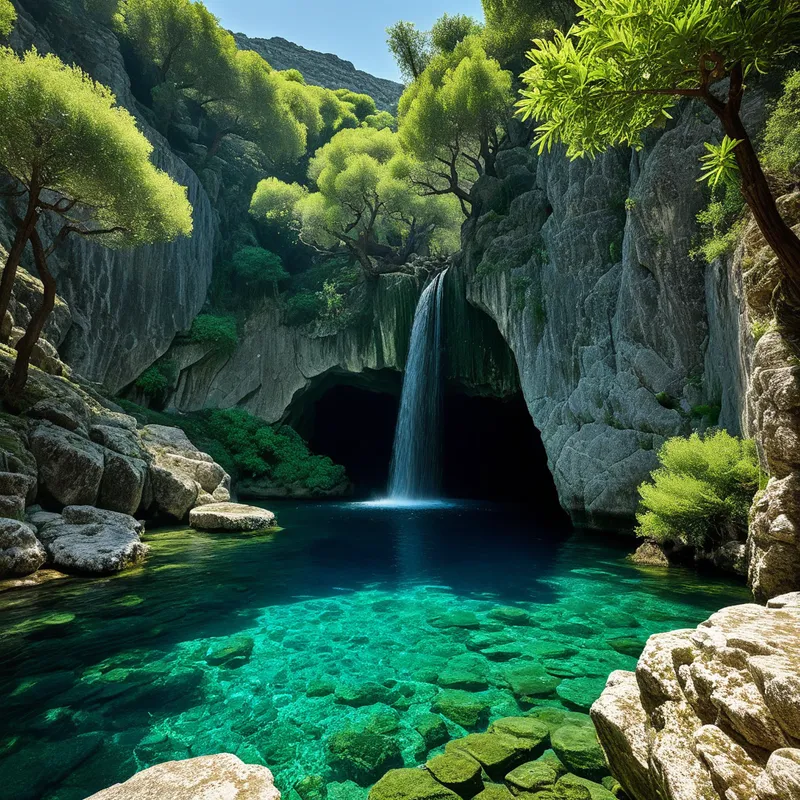
A sacred spring on Mount Helicon, born from the strike of Pegasus's hoof, granting poetic inspiration to those who drink from its waters.
The Tale of Hippocrene
Hear now the tale of the spring that sings. It begins not with a whisper, but with a thunderous blow upon the silent bones of the earth.
In the age when gods walked with men and monsters haunted the wild places, there stood a mountain sacred to memory and art: Mount Helicon. Its slopes were the domain of the nine Muses, daughters of Zeus and Mnemosyne. Here, amidst the whispering pines and sun-dappled glades, the air itself hummed with the potential for song, for epic, for the dance that tells of life and loss. Yet, for all its sanctity, the mountain’s heart was stone. Its streams were ordinary, its waters clear but mute.
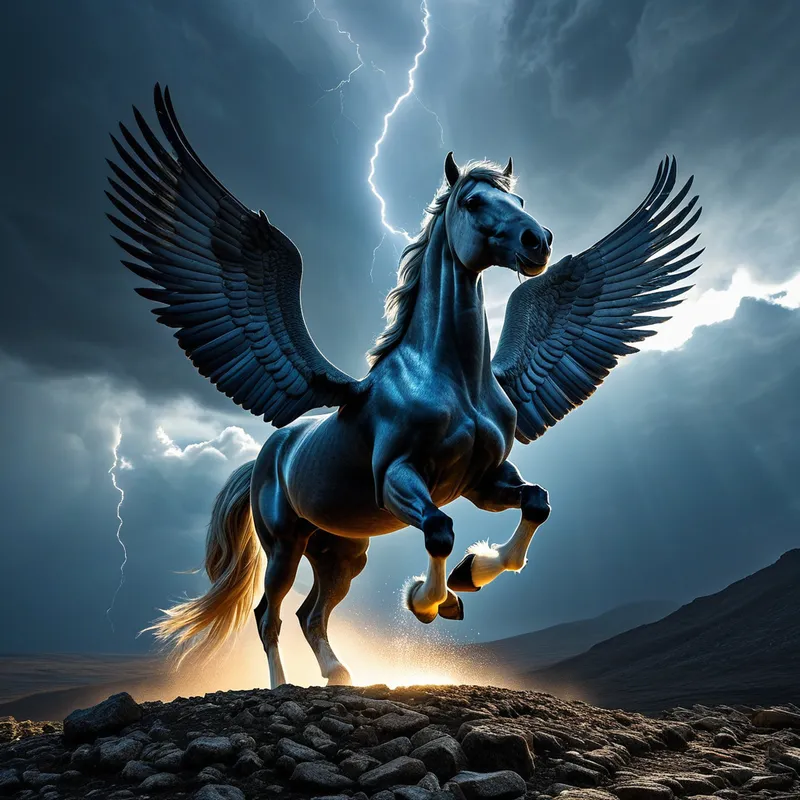
The catalyst arrived on wings of storm and salvation. He was Pegasus, the snow-white stallion born from the blood of the slain Medusa, sired by the sea god Poseidon. After aiding the hero Bellerophon, the winged horse ascended, seeking a home worthy of his divine nature. He soared over plains and forests until the resonant silence of Helicon called to him. He descended, his hooves, hard as adamant and touched by the sea’s chaotic power, clicking on the ancient limestone.
Perhaps he was parched from his celestial journey. Perhaps he sensed a latent power sleeping in the mountain’s core, a power that answered the wild, creative force within his own being. With a mighty snort that scattered clouds, Pegasus reared. The Muses, unseen, held their breath. The mountain waited.
Then, down came the hoof—not a gentle tap, but a strike of pure, unleashed potency. It was the impact of the transcendent upon the mundane, of chaotic potential upon structured form. The sound was not of breaking, but of opening. A crack, sharp as lightning, split the stone. From the deep, hidden aquifers of the earth, from the very wellspring of Gaia herself, water erupted. But this was no common spring. It burst forth in a shining, arcing jet, cold and clear as moonlight, singing as it flew. It gathered in a pool that mirrored the sky not as it was, but as it could be—brighter, deeper, infused with the essence of the stars.
The waters settled, bubbling gently. The Muses approached, their eyes wide. One, perhaps Calliope, knelt and cupped the water in her hands. She drank. And where before there was skill, now there was revelation. Where there was knowledge, now there was inspiration. The spring was named Hippocrene, and its waters became the sacred draught of poets, the fount from which all true art flows. Pegasus had not found water; he had, with a single, violent act of creation, summoned it into being.
Cultural Origins & Context
The myth of Hippocrene is woven into the broader tapestry of Boeotian lore, most famously preserved in the works of the poet Hesiod. In his Theogony, he claims direct invocation by the Muses on Helicon’s slopes, implicitly linking his authority to that sacred landscape and its springs. The story was not mere entertainment; it was a foundational etiological myth explaining the source of artistic inspiration within a culture that viewed poetry, music, and history as divine gifts, not merely human crafts.
Hippocrene functioned as a powerful spiritual and cultural landmark. For the Greeks, springs were often numinous places, portals to the underworld or seats of nymphs. Hippocrene elevated this concept, directly linking the source of inspiration to a dramatic, divine intervention. It served society by sanctifying the artistic endeavor. To drink from Hippocrene—whether literally as a ritual act at the site or metaphorically through the invocation of the Muses—was to align oneself with a transcendent order. It answered the profound human question: where do sublime ideas come from? The Greeks answered: from a place where divine force (Pegasus) strikes the hard reality of the world (the mountain), releasing what was hidden but always present.
Symbolic Architecture
At its core, Hippocrene is a symbol of inspired creation born from a transformative shock. Each element is a psychic component in the drama of bringing something new into the world.
Pegasus represents the soaring, untamed spirit of creativity itself. Born from death (Medusa) and sired by the chaotic, fertile sea (Poseidon), he embodies the raw, often disruptive power of the unconscious that must be harnessed. He is not the gentle muse but the dynamic force that makes inspiration possible.
Mount Helicon symbolizes the structured mind, the realm of tradition, memory (Mnemosyne), and established forms. It is orderly, sacred, but potentially sterile without an infusion of vital energy.
The strike of the hoof is the critical moment of encounter. It is the traumatic yet fertile collision between unconscious impulse and conscious structure, between wild inspiration and the need for form. It is not a polite request; it is a violent, necessary rupture.
The spring is not found, but forged. True inspiration is not a gentle discovery, but a forceful emergence from the collision of soul and world.
The waters of Hippocrene, therefore, are the resulting libido or life-energy of the psyche, now transformed. They are no longer hidden groundwater (latent potential) but are liberated, clarified, and made sacred—fit for the conscious mind (the Muses) to utilize. The spring represents the continuous flow of creative vitality that follows the initial breakthrough.
The Dreamer's Resonance
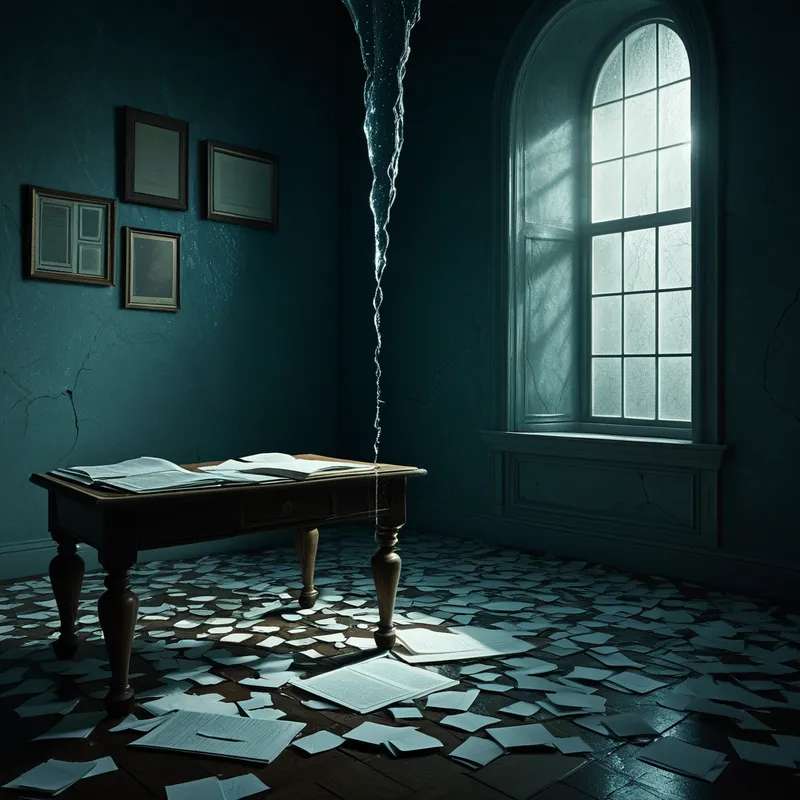
When the pattern of Hippocrene stirs in the modern unconscious, it often manifests in dreams of arid landscapes, blocked creativity, or searching for a source. A dreamer might find themselves in a dry, intellectual desert—perhaps their own office or a library where all the books are blank. They feel a profound thirst. The conflict arises as a mounting frustration, a somatic pressure for expression with no outlet.
The pivotal dream image is the strike or the breakthrough. This could be a hammer hitting rock, a lightning bolt, a sudden fall that cracks the ground, or even a powerful animal (a horse, a bird) impacting a barrier. This is the psyche’s enactment of the Pegasus event. It is often jarring, even frightening, representing the ego’s resistance to the disruptive power of a new idea or feeling trying to surface.
Following this, the dream may reveal the water: a small, glowing pool in an unexpected place, a faucet that suddenly flows with luminous liquid, or rain beginning to fall on parched earth. Drinking this water in the dream is the somatic integration of the insight. The dreamer awakens not necessarily with a fully formed poem, but with a sense of relief, clarity, or a subtle inner shift—the "thirst" momentarily quenched. The process signifies the unconscious breaking through a personal "Helicon"—a rigid mindset, a creative block, or an emotional stagnation—to release a nourishing new attitude or perspective.
Alchemical Translation
The myth of Hippocrene is a perfect allegory for the alchemical and Jungian process of individuation, specifically the stage of solutio (dissolution) and the emergence of the aqua permanens (the permanent water, or philosophical water).
In the alchemical vessel of the psyche, the initial state is one of siccitas—dryness. This is the rational, overly structured, or spiritually barren conscious attitude (the stony mountain). The prima materia, the chaotic base material needed for transformation, is the Pegasus-energy: the unruly, instinctual, and potent contents of the unconscious that feel alien to the ego.
The individuation process requires that this material impinge upon consciousness. This is the hoof-strike—a moment of crisis, depression, obsession, or powerful emotion that feels like an attack on one’s stable worldview. It is a necessary nigredo, a darkening, where the old order is shattered.
The goal is not to avoid the strike, but to recognize it as the prelude to the spring. The wound is the place where the water enters.
From this rupture flows the aqua vitae, the water of life—Hippocrene. In psychological terms, this is the reconciling symbol, the new attitude that emerges from the conflict between conscious and unconscious. It is the healing insight, the creative solution, the transcendent function that quenches the inner drought. The Muses represent the differentiated faculties of the conscious mind that can now channel this raw inspiration into specific arts and sciences—integrating the numinous into culture and life.
For the modern individual, the myth teaches that profound inspiration and psychic renewal are rarely gentle. They often arrive through a disruptive encounter with our own depths. The challenge is to not flee from the "strike" of a powerful dream, a disruptive emotion, or a life crisis, but to tend to the fissure it creates, for that is the very aperture through which the soul’s deepest waters may begin to flow. We are called not just to drink from the spring, but to become the mountain that learns to bear the hoof-print, and thus, the source.
Associated Symbols
Explore related symbols from the CaleaDream lexicon: