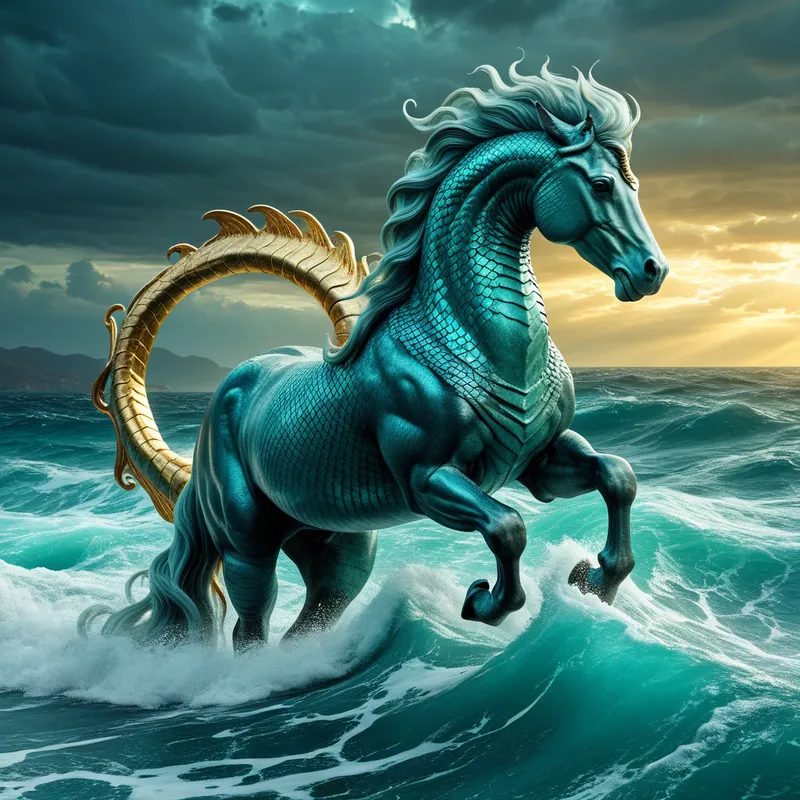
Hippocampus Myth Meaning & Symbolism
A mythical creature of the deep, part horse, part serpent-fish, bearing gods and heroes across the threshold of the unconscious sea.
The Tale of Hippocampus
Hear now a tale not of the sun-baked earth, but of the wine-dark sea, that realm of fathomless mystery and primordial memory. Before the first ship’s keel carved a path upon the waves, the deep belonged to him—the Earth-Shaker, the Lord of Horses, Poseidon. Yet the rolling plains of the ocean floor were no place for the steeds of the land. Their hooves, made for thundering across plains, would find no purchase in the abyssal silt.
So, from the very essence of his dual kingdom, Poseidon summoned a new breed. From the crashing surf and the primal ooze, he drew forth their spirit. Their forequarters rose, powerful and sleek, the very image of his own sacred animal—the horse, all muscle, grace, and untamed spirit. But where the terrestrial horse ended, the deep began. Their bodies flowed not into hind legs, but into the coiling, powerful form of a great fish or a serpent of the abyss, scaled in hues of lapis lazuli and seafoam green, fins like woven kelp, tails that could churn the sea into a maelstrom.
These were the Hippocampi. They did not gallop but flowed, a perfect fusion of equine nobility and piscine fluidity. When Poseidon’s rage was stirred, and he seized his trident, it was a team of these creatures, harnessed to his shell-adorned chariot, that bore him from his coral palace. They would surge from the depths, manes and tails streaming not with hair, but with living froth and tangled seaweed, their passage raising waves that could topple mountains. They were the living embodiment of the sea’s dual nature: surface beauty and terrifying depth, playful dolphins one moment, leviathans the next.
But theirs was not only a duty of divine fury. In quieter times, they were the bearers of the sea’s gentler children. The Nereids, the lovely daughters of the Old Man of the Sea, would ride them through sun-dappled waters, their laughter mingling with the creatures’ whistling cries. And when a hero favored by the gods, or a soul destined for the Elysian Fields, needed passage across the final river, it was often a Hippocampus, a serene and knowing guide, that carried them from the world of the living to the shore of the blessed dead, a silent ferryman between all states of being.
Cultural Origins & Context
The image of the Hippocampus is woven into the very fabric of Hellenic engagement with the sea. Unlike the structured, philosophical myths of Olympus, the Hippocampus belongs to the older, more visceral stratum of myth—the world of elemental forces and hybrid beings that defy easy categorization. It is art, not epic poetry, that is its primary scripture.
We find them depicted on pottery, in frescoes, and most famously in mosaic floors, particularly from the Hellenistic period onward. They adorn the borders of marine scenes, pulling the chariots of Triton as often as Poseidon’s. Their societal function was symbolic and talismanic. For a seafaring culture, the sea was both highway and graveyard. The Hippocampus served as a protective emblem, a representation of the sea itself made servant to divine (and, by proxy, human) will. To depict a Hippocampus was to acknowledge the sea’s power while imaginatively harnessing it. It was a creature of the popular and artistic imagination, a bridge between the known world of the horse—a symbol of civilization, travel, and conquest—and the unknown, chaotic, and fertile world of the deep.
Symbolic Architecture
The Hippocampus is not a monster to be slain, but a synthesis to be ridden. It is a perfect symbol of coniunctio oppositorum—the sacred marriage of opposites. Here, the horse, representing the conscious mind, terrestrial power, directed will, and the domesticated spirit, is irrevocably fused with the serpent-fish of the deep, representing the unconscious, the fluid, the instinctual, the untamed and mysterious depths of the psyche.
To encounter the Hippocampus is to be presented with the possibility of riding the wave of your own deepest nature, rather than being drowned by it.
It is a creature of the threshold, the limen. It does not belong wholly to the land nor wholly to the sea, but to the dynamic, foaming interface where they meet. Psychologically, this is the realm of emotion, intuition, and the tidal pull of the unconscious upon the ego. The Hippocampus is the embodied capacity to navigate this liminal space. Its equine head suggests consciousness looking forward, having vision and direction, while its piscine body is the immense, supportive, and powerful unconscious current that propels it. One cannot exist without the other in this mythic form; the conscious mind is carried by, and must cooperate with, the deep self.
The Dreamer's Resonance
When a Hippocampus surfaces in the modern dreamscape, it rarely appears as a simple animal. It arrives as an emissary from the depths of the dreamer’s own psychic ocean. To dream of seeing one from afar, arcing gracefully over waves, may speak to a nascent awareness of a powerful synthesis within—a feeling that one’s disciplined, "horse-like" efforts are being supported by a newfound fluidity or creative depth.
To dream of riding a Hippocampus is a profound signal. It suggests the dreamer is successfully navigating a major emotional or transitional phase, carried by forces larger than the ego, yet still holding the reins of direction. There is a somatic sense of powerful, surging movement that is both exhilarating and slightly terrifying, a surrender to a greater current.
Conversely, to dream of being chased or overwhelmed by one indicates that the contents of the unconscious—perhaps a tidal wave of repressed emotion, instinct, or forgotten memory—are threatening to engulf the conscious standpoint. The "horse" of the ego feels bolted to a "fish-tail" of chaos it cannot control. The dream calls not for defeat, but for the difficult task of turning to face the creature, to attempt, like Poseidon, to harness this raw, elemental power of the deep self.
Alchemical Translation
The alchemical journey is one of disintegration and recombination, of separating elements only to unite them in a higher, more resilient form. The myth of the Hippocampus provides a potent model for this psychic transmutation, the core of individuation.
The initial state is one of separation: the dry, rational, "horse" part of the psyche views the wet, emotional, "fish" part as alien, other, and potentially dangerous. The ego fears dissolution in the unconscious sea. The alchemical nigredo, or blackening, is the plunge into that sea—a period of depression, confusion, or emotional turmoil where these opposites clash.
The emergence of the Hippocampus symbolizes the albedo, the whitening. It is the visionary moment when the conflict is seen not as a problem to be solved by eliminating one side, but as a paradox to be embodied. The task is the union: to consciously forge the connection between the head and the tail, between will and surrender, between structure and flow.
The goal is not to tame the sea-horse, but to become the charioteer who, through respect and alliance, commands its hybrid power.
The final stage, the rubedo or reddening, is represented by the golden chariot of Poseidon itself. This is the integrated Self, the conscious personality now carried forward by the immense power of the united opposites. The individual gains the capacity to traverse all realms—to navigate the surface world with purpose, to dive into the depths for wisdom, and to ferry themselves across the greatest thresholds of life, death, and rebirth. The Hippocampus becomes the enduring symbol of the soul itself: a beautiful, powerful hybrid, forever journeying between the shores of the known and the mysteries of the deep.
Associated Symbols
Explore related symbols from the CaleaDream lexicon: