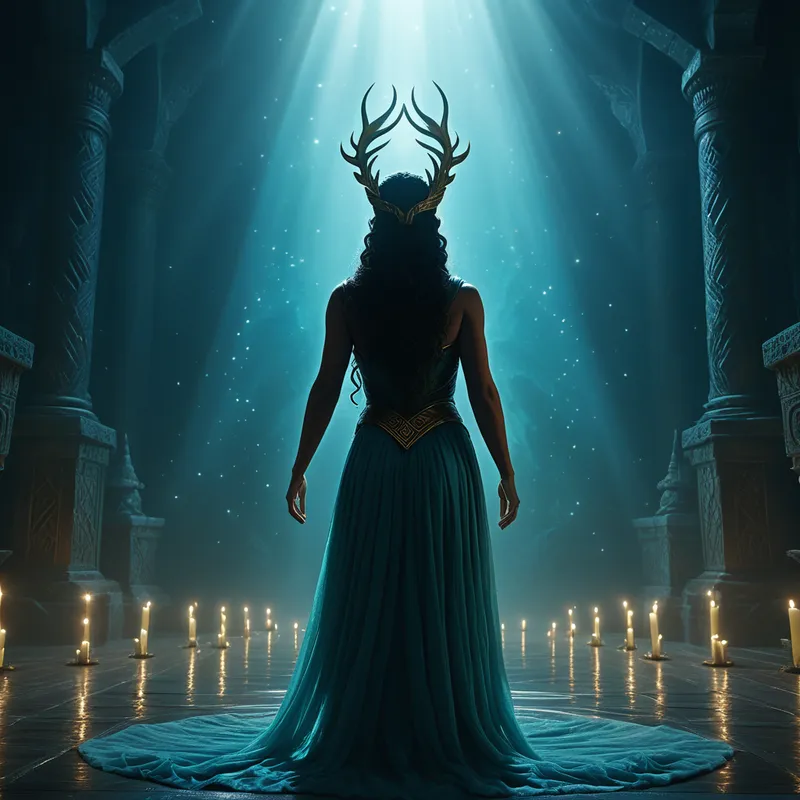
Hi'iaka the Younger Sister
A Hawaiian goddess undertakes a perilous journey to rescue her sister's lover, testing her loyalty and revealing the volcanic origins of the islands.
The Tale of Hi'iaka the Younger Sister
The story begins not with Hi'iaka, but with her eldest sister, the magnificent and tempestuous volcano goddess Pele. Consumed by a vision of a handsome chief named Lohiʻau on the distant island of Kauaʻi, Pele’s spirit traveled to him in a dream. She found him as captivating as her vision, but upon waking, her physical form remained trapped in her volcanic home at Kīlauea. A profound longing, a fire of a different kind, took hold of her. She could not go herself, for her presence was the land itself, ever-shifting and consuming. So she turned to her favorite among her many sisters, Hiʻiaka-i-ka-poli-o-Pele—Hiʻiaka in the bosom of Pele.
Hiʻiaka, a goddess of the peaceful arts—of hula, of healing chant, of the lush, life-giving ferns and forests—was bound to her fiery sister by deep love. Pele’s request was simple in utterance, impossible in scope: journey across the treacherous sea channels to Kauaʻi, find Lohiʻau, and bring him back alive. As a pledge, Pele entrusted Hiʻiaka with the care of her sacred lehua groves and gave her a strict timeframe for the journey. Most crucially, she extracted a vow: Hiʻiaka must not embrace Lohiʻau, must not give in to the love she might herself feel. The journey was to be one of pure service.
Thus began Hiʻiaka’s hero’s journey. Accompanied by her faithful companion, the woman Wahineʻōmaʻo, she traversed islands. Her path was not one of brute force, but of profound connection. She chanted life into the dead, restoring a woman named Hopoe, who became a friend. She battled moʻo, lizard-like water spirits, not merely with power but with cleverness and sacred prayer. She confronted the cliff-dwelling demon Panaʻewa, subduing him with the force of her words and the truth of her mission. At every turn, she healed, restored, and created alliances, weaving a net of life and reciprocity across the archipelago.
When she finally reached Kauaʻi, she found Lohiʻau dead, his spirit broken by the intensity of Pele’s dream-visitation. Undeterred, Hiʻiaka performed the most profound act of her healing arts. Through days and nights of potent chant and prayer, she called his spirit back from the underworld, restoring breath to his body. In this act of resurrection, a bond was forged between healer and healed. The vow to Pele grew heavy.
Their return journey was slower, laden with the weight of the unspoken. When they finally approached Pele’s domain, they saw ominous black smoke staining the sky. Pele, consumed by impatience and a jealous imagination, had already begun burning Hiʻiaka’s beloved lehua groves and had killed her dear friend Hopoe, turning her into stone. Witnessing this wanton destruction of all she held sacred, Hiʻiaka’s heart broke, then hardened. In a moment of defiant grief and burgeoning autonomy, she embraced Lohiʻau, fulfilling the letter of her desire if not the spirit of her original vow.
Pele, in a final, cataclysmic rage, sent waves of lava to consume Lohiʻau. Hiʻiaka fought back, digging furious pits to divert the flows. In some tellings, Lohiʻau is consumed; in others, Hiʻiaka saves him, and he becomes a companion to her. The conflict between the sisters reshaped the land itself, leaving new calderas and stone formations as scars of their fractured love. Hiʻiaka, the younger sister, emerged forever changed—no longer solely “in the bosom of Pele,” but a powerful deity in her own right, her loyalty transformed into a complex legacy of grief, righteous anger, and hard-won sovereignty.
Cultural Origins & Context
The Hiʻiaka epic is part of the vast, fluid oral tradition of kaʻao (legendary narratives) and moʻolelo (histories/stories) of Hawaiʻi. It is not a single, fixed text but a cycle of chants and stories that vary by island and lineage. The epic serves as a cosmogonic myth for the Hawaiian landscape, providing poetic etiologies for specific rock formations, place names (like the Pali Kapu o Kāʻōnohi on Oʻahu), and ecological features. Hiʻiaka’s journey literally names and animates the islands.
Within the Hawaiian pantheon, the relationship between Pele and Hiʻiaka represents a fundamental dialectic. Pele (the volcano) is the force of creation-through-destruction, immediate passion, and transformative power. Hiʻiaka (the fern and forest) represents growth, healing, patience, and sustaining life. They are not opposites but interdependent halves of a whole: the land cannot be born without the volcano, and it cannot sustain life without the forest. Their conflict dramatizes the necessary and painful tension between these primal forces, both in the ‘āina (land) and within the human psyche. The story is deeply rooted in the concept of kuleana (responsibility, privilege) and the devastating consequences when sacred trust is broken.
Symbolic Architecture
The myth is a masterwork of symbolic tension. Hiʻiaka’s journey is a path from naive loyalty to conscious, wounded integrity. Her initial vow to Pele represents the unquestioning bonds of family and system. Her healing of Lohiʻau is an act of pure pono (righteousness), restoring what was unbalanced. The destruction of the lehua groves is the pivotal trauma—the moment the system (Pele) betrays the individual’s (Hiʻiaka’s) deepest values and loves.
The embrace of Lohiʻau is less a romantic act than a symbolic declaration of independence. It is Hiʻiaka claiming the fruits of her own labor, her own transformative power, for herself, even if it means breaking the old covenant.
The landscape itself is the story’s parchment. Every pit Hiʻiaka digs to fight Pele’s lava, every spring she creates, every demon turned to stone, is a literal inscription of psychological conflict onto the physical world. The epic maps an internal journey of differentiation onto the external geography of the islands.
The Dreamer's Resonance
For the modern dreamer or psyche, Hiʻiaka’s tale resonates as the journey of the conscious heart. She begins as the archetypal loyal child, the “good sister” who subsumes her own desires to serve a dominant, charismatic, and volatile authority figure (be it a parent, a partner, an ideology, or an inner critic). Her quest is ours when we are tasked with an impossible mission to “fix” something for someone else, a mission that inevitably forces us to develop our own latent strengths.
The central trauma—the burning of her groves—mirrors those moments when the system we served destroys what we, personally, nurtured and loved. This betrayal forces a crisis: continue in blind loyalty, or act from our own moral center, even at the cost of conflict and exile? Hiʻiaka chooses the latter. Her rage is not petty; it is the righteous fire of boundaries being drawn. Her story gives permission for the “good child” to grow up, to feel anger at betrayal, and to claim authority earned through ordeal, even if it fractures a previously defining relationship.
Alchemical Translation
Psychologically, the epic narrates the alchemy of the Self. Pele represents the unconscious, instinctual, and often eruptive libidinal energy. Hiʻiaka is the emerging consciousness, the ego tasked with relating to and retrieving a valued object (Lohiʻau, symbolizing a lost state of vitality or connection) from the world. The journey is the process of individuation.
The initial vow—"do not embrace what you revive"—is the impossible injunction of the unconscious: “Become conscious, but do not change our relationship. Serve me, but do not grow beyond me.” Consciousness, by its nature, must eventually “embrace” its own creations and insights, claiming them as its own. This necessary betrayal of the old order is the catalyst for higher synthesis.
The final battle is not about victory of one sister over the other, but the establishment of a new, more dynamic, and conflicted equilibrium. The psyche is no longer a monolithic kingdom ruled by a single instinct (Pele). It becomes a landscape—sometimes peaceful, sometimes turbulent—where creative fire (Pele) and healing growth (Hiʻiaka) coexist in perpetual negotiation. The individual is no longer just a subject of inner forces but an active shaper of the inner terrain.
Associated Symbols
Explore related symbols from the CaleaDream lexicon:
- Journey — The fundamental process of leaving a known state, undergoing transformative trials, and returning irrevocably changed, mapping the soul’s growth.
- Sister — Represents a profound bond of shared origin, embodying themes of loyalty, rivalry, mirroring, and the complex differentiation of identity within relationship.
- Fire — The elemental force of destruction, purification, passion, and primal creative energy that both forges and consumes.
- Forest — A realm of organic growth, hidden life, mystery, and nourishment; the lush, complex interior of the psyche or the natural world.
- Healing — The active process of restoring integrity, making whole that which was fragmented, wounded, or lifeless, often requiring profound skill and patience.
- Transformation Cocoon — The necessary, often hidden, period of dissolution and restructuring where an old form breaks down so a new, more complex one can emerge.
- Grief — The deep, transformative sorrow that follows a profound loss, carving out new depths of compassion and understanding in the soul.
- Rage — A righteous, boundary-forming fire that arises in response to betrayal or injustice, defending the sanctity of the self or what one loves.
- Bridge — A structure of connection and transition, enabling passage between separated realms, states of being, or aspects of the self.
- Stone — The enduring record of memory, trauma, or transformation; that which is solidified from fluid experience into permanent testament within the landscape of being.