Hestia Myth Meaning & Symbolism
The first-born Olympian who renounced throne and conflict for the sacred hearth, becoming the still center of the world and the soul.
The Tale of Hestia
In the beginning, before the ordering of the world, there was a great swallowing of stone. The Titan Kronos, fearing a prophecy, consumed each of his newborn children. First among them was a daughter, not of thunder or war, but of a different essence entirely. She was the first spark in the void, the first warmth against the cold of chaos. Her name was Hestia.
When the last son, Zeus, was saved and grew to mighty power, he forced the Titan to disgorge his siblings. From the darkness of the belly, they emerged in reverse order: first the last swallowed, then the one before, until finally, the first-born returned to the light. Hestia stepped forth, not with a cry of vengeance, but with a quiet, steady gaze. She had known the primordial dark, the confines of the belly of time, and from it, she carried not a weapon, but a secret—the memory of a necessary, central heat.
The Olympians claimed their thrones on Mount Olympus, a realm of glittering ambition and clashing wills. Poseidon shook the earth with his trident; Hades ruled the silent depths; Hera and Zeus wove plots of power and passion. Apollo sought the lyre’s truth, Artemis the forest’s solitude, and Aphrodite spun webs of irresistible desire. In this cacophony of divinity, Hestia asked for no scepter, no domain of sea or sky.
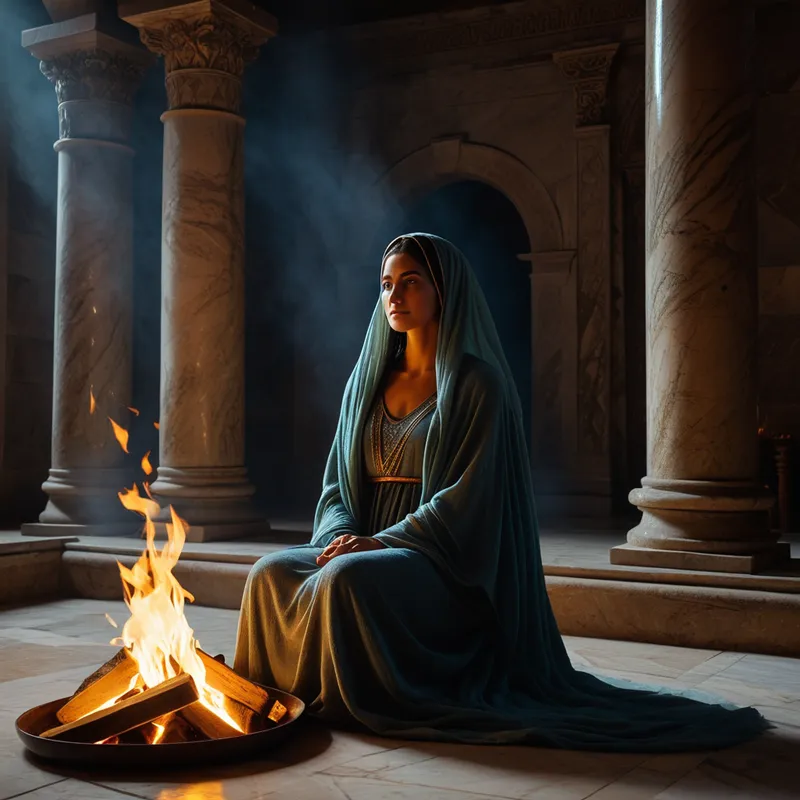
She went to the center of the great hall, where the floor was cold marble. There, she knelt. With her own breath and the focused stillness of her being, she kindled a fire upon the stones. Not a raging conflagration, but a perfect, contained flame. Its light did not blaze; it glowed. Its heat did not scorch; it nurtured. The crackle of its burning was a soft, rhythmic counterpoint to the divine arguments echoing in the vaults above. This was her throne: the hearth. This was her power: to be the still point.
When the gods Ares and Hephaistos vied for her hand, seeing in her stillness a prize to be won, Hestia did not engage. She placed her hand upon the warm stones of her hearth, and with Zeus as witness, swore a great and silent oath. She would remain a virgin, not in coldness, but in wholeness—belonging to no one, so she could belong to everyone. She renounced the drama of possession for the sovereignty of presence. The gods fell silent, then bowed. For in her refusal, they recognized a authority greater than force: the inviolable sanctuary.
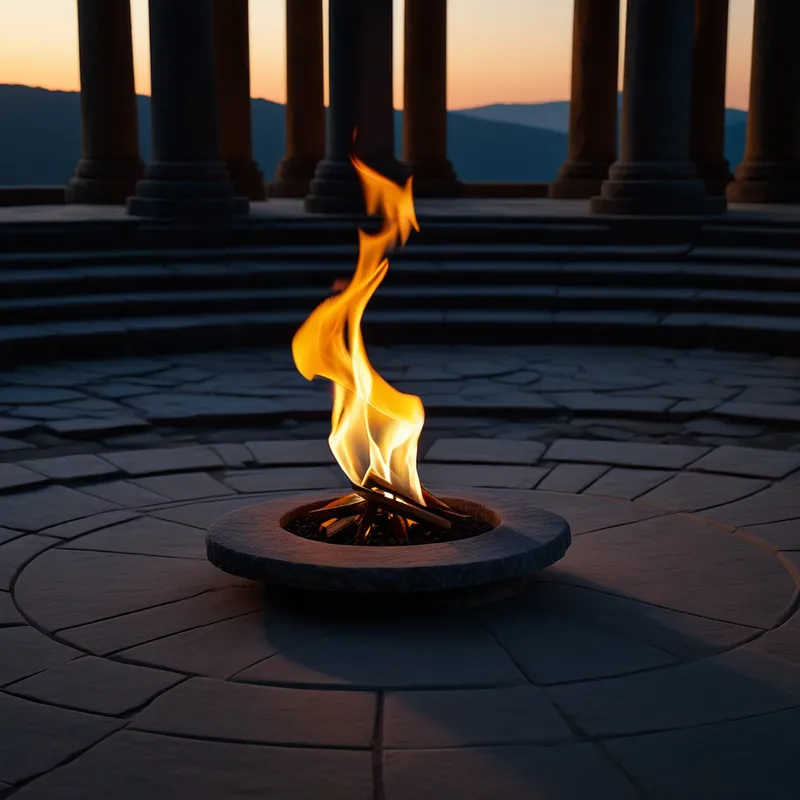
And so, in every city founded by mortals, the first act was to carry a flame from her sacred hearth. In every home, the first prayer was to her. Before every feast, the first offering of wine was poured into her fire. She asked for no temples filled with statues, for her temple was the threshold, the heart of the house, the public square. She was the fire that was never allowed to die, the center that held all chaos at bay, the first-born who became the eternal welcome.
Cultural Origins & Context
The figure of Hestia springs from the ancient Greek world, but her function touches a universal nerve. Her worship was not centered in grandiose temples but was embedded in the daily, somatic reality of the oikos (household) and the polis (city-state). She was the deity of the hestia—the hearth—both literal and symbolic.
Her myth was passed down not through epic cycles of heroism, but through ritual practice. Every father was her priest in the home; every community maintained her public fire. Her story was told in the act of kindling the morning flame, in the shared meal cooked over it, in the stranger granted warmth at its side. She existed in the doing, not just the telling. Societally, Hestia represented the foundational contract of civilization: the creation of a safe, shared center. The hearth-fire was the source of heat, light, and cooked food, but also the altar for the family gods, the gathering place for discussion, and the literal anchor of the architectural space. To be without a hearth was to be utterly adrift. Her myth served as the sacred justification for hospitality, for domestic order, and for the spiritual significance of the mundane, repetitive acts that sustain life.
Symbolic Architecture
Psychologically, Hestia represents the archetype of the inner sanctuary. She is the psychic function that creates and maintains a sense of sacred, inviolable center within the individual.
The first-born divinity is not the one who conquers the world, but the one who returns from its belly to tend the fire at its core.
She symbolizes the ego’s capacity for conscious renunciation. Where other gods expand outward—conquering, creating, loving, ruling—Hestia’s power is one of contraction to a vital point. She gives up the throne (conscious dominance) and romantic entanglement (possessive projections) to hold a space that is neither aggressive nor defensive, but simply present. Her virginity is not asexuality, but a symbol of psychological integrity—a wholeness that requires no other to complete it, making it capable of true, non-possessive relatedness.
The hearth-fire is the symbol of consciousness itself: a fragile, living light that must be tended, that transforms raw fuel (experience, emotion, instinct) into usable warmth and light (understanding, compassion, insight). It is the still point in the turning world of the psyche, the place from which one can observe the tumult of other complexes—the inner Ares, the cunning inner Hermes—without being consumed by them.

The Dreamer's Resonance
When Hestia’s pattern stirs in the modern dreamer, it often manifests not as a figure, but as a place or a sensation. To dream of a forgotten room in one’s own house, containing a warm, lit fireplace; of finding a calm, circular courtyard at the center of a chaotic cityscape; or of the profound, somatic feeling of “coming home” to a deep, quiet peace within—these are visitations of the Hestia archetype.
This dream resonance signals a psychological process of centering. It often occurs when the dreamer’s outer life is characterized by fragmentation, excessive extraversion, or a loss of personal boundaries. The psyche is initiating a compensatory movement, pulling energy back from the peripheries to re-establish the inner hearth. The somatic feeling is one of grounding, of warmth spreading from the core, of a sigh of relief that needs no explanation. It is the unconscious affirming the need for sanctuary, for a withdrawal not into isolation, but into a nourishing interiority where the soul’s flame can be safeguarded and fed.

Alchemical Translation
The alchemical journey modeled by Hestia is one of incubation and simplification. In the process of individuation—becoming who one fundamentally is—there is a stage that is not about adding, achieving, or integrating, but about subtracting to the essential.
The great work is not always a forging of the sword; sometimes it is the careful banking of the coals, so the light survives the long night.
The “swallowing by Kronos” represents the necessary, often painful, immersion in the unconscious or in a life circumstance that feels like a devouring confinement. From this, Hestia emerges as the prima materia—the first, fundamental substance of the self, unscathed by the drama because her nature is of a different order. Her subsequent renunciation is the alchemical separatio: the conscious decision to separate oneself from the collective pressures of ambition, persona, and possessive relationships to claim one’s own sacred ground.
Tending the hearth is the opus of continual, mindful repetition—the daily practice of meditation, reflection, or simple, intentional living that keeps the flame of consciousness alive. It is the “pearl of great price” for which other glittering offers are traded. The ultimate transmutation is not into gold, but into a vessel that can hold and radiate a steady, warming light. The individual becomes a living hearth: a centered, whole presence that offers sanctuary first to oneself, and by that very integrity, becomes a calming, centering force for the world immediately around them. In a culture obsessed with burning out in a brilliant blaze, Hestia’s alchemy teaches the sacred science of burning on, forever.
Associated Symbols
Explore related symbols from the CaleaDream lexicon:
- Kitchen
- Private
- Security
- Dishes
- Condo
- Reception
- Altar
- Tray
- Sofa
- Waitress
- Cook
- Safety
- Temperature
- Hostess
- Bartender
- Shelter
- Farmhouse
- Residential
- Host
- Diner
- Landlord
- Grill
- Fluffy Alpaca
- Silverware Set
- Pet Bed
- Linen Closet
- Electric Heater
- Cybersecurity
- Smart Security System
- Crispy Fried Chicken
- Oven Mitt
- Rice Pot
- Chocolate Chip Cookie
- Cereal Bowl
- Roasting Turkey
- Cupcake Tower
- Smoky Barbecue
- Fluffy Pajamas
- Oversized Hoodie
- Fuzzy Slippers
- Rustic Apron
- Fancy Slippers
- Thermal Socks
- Apron
- Cooking Meals
- Fencing Off
- Creamy Vanilla
- Garnet Bead
- Almandine Garnet
- Garnet Brooch
- Friendly Waiter
- Barista's Coffee Machine
- Real Estate Agent's Key
- Cooking Utensils
- Baking Apron
- Grilled BBQ
- Chimney
- Ceramic Mug
- Iron Spatula
- Stone Fireplace
- Curvy Couch
- Lantern Adorned Side Table
- Kitchen Island
- Illuminated Night Table
- Worn Leather Sofa
- Modern Coffee Cart
- Flowered Armchair
- Baking Sheet with Cookies
- Glass Baking Dish
- Mason Jar Lantern
- Floral Oven Mitts
- Rustic Spice Rack
- Tealight Candle Holder
- Baking Sheet
- Serving Platter
- Tableware
- Baking Dish
- Casserole Dish
- Basting Brush
- Velvet Ribbon
- Smart Fridge
- Home Theater System
- Magnetized Refrigerator
- Dollhouse
- Play Kitchen Set
- Cuban Casa
- Victorian House
- Quaint Farmhouse
- Victorian Home
- Village Hut
- Quaint Kitchen
- Candlelit Lounge
- City Maintenance Vehicle
- Chimney Smoke
- Ritualistic Fire Pit
- Greasy Spoon
- Stone Hearth
- Fire Pit Embers
- Campfire Smoke
- Fireside Wisdom
- Root Cellar
- Porridge Stone
- Twilight Firelight
- Ritual Fire
- Earth Oven
- Hearth Fire
- Earthen Oven
- Clay Bowl
- Stone Age Kitchen
- Thermal Stones
- Ritual Firepit
- Hearth Stone
- Braziers of Old
- Firekeeper's Staff
- Firepit Stories
- Earth Lodge
- Ritual Fire Pit
- Firewood Pile
- Altar Table
- Sabbath Candles
- Mezuzah
- Hanbok Dress
- Number 6
- Atrium
- Insulation
- Sterilization
- Area
- Tranquility
- Pericardial
- Vanilla
- Paprika