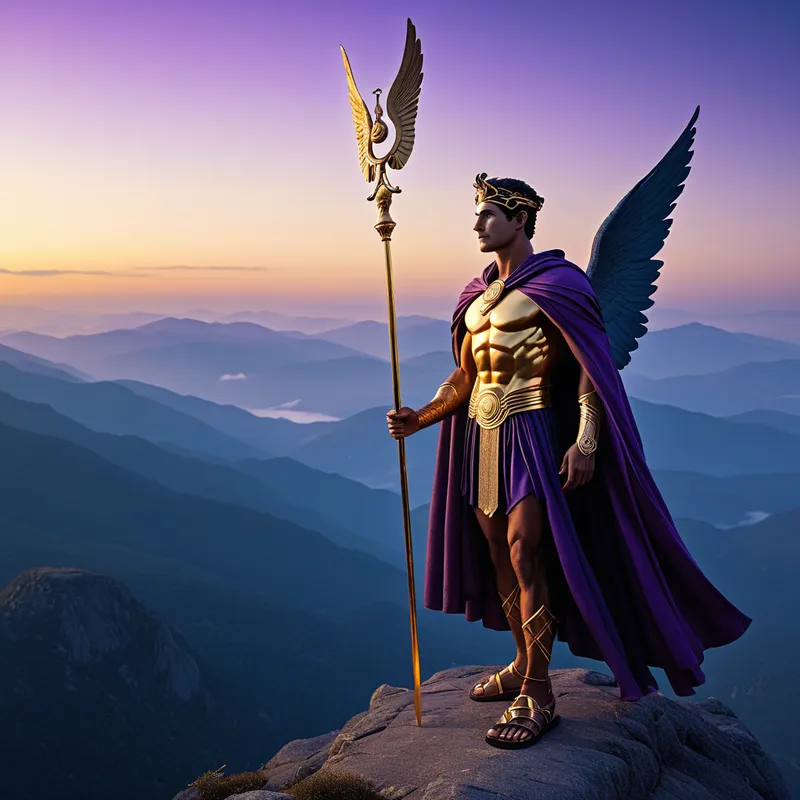
Hermes Myth Meaning & Symbolism
A story of the divine trickster, born at dawn, who steals divine fire to forge connection, becoming the guide between all worlds.
The Tale of Hermes
Before the sun had fully claimed [the sky](/myths/the-sky “Myth from Persian culture.”/), in the violet hour where night bleeds into day, he was born. His first cry was not a wail, but a laugh, a sound of pure, mischievous potential. Maia, daughter of the Titan Atlas, had borne him in a secret, shadow-draped cave on Mount Cyllene. The air was cool and smelled of damp stone and earth. The infant did not rest. His eyes, bright as polished river stones, saw everything.
While his mother slept, exhausted from her labor, the newborn slipped from his swaddling clothes. His limbs, though new, were firm. He walked—no, he danced—to the mouth of [the cave](/myths/the-cave “Myth from Platonic culture.”/). There, in the first golden rays, he found a [tortoise](/myths/tortoise “Myth from Greek culture.”/), slow and ancient. With a touch that was both gentle and decisive, he ended its earthly journey and hollowed its shell. He stretched sinews from stolen cattle across it, crafting an instrument never before seen or heard. He plucked the strings, and the cave filled with a sound that was neither of [the earth](/myths/the-earth “Myth from Hindu culture.”/) nor the heavens, but the very music of the space between.
But music was not enough. A deeper hunger stirred in him—a hunger for action, for consequence. He looked toward the sun-drenched plains where [the immortal](/myths/the-immortal “Myth from Taoist culture.”/) cattle of his brother, the mighty Apollo, grazed. Under the blinding noon sun, the infant god became a thief. He reversed the cattle’s hooves and wore strange shoes of bark and myrtle to leave false tracks, a puzzle leading nowhere. He drove fifty head to a hidden grove, where he sacrificed two, offering the rich, savory smoke to the twelve great gods of Olympus—including himself. He buried the rest, erasing all trace.
Returning to his cradle as silently as a shadow, he feigned sleep. But Apollo, whose sight pierces all deception, was already storming up the mountain, fury in his wake. He confronted the babe in the cradle. Hermes met his brother’s blazing anger with wide, innocent eyes and a tongue of silver. He spun tales of his own infancy, denying all with such clever, twisting logic that even the truth seemed doubtful. Apollo, enraged yet bewildered, dragged him before their father, Zeus, on high Olympus.
Before the throne of the Thunderer, Hermes did not cower. He repeated his lies, his voice a melody of false innocence. Zeus, who sees the hearts of gods and men, threw back his head and laughed, a sound like rolling thunder that shook the halls. He saw not a crime, but a promise. He commanded the brothers to reconcile. To appease Apollo, Hermes took up his strange shell-instrument and played. The music that flowed forth was so heartbreakingly beautiful, so full of longing and joy, that Apollo’s anger melted into awe. In that moment, the cattle were forgotten. Apollo traded his herd for the lyre.
And so, the thief was appointed the messenger. [The trickster](/myths/the-trickster “Myth from Various culture.”/) became the guide. Zeus gave him winged sandals, a [herald](/myths/herald “Myth from Greek culture.”/)’s staff, and a sacred duty: to walk the roads between Olympus, Earth, and the dark realm of [Hades](/myths/hades “Myth from Greek culture.”/). He who began by crossing boundaries in secret was now the master of all thresholds, the divine connector, the soul who speaks to everyone and belongs everywhere and nowhere.

Cultural Origins & Context
The figure of Hermes, known to the Romans as [Mercury](/myths/mercury “Myth from Roman culture.”/), is a foundational archetype in the Greek mythological system. His stories are primarily woven from the fabric of the Homeric Hymns, particularly the “Hymn to Hermes,” a poetic narrative from the archaic period (c. 7th-6th century BCE) that captures his essential nature. These hymns were performed ritually, likely at festivals or as preludes to epic recitations, serving both religious and entertainment purposes.
Hermes was not a god of centralized, state power like Zeus or Athena, but a god of the margins and the in-between. He was worshipped by travelers, merchants, shepherds, and orators—all those whose lives depended on movement, exchange, and persuasive communication. His herms, stone markers featuring a head and a phallus, were placed at crossroads, boundaries, and thresholds, both protecting and defining liminal spaces. This cultural context reveals his societal function: he was the divine principle that facilitated connection, commerce (both material and spiritual), and safe passage through life’s uncertain transitions. He made the movement of goods, words, and souls possible.
Symbolic Architecture
Hermes embodies the [archetype](/symbols/archetype “Symbol: A universal, primordial pattern or prototype in the collective unconscious that shapes human experience, behavior, and creative expression.”/) of the [Trickster](/symbols/trickster “Symbol: A boundary-crossing archetype representing chaos, transformation, and the subversion of norms through cunning and humor.”/), but his trickery is never meaningless destruction. It is a creative, catalytic force. His theft of Apollo’s cattle is not mere larceny; it is the stealing of “divine fire”—in this [case](/symbols/case “Symbol: A case often signifies containment, protection of personal matters, and the need for organization in one’s life.”/), Apollo’s prized possessions, symbols of [material](/symbols/material “Symbol: Material signifies the tangible aspects of life, often representing physical resources, desires, and the physical world’s influence on our existence.”/) [wealth](/symbols/wealth “Symbol: Wealth in dreams often represents abundance, security, or inner resources, but can also symbolize burdens, anxieties, or moral/spiritual values.”/) and [stability](/symbols/stability “Symbol: A state of firmness, balance, and resistance to change, often represented by solid objects, foundations, or steady tools.”/)—to forge a new [relationship](/symbols/relationship “Symbol: A representation of connections we have with others in our lives, often reflecting our emotional state.”/), a new [artifact](/symbols/artifact “Symbol: An object from the past carrying historical, cultural, or personal significance, often representing legacy, memory, or hidden knowledge.”/) (the [lyre](/symbols/lyre “Symbol: The lyre symbolizes harmony, creativity, and the connection between the divine and human experiences.”/)), and ultimately, a new [role](/symbols/role “Symbol: The concept of ‘role’ in dreams often reflects one’s identity or how individuals perceive their place within various social structures.”/) for himself.
The first act of the soul seeking connection is often a transgression, a crossing of a boundary that was meant to be static.
His domains are a map of psychic functions: the winged sandals (swift thought, [intuition](/symbols/intuition “Symbol: The immediate, non-rational understanding of truth or insight, often described as a ‘gut feeling’ or inner knowing that bypasses conscious reasoning.”/), mobility of [consciousness](/symbols/consciousness “Symbol: Consciousness represents the state of awareness and perception, encompassing thoughts, feelings, and experiences.”/)), the [caduceus](/symbols/caduceus “Symbol: A winged staff entwined by two serpents, symbolizing healing, commerce, and divine messenger status.”/) (the reconciliation of opposites, healing through [integration](/symbols/integration “Symbol: The process of unifying disparate parts of the self or experience into a cohesive whole, often representing psychological wholeness or resolution of internal conflict.”/), as seen with the two serpents), and the herald’s role (the function of [the ego](/myths/the-ego “Myth from Jungian culture.”/) as messenger between the unconscious and the conscious mind). He is the personification of Hermeneutics—the art of interpretation. Just as he translates the will of Zeus to gods and mortals, he represents our inner [capacity](/symbols/capacity “Symbol: A measure of one’s potential, limits, or ability to contain, process, or achieve something, often reflecting self-assessment or external demands.”/) to translate the raw, often cryptic symbols of the unconscious into the understandable [language](/symbols/language “Symbol: Language symbolizes communication, understanding, and the complexities of expressing thoughts and emotions.”/) of the conscious self.

The Dreamer’s Resonance
To dream of Hermes is to dream of a psychic state of transition and communication. The dream imagery is often liminal: empty airports, phone lines crackling with static, unexpected messages from strangers, or finding a hidden door in a familiar room. Somatic sensations might include restlessness, a fluttering in the chest or stomach, or a feeling of being “in transit.”
Psychologically, such dreams signal that unconscious content is seeking expression and needs to be “delivered” to consciousness. The Hermes dream is active during life transitions—career changes, moves, the beginning or end of relationships. If the Hermetic figure in the dream is blocked, lost, or delivers a confusing message, it suggests the dreamer is resisting this inner movement, perhaps clinging to an old, stable order (Apollo’s cattle) and refusing the creative theft required for growth. The dream urges agility, cleverness, and a willingness to engage with the unexpected messenger within.

Alchemical Translation
The myth of Hermes is a precise alchemical manual for psychic transmutation. It begins in the [nigredo](/myths/nigredo “Myth from Alchemical culture.”/), the dark cave of potential, where the unformed self resides. The “infant” consciousness, full of instinctual cunning, must perform its first act of creation—often from something humble or discarded (the tortoise shell). This is the forging of the unique instrument of the soul.
The lyre is fashioned from sacrifice; our creative voice emerges only when we dare to use what the world considers slow, low, or useless.
The central alchemical operation is the theft and the subsequent reconciliation. The conscious ego (Apollo), ordered, bright, and possessive of its resources, is confronted by the trickster unconscious (Hermes), which “steals” energy, patterns, or assumptions to force a change. The ensuing conflict, brought before the transcendent function (Zeus), does not end in punishment but in a divine laugh and a trade. The conscious mind loses its rigid holdings but gains a new capacity—the music of the lyre, the gift of art, insight, or deeper communication.
Thus, individuation follows the Hermetic path: we must become the thief of our own stagnant energies, guide them through the tricky negotiations of inner conflict, and ultimately become the messenger who can freely travel between all layers of our being, delivering wholeness. We are called to stop being mere inhabitants of a single psychic territory and become, like Hermes, the connective tissue of our own soul.
Associated Symbols
Explore related symbols from the CaleaDream lexicon:
- Phone
- Feet
- Legs
- Shoe
- Traffic
- Trailer
- Market
- Telephone
- Curb
- Customer
- Escalator
- Hurry
- Somehow
- Penis
- Switch
- Move
- Language
- Taxi
- Ski
- Brief
- Acquaintance
- Newspaper
- Movement
- Visit
- Guide
- Microphone
- Pass
- Action
- Channel
- Remote
- Foyer
- Border
- Media
- Amplifier
- Cashier
- Speed
- Convertible
- Speaker
- Tongue
- License
- Instant
- Rush
- Scooter
- Mailbox
- Pickup
- Quick
- Rail
- Casino
- Delivery
- Secretary
- Server
- Mid
- Rental
- Expression
- Unusual
- Smooth
- Suddenly
- Passport
- Outskirts
- Briefcase
- Jet
- Surprised
- Tone
- Thief
- Motel
- Electronic
- Skateboard
- Gig
- Sale
- Shepherd
- Interaction
- Passageway
- Elbow
- Signal
- Cheetah Speed
- Lizard Tongue
- Inquisitive Chipmunk
- Worn-out Shoes
- Whisk
- Smartphone
- Cloud Computing
- Electric Scooter
- Remote Work
- E-Commerce
- Text Message Notifications
- Wifi Signal
- Podcast
- Sushi Roll
- Bubble Tea
- Mismatched Socks
- Feathered Cape
- Studded Boots
- Ultra-Modern Sneakers
- Brightly Colored Socks
- Causal Beanie
- Breezy Tank Top
- Graphic Tee
- Rain Boots
- Tracksuit
- Flickering Tongue
- Right Foot
- Waving Hand
- Tapping Foot
- Logging Off
- Sending Messages
- Bustling Train Station
- Chilly Ski Resort
- Quantum Leap
- Velocity of Thought
- Transient Thought
- Rogue
- Balance Bike
- Monorail
- Custom Motorcycle
- Bicycle Ride
- Subway Station
- Scooter Ride
- Bus Station
- Personal Jet
- Zipline
- Longboard
- High-speed Train
- Escape Van
- Jet-Ski Adventure
- Speeding Motorcycle
- Interstate Highway
- Breezy Kitesurfboard
- Illuminated Satellite
- Quartz Crystal
- Beryl Prism
- Chrysocolla Sphere
- Tanzanite Gemstone
- Chrysocolla Disk
- Angelite Gem
- Chrysocolla Gem
- Nickel Dreams
- Silicon Wave
- Sleet and Slush
- Snapdragon Surprise
- Canopy Walk
- Clover Blossom
- Cloaked Snapdragon
- Grasshopper Jump
- Dreamy Antenna
- Snail
- Anole
- Snake Charmer
- Mudskipper Jump
- Silver-Striped Sidewinder
- Breezy Sandpiper
- Tropical Casuarin
- Friendly Coyote
- Witty Kinkajou
- Boots of Swiftness
- Winged Sandal
- Fleeting Glimpse
- Teleportation Gate
- Trickster Coyote
- Whistle
- Diplomat’s Briefcase
- Taxi Driver’s Meter
- Digital Tablet
- Harmonica
- Theremin
- Wooden Marimba
- Sleek Keytar
- Secretive Claves
- Miniature Piano
- Leather Cajon
- Cycling Gear
- Ice Skates
- Ping Pong Table
- Track Suit
- Athletic Socks
- Distant Whistle Echo
- Badminton Shuttlecock
- Flashlight Tag
- Flag Football
- Ski Equipment
- Lemonade Stand
- Magic Show
- Roller Skates
- Camping Gear
- Hiking Boot
- Classic Bicycle
- Secret Santa Gift
- Ski Resort
- Outdoor Skating Rink
- Sledding Hill
- James Bond’s Briefcase
- Civil War Letter
- Illusory Doodle
- Symbolic Metaphor
- Twilight Anthology
- Television Antenna
- Sleek Ottoman
- Swinging Hammock
- Folding Chair
- Sleek Entertainment Center
- Wooden Skewers
- Microwave Oven
- Zester
- Bow Tie
- Patterned Socks
- Polka Dot Socks
- Trendy Cap
- Beryl Necklace
- Kinetic Jewelry
- Bumpy Skateboard
- Illuminated Tricycle
- Convertible Car
- Rocket Powered Skateboard
- Dune Buggy
- Moped
- Chopper
- Mini Cooper
- Rollerblades
- Freight Plane
- Go-Kart
- Foot-Powered Go-Kart
- Autonomous Pod Car
- Wireless Router
- Electric Bike
- Electric Piano
- Waving Antenna
- Rapidly Spinning Media Spinner
- Wireless Charger
- Electric Skateboard
- Car Dashboard Display
- Smart IoT Device
- Confusing Remote Control
- Diminishing Signal Bar
- Sticky Note
- Whiteboard Marker
- Pencil Case
- Ballpoint Pen
- Fax Machine
- Velcro Pockets
- Mechanical Pencil Mirage
- Computer Mouse
- Invisible Ink
- Echoing Printer Cartridge
- Presentation Slides
- Pogo Stick
- Tricycle
- Toy Piano
- Miniature Car
- Fuzzy Dice
- Toy Magic Kit
- Audio Mixer
- Accordion Dreams
- Resonant Speaker
- Transitional Space
- Kiosk
- Mercantile Exchange
- Mountain Lodge
- Vintage Train Station
- Grand Bazaar
- Campsite
- Mobile Room
- Busy Intersection
- Sandy Boardwalk
- Urban Playground
- City Limits Sign
- Cobblestone Street
- Billboard Advertisement
- Vendor Cart
- Skybridge Walkway
- Bustling Market
- Traffic Cone
- Overpass
- Shopping District
- Pedestrian Walkway
- Timeless Sandals
- Crowded Casino
- Fugitive Car
- Chevron Stripes
- Wavelength Patterns
- Wind-Borne Seeds
- Animal Tracks
- Squawking Partridge
- Lantern Fish
- Pebble Game
- Trail Markers
- Animal Footprints
- Sunset foraging
- Animal Track Prototype
- Bonfire Smoke Signals
- Coyote Call
- Jangseung Totem
- Condor Flight
- Number 15
- Number 25
- Angel Number 555
- Tingling Nerve
- Animus
- Wisdom’s Key
- Threshold Crossing
- Augmented Overlay
- Network Lag
- Emoji Cascade
- Wi-fi Waves
- Encryption Key
- App Notification
- Network Static
- Online Disconnect
- Doppler Effect
- Dew Point
- Mesosphere
- Sound Propagation
- Sound Velocity
- Static Field
- Quantum Tunneling
- Radio Waves
- Neutrino
- Random Walks
- The Border
- Jurisdictional Boundary
- Asterisk
- Grammar
- Semantics
- Dialect
- Idiom
- Simile
- Anagram
- Neologism
- Homonym
- Preposition
- Clitic
- Appositive
- Backformation
- Implicature
- Translation
- Punctuation
- Emoji
- Typography
- Jargon
- Prose
- Phonology
- Morse
- Metonymy
- Interface
- Checkpoint
- Warp
- Dialogue
- Fasttravel
- Speedrun
- Fast
- Synchronicity
- Transient
- Fast-forward
- Milestone
- Wavelength
- Oscillator
- Transmission
- Conduit
- Mezzanine
- Podium
- Zoom
- Steadicam
- Aside
- Subtlety
- Trade
- Exchange
- Arbitrage
- Tariff
- Barter
- Caduceus
- Hod
- Conductivity
- Catalysis
- Outward
- Diagonal
- Tangential
- Boundary
- Sleetfall
- Flurry
- Jetstream
- Mediator
- Saliva
- Blueshift
- Doppler
- Sprint
- Skip
- Col
- Proximity
- Index
- Hypnopompic
- Lightness
- Rapid
- Garlic
- Scintillation
- Medium
- Cairn of Sticks
- Wand
- Writing Desk
- Bus Terminal
- Neurotransmitter
- Canvas Sneakers
- Telephone Booth
- Comma
- Announcement