Hercules at the Crossroads Myth Meaning & Symbolism
The young hero Hercules, at a solitary crossroads, is visited by two goddesses who offer him the paths of Pleasure or Excellence, defining his destiny.
The Tale of Hercules at the Crossroads
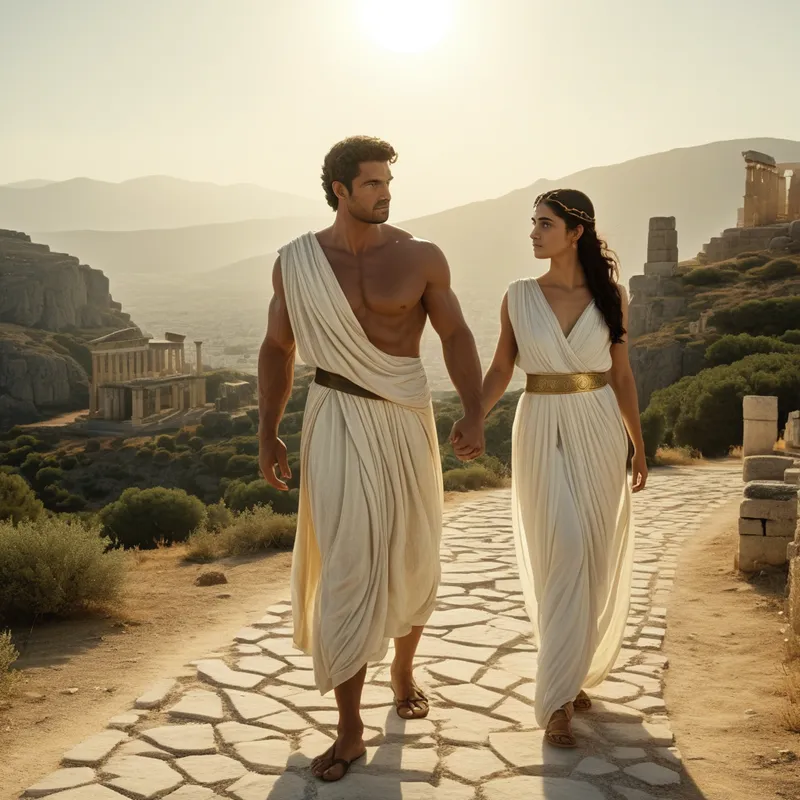
The heat was a physical weight upon the land, pressing the scent of [thyme](/myths/thyme “Myth from Greek culture.”/) and dry earth into the air. Herakles, not yet the [Hercules](/myths/hercules “Myth from Greek culture.”/) of legend but a youth of formidable frame and restless spirit, found himself alone. The road behind him was a memory; the road ahead, a question. He had come to a place where the path shattered into possibility—a crossroads of bare earth and stone, baked white under the relentless sun.
It was in this place of decision, where [the wind](/myths/the-wind “Myth from Various culture.”/) itself seemed to hold its breath, that the visions appeared. They did not walk from the hills or the olive groves. They simply were, materializing from the shimmering air as if they had always been waiting.
To his right stood a woman of such breathtaking allure that the very light bent toward her. Her robes were of Phoenician purple, intricately embroidered with threads of gold, and they clung to a form of perfected luxury. Her skin was pampered smooth, her eyes deep pools of promised ease. A crown of roses rested upon her brow, and the scent of myrrh and honeyed wine preceded her. She was Kakia, and her smile was an invitation to a soft eternity. “Come, noble youth,” her voice was a melody of silk, “walk with me. My path is smooth and shaded. You will know no toil, only the sweetest pleasures. You will taste every delight, recline on the softest couches, and your name will be whispered in halls of feasting.”
Even as her words wrapped around his heart, another presence solidified to his left. This woman wore a plain, white chiton. Her beauty was not of cosmetics but of character—a face etched with clarity, her body strong and capable from use, not ornament. Her gaze was steady, like [the North Star](/myths/the-north-star “Myth from Various culture.”/). She was Aretē, and her silence held more weight than the other’s song.
When she spoke, her voice was clear [water](/myths/water “Myth from Chinese culture.”/) over stone. “I offer you no false promises,” she said. “The path I guard is steep and rocky. It is the road of honor, earned by sweat and sacrifice. The gods give nothing good and great to mortals without effort and vigilance. If you seek true glory—a name that will echo through the ages not for your feasts, but for your deeds—you must labor. You must strive. You must become more than you are.”
Kakia laughed, a sound like tinkling bells. “See how she threatens you with hardship! My way is happiness. Hers is endless misery.”
Aretē did not flinch. “What you call happiness is a waking sleep. You lead your followers to a satiated decay. I lead mine to a life awake—to the respect of the city, the genuine friendship of good men, and the noble deeds that make a soul worthy of memory. The choice, Herakles, is between a pleasant obscurity and a difficult immortality.”
The young hero stood between them, the weight of his future in the balance. He felt the seductive pull of comfort, [the sweet poison](/myths/the-sweet-poison “Myth from Alchemical culture.”/) of ease. Then he looked into the eyes of Aretē, saw the unflinching truth there, and saw reflected not who he was, but who he could become. Without another word, he turned his broad shoulders away from the perfumed path and took his first, resolute step onto the stony road of Excellence. The die was cast. The labors awaited.
Cultural Origins & Context
This profound allegory is not found in the epic cycles of [Homer](/myths/homer “Myth from Greek culture.”/) but comes to us from the later, philosophically-minded classical period. It is most famously preserved in the writings of the Athenian soldier and historian Xenophon, in his work Memorabilia, where he attributes the tale to the sophist Prodicus. This context is crucial. The story emerged not as a sacred hymn but as a moral fable, a tool for ethical education used by teachers and philosophers.
Its societal function was clear: to illustrate the foundational Greek ideal of aretē. For the Greek citizen, particularly the young aristocrat, life was a project of self-cultivation for the good of the polis. The myth externalizes an internal, psychic conflict into a memorable, dramatic encounter. It served as a cultural narrative reinforcing the value of discipline (askēsis) over hedonism, positioning the “good life” not as one of pleasure, but one of meaningful action and earned honor. It was a story told to shape character, to provide a template for the moment of existential choice that defines a life.
Symbolic Architecture
At its [heart](/symbols/heart “Symbol: The heart symbolizes love, emotion, and the core of one’s existence, representing deep connections with others and self.”/), the [Crossroads](/symbols/crossroads “Symbol: A powerful spiritual symbol representing a critical decision point where paths diverge, often associated with fate, transformation, and life-altering choices.”/) is the ultimate [symbol](/symbols/symbol “Symbol: A symbol can represent an idea, concept, or belief, serving as a powerful tool for communication and understanding.”/) of the liminal [space](/symbols/space “Symbol: Dreaming of ‘Space’ often symbolizes the vastness of potential, personal freedom, or feelings of isolation and exploration in one’s life.”/)—[the threshold](/myths/the-threshold “Myth from Folklore culture.”/) where one state of being ends and another must begin. It is not a place of dwelling, but of decisive, directional change.
The Crossroads is the psyche’s moment of crystallization, where potential condenses into fate through an act of will.
Hercules represents the nascent ego, the conscious self poised at the brink of adulthood, brimming with potential but unformed. He is raw power in search of a principle to guide it. The two goddesses are not minor deities but profound archetypal forces. Kakia embodies the allure of the unconscious, regressive pull—the temptation to remain in a state of childish, undifferentiated pleasure, to avoid the suffering and [responsibility](/symbols/responsibility “Symbol: Responsibility in dreams often signifies the weight of duties and the expectations placed upon the dreamer.”/) that [consciousness](/symbols/consciousness “Symbol: Consciousness represents the state of awareness and perception, encompassing thoughts, feelings, and experiences.”/) demands. Her [path](/symbols/path “Symbol: The ‘path’ symbolizes a journey, choices, and the direction one’s life is taking, often representing individual growth and exploration.”/) is the path of least [resistance](/symbols/resistance “Symbol: An object or tool representing opposition, struggle, or the act of pushing back against external forces or internal changes.”/), leading to a dissipated, shadowy existence.
Aretē, in stark contrast, personifies the demanding call of [the Self](/myths/the-self “Myth from Jungian culture.”/) (in Jungian terms), the guiding [archetype](/symbols/archetype “Symbol: A universal, primordial pattern or prototype in the collective unconscious that shapes human experience, behavior, and creative expression.”/) of wholeness. She does not promise pleasure, but meaning. Her steep path is the arduous [journey](/symbols/journey “Symbol: A journey in dreams typically signifies adventure, growth, or a significant life transition.”/) of individuation—the process of becoming a distinct, responsible, and integrated individual. Her promise of “glory” is the promise of a realized, authentic [life](/symbols/life “Symbol: The symbol of ‘Life’ represents a journey of growth, interconnectedness, and existential meaning, encompassing both the joys and challenges that define human experience.”/). The myth brilliantly frames [virtue](/symbols/virtue “Symbol: A moral excellence or quality considered good, often representing inner character, ethical principles, or spiritual ideals in dreams.”/) not as a passive goodness, but as the most heroic and difficult [choice](/symbols/choice “Symbol: The concept of choice often embodies decision-making, freedom, and the multitude of paths available in life.”/) one can make.
The Dreamer’s Resonance
When this mythic pattern erupts in the modern dreamscape, the dreamer is at a critical juncture in their psychological development. The “crossroads” may appear as a literal intersection, a forked path in a forest, a choice between two doors, or two compelling figures offering conflicting advice.
The somatic experience is often one of paralysis or acute anxiety—a feeling of being “stuck” with a life-altering decision. This is [the ego](/myths/the-ego “Myth from Jungian culture.”/), like Hercules, feeling the tremendous gravitational pull of two irreconcilable inner forces. One figure (the Kakia archetype) may offer seductive images of escape, comfort, regression, or the abandonment of a burdensome duty. The other (the Aretē archetype) may appear stern, challenging, or associated with a difficult but meaningful task like climbing a mountain or mastering a skill.
This dream signals that the dreamer’s [psyche](/myths/psyche “Myth from Greek culture.”/) is forcing a confrontation with a moral or existential choice that has been avoided. It is the soul’s way of shouting, “You can no longer remain here. You must choose the direction of your life.” The tension is the growing pain of consciousness expanding, of the personality being asked to commit to a path of greater complexity and responsibility, leaving a simpler, more pleasurable, but less authentic way of being behind.

Alchemical Translation
The alchemical process mirrored here is the [nigredo](/myths/nigredo “Myth from Alchemical culture.”/)—the blackening, the initial confrontation with the primal material of the soul. Hercules at [the crossroads](/myths/the-crossroads “Myth from Celtic culture.”/) is the [prima materia](/myths/prima-materia “Myth from Alchemical culture.”/), the unrefined psychic substance, standing in [the crucible](/myths/the-crucible “Myth from Alchemical culture.”/) of choice.
The alchemical fire is not external circumstance, but the searing heat of conscious decision. In that fire, the base metal of potential is forged into the gold of character.
The choice for Aretē’s path is the beginning of [the opus](/myths/the-opus “Myth from Alchemical culture.”/). Each “labor” that follows for Hercules becomes a symbolic stage in the alchemical transformation: confronting and integrating [the shadow](/myths/the-shadow “Myth from Jungian culture.”/) ([the Nemean Lion](/myths/the-nemean-lion “Myth from Greek culture.”/), [the Lernaean Hydra](/myths/the-lernaean-hydra “Myth from Greek culture.”/)), reconciling opposites (capturing the Ceryneian Hind and [the Erymanthian Boar](/myths/the-erymanthian-boar “Myth from Greek culture.”/)), and ultimately achieving a form of psychic sovereignty (cleaning [the Augean stables](/myths/the-augean-stables “Myth from Greek culture.”/), retrieving [the Apples of the Hesperides](/myths/the-apples-of-the-hesperides “Myth from Greek culture.”/)). The initial, decisive turn onto the difficult path sets this entire transformative sequence in motion.
For the modern individual, the alchemical translation is clear. Our “crossroads” are the moments where we choose between the comfortable, familiar, and ultimately soul-negating pattern, and the difficult, unknown, but soul-summoning path. It is choosing the hard conversation over silent resentment, the disciplined practice over distracted consumption, the integrity of saying “no” over the pleasantry of a compliant “yes.” This myth teaches that the heroic act is not a single slaying of a monster, but the daily, repeated choice for the path of excellence—the path that demands we transmute our base impulses into conscious deeds, thereby creating a self that is not given, but earned. The immortality promised is not of the body, but of the meaning woven into the very fabric of a life fully lived.
Associated Symbols
Explore related symbols from the CaleaDream lexicon: