Heracles at the Crossroads Myth Meaning & Symbolism
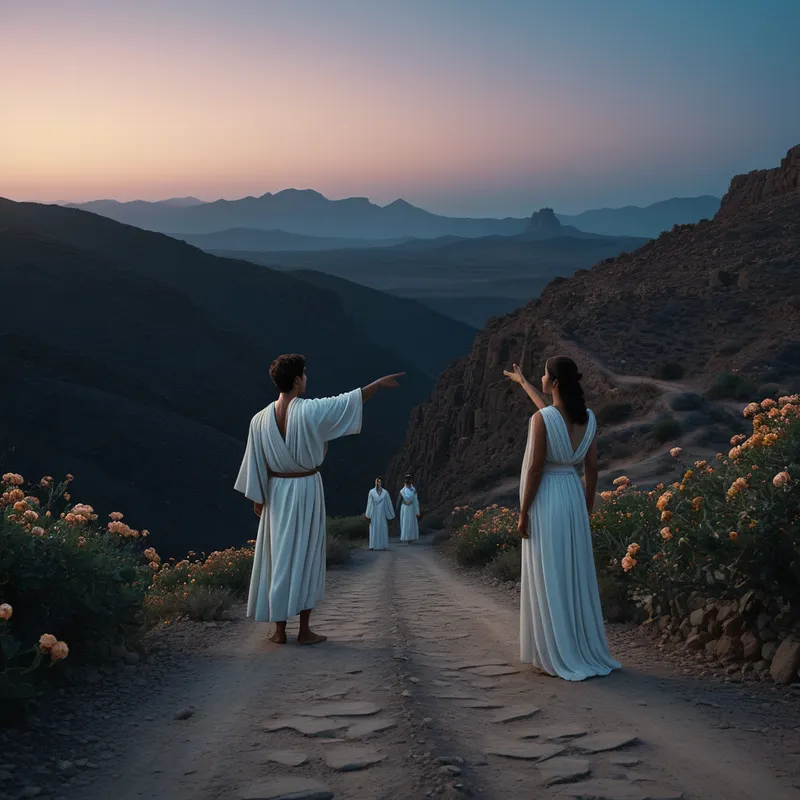
The young hero Heracles is confronted by two goddesses, Virtue and Vice, who offer him two starkly different paths for his life's journey.
The Tale of Heracles at the Crossroads
The heat of the day was fading, leaving the dust of the road to hang in the golden, slanting light. He was not yet the Heracles of legend, but a youth named Alcides, son of Amphitryon, wrestling with the colossal strength in his limbs and the storm in his heart. He had withdrawn to a lonely place, where the world narrowed to a bare fork in the path. Here, the earth itself seemed to hold its breath.
It was in this suspended silence that they came to him. Not as phantoms, but with the terrible clarity of truth made flesh.
First came Kakia. She was beauty of a consuming kind. Her robes were dyed with the purple of twilight and stitched with promises that shimmered. Her skin was perfumed with myrrh, her lips curved in a smile that knew no effort. She moved with a languid grace, and the very air around her grew soft and indulgent.
“Why do you labor, son of a mortal king?” Her voice was honey and velvet. “Follow me. I will lead you down the pleasant road. You will taste every delight without toil, sleep on beds of ease, and your name will be whispered in halls of pleasure. Your strength is for joy, not burden. Choose the smooth path. Choose me.”
Her words settled on him like a warm, heavy cloak. The road she gestured to wound through a gentle meadow, blooming with poppies, leading to a distant, glittering city where music seemed to play on the breeze.
But before the seduction could take root, another presence asserted itself. This was Arete. She bore no perfume save the scent of high, clean air. Her form was not softened by luxury but defined by a noble austerity. Her garments were pure white, simple, and showed the marks of weather. Her eyes held not invitation, but a formidable challenge.
“I know your parentage, Alcides,” she said, and her voice was like clear water over stone. “I know the seed of Zeus within you. The path I offer is steep and rugged. It leads upward, into the mountains where the air is thin. You will know weariness, danger, and the scorn of lesser men. But if you walk it, you will do great deeds. You will cleanse the earth of monsters, aid the helpless, and achieve a glory that does not fade with the body. You will become what you are meant to be. The gods themselves will honor you.”
The road she pointed to was a goat track, climbing sharply toward distant, snow-capped peaks wreathed in cloud. It looked arduous, lonely, and long.
The youth stood between them, the weight of his life—all potential, all uncertainty—pressing down upon that single point in the dust. The twilight deepened, painting the crossroads in hues of amber and violet. He looked from the smiling, opulent figure to the stern, radiant one. He felt the pull of effortless pleasure, a life of sweet oblivion. Then he felt the call of his own unformed greatness, a destiny written in stars and struggle.
He drew a breath that filled his mighty chest. His choice was not a whisper, but a declaration that shattered the stillness.
“I choose the hard road. I choose the path of Arete.”
At his words, Kakia’s beautiful face darkened with a fleeting spite before she dissolved like mist in the rising moon. Arete did not smile, but a fierce approval lit her features. She nodded once, a sovereign acknowledging a sovereign decision. Then she, too, was gone.
Alcides was alone again at the crossroads. But he was alone no longer. He had chosen his companion for the journey: his own fate. He turned his face toward the mountain path, and taking his first step upon it, he began to become Heracles.

Cultural Origins & Context
This allegory is attributed to the sophist Prodicus of Ceos, who lived in the 5th century BCE. It was not a myth of primordial gods, but a philosophical parable crafted for an educated, predominantly male Athenian audience. Prodicus used it in his teachings on ethics and rhetoric, a powerful “thought experiment” made narrative.
Its societal function was didactic and civic. In a culture that idealized arete but was acutely aware of the temptations of power, luxury, and hubris, the story provided a clear, dramatic model for the education of the young elite. It framed the central question of a good life not as a matter of fate or divine whim, but of conscious, difficult choice. The myth was passed down not by epic poets like Homer, but by philosophers like Xenophon, who recorded it in his Memorabilia, ensuring its preservation as a cornerstone of Socratic and later Stoic moral philosophy.
Symbolic Architecture
At its core, the myth maps the fundamental architecture of a psychic crisis. The crossroads is not a place in the world, but a place in the soul—the critical juncture where instinctual nature confronts conscious will.
The hero is not born in the triumph, but in the moment of choice that makes the triumph possible.
The two goddesses are not external beings but profound personifications of internal potentials. Kakia represents the allure of the undifferentiated life, the path of least resistance where the individual dissolves into pleasure, comfort, and collective values. She promises a life without shadow, but also without substance—a spiritual death by indulgence. Arete embodies the daunting call to individuation. Her path is difficult because it demands the hero differentiate himself from the mass, carry his own burden of consciousness, and engage in a lifelong struggle against his own inner “monsters” of laziness, fear, and mediocrity.
Heracles’ youth is key. This is the crisis of adolescence in its most amplified, archetypal form: the terrifying and exhilarating realization that one’s life is one’s own to make or squander. The “parentage” Arete references is the divine spark of potential within—the Self, in Jungian terms, calling the ego to its service.
The Dreamer's Resonance
When this myth pattern erupts in the modern dreamscape, the dreamer is at a somatic and psychological crossroads of their own. The setting may be modern—a literal intersection, a choice between two job offers symbolized by doors, or two people representing life directions—but the archetypal tension is identical.
Somnially, this manifests as a feeling of profound paralysis. The dreamer often reports being “frozen” or “unable to move,” feeling the immense gravity of the decision in their body. One path may glow with seductive, warm light but feel eerily hollow; the other may appear dark, foreboding, yet hum with a strange, magnetic truth. The figures that appear are often not classical goddesses, but potent dream images: a comforting but stifling parent versus a stern but inspiring mentor; a luxurious, decaying mansion versus a bare, wind-swept cliffside cabin.
This dream signals that the psyche has reached a threshold. The comfortable, adapted persona (the path of Kakia) is no longer sufficient, and the Self is applying pressure for a more authentic, though more difficult, alignment. The paralysis is the ego’s resistance, feeling the death of an old way of life that must occur before the new path can be taken.

Alchemical Translation
The alchemy modeled here is the transmutation of potential into essence. Heracles begins as prima materia—raw, unshaped power (his physical strength) plagued by inner conflict (his uncertain identity). The crossroads is the nigredo, the blackening, the moment of supreme confusion and despair where all easy answers dissolve.
The choice for the steep path is the first act of the opus: the conscious submission of the ego’s desire for comfort to the soul’s demand for meaning.
Kakia offers a false, premature albedo (whitening)—a pseudo-enlightenment through escape and pleasure, a clarity that is merely the absence of struggle. Arete offers the true, arduous albedo: the purification that comes only through confronting the shadow (the monsters he will later face) and enduring the separatio—the separation from the collective, easy life.
By choosing Arete, Heracles places his raw power (libido) in the service of a symbolic goal—becoming a hero who serves a cosmic order. This is the citrinitas (yellowing), the dawning of the “solar” consciousness, where action is guided by principle, not impulse. His subsequent labors are the detailed, iterative stages of this alchemical process, each one further refining and solidifying the initial choice made at the lonely fork in the road.
For the modern individual, the myth does not promise a life of literal monster-slaying, but prescribes the inner attitude necessary for psychic integration. It asserts that our deepest fulfillment—our “immortal glory”—is forged not in avoiding life’s arduous climbs, but in consciously, courageously choosing them. The hero’s journey begins not with a call to adventure, but with a silent, solitary, and irrevocable vote for the difficult truth of one’s own being over the comforting lie.
Associated Symbols
Explore related symbols from the CaleaDream lexicon: