Heracles Myth Meaning & Symbolism
The demigod Heracles, driven mad by Hera, must complete twelve impossible labors to atone, a brutal path from monstrous rage to divine immortality.
The Tale of Heracles
Hear now the tale of the strongest man who ever lived, a story born not in gentle light, but in the thunderous clash of divine wills. It begins with a cry of a newborn, not of innocence, but of prophecy and poison. From his first breath, Hera’s hatred was his cradle-song. She sent serpents to his crib, but the infant, with fists like stones, strangled them before his swaddling clothes were soiled. This was Heracles, son of Zeus and the mortal Alcmene, and his strength was a curse disguised as a gift.
His life was a storm of victories and tragedies, a path paved with monstrous corpses and personal ruin. He cleared lands of beasts, won wars, and sired children. Yet Hera’s vengeance was patient, a poison in the wine of his soul. In a fit of madness she sent upon him, his divine strength turned inward, and in a red haze he saw not his beloved wife Megara and their sons, but the shapes of his enemies. When the fog lifted, he stood in a silent house, his hands stained with the blood of his own family.
Broken, hollowed out by a grief no mortal was meant to bear, Heracles sought purification. The oracle at Delphi spoke with the voice of the god: to be cleansed, he must enter the service of his cousin, the weak and spiteful King Eurystheus, and perform ten labors—a sentence that swelled to twelve by the king’s treachery. This was his atonement: not prayer, but impossible action.
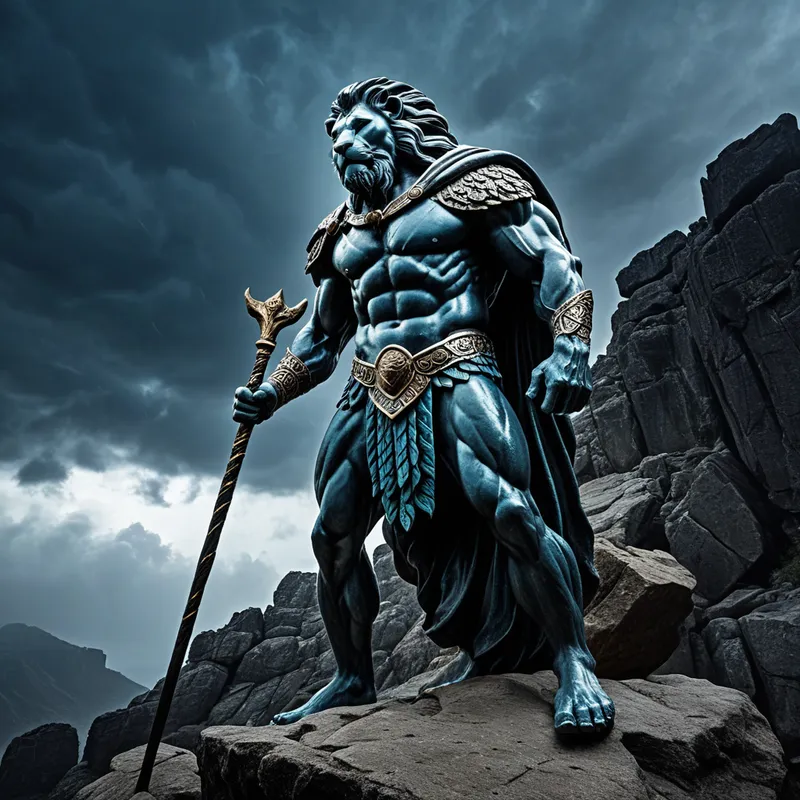
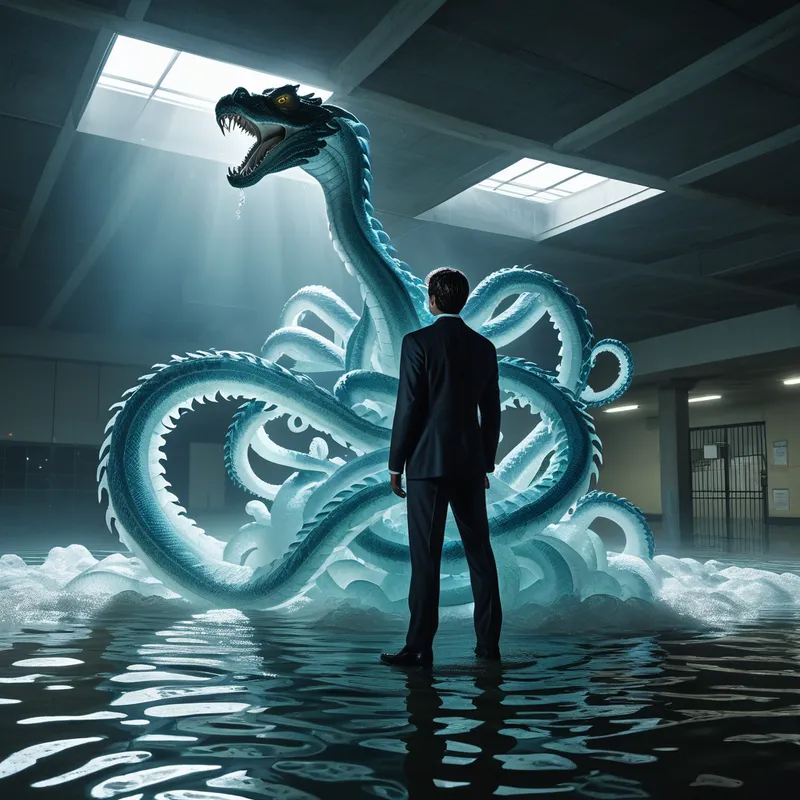
And so the labors began, a brutal geography of the impossible. He faced the Nemean Lion with his bare hands, learning that brute force must yield to cunning, strangling the beast and skinning it with its own claws. He battled the Lernaean Hydra, its breath a poison mist, and with his nephew Iolaus’s help, seared the necks with fire to prevent regeneration. He chased the Erymanthian Boar through deep snow, captured the Ceryneian Hind without harming it, and drove away the Stymphalian Birds with deafening bronze rattles.
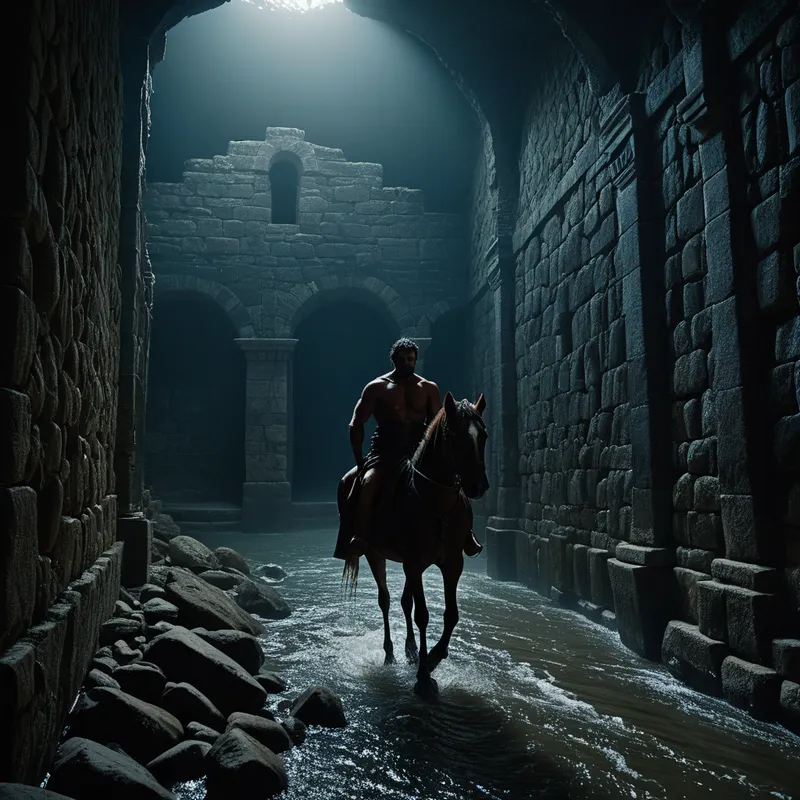
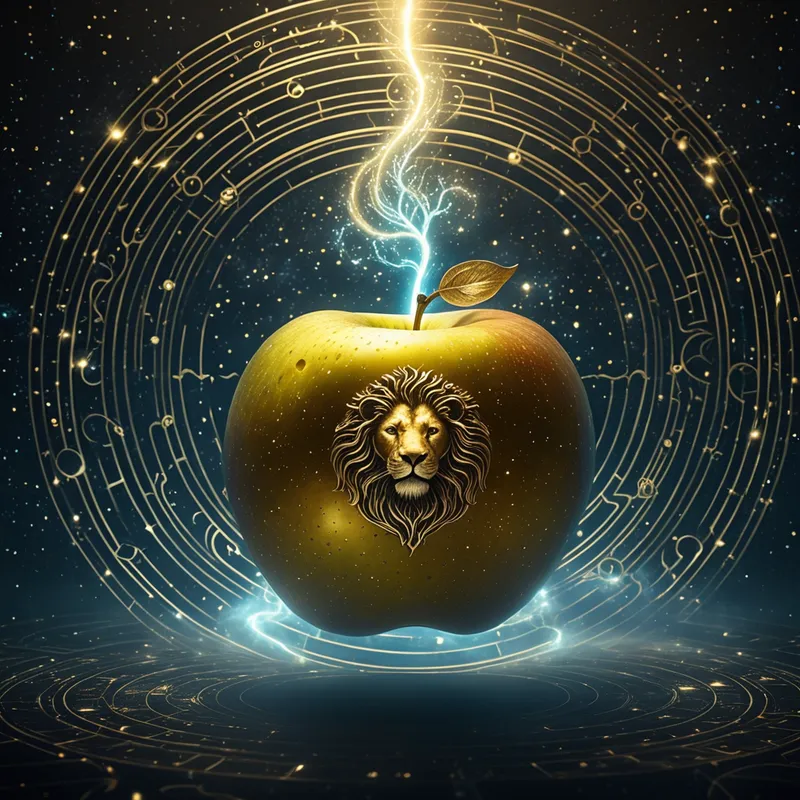
He cleansed the Augean Stables in a day, not with a shovel, but by redirecting rivers—a labor of intellect scorned. He mastered the Cretan Bull, wrestled the Mares of Diomedes, and claimed the girdle of the warrior Queen Hippolyta. He journeyed to the edge of the world to fetch the red cattle of the monster Geryon, and descended into utter darkness to retrieve the three-headed hound, Cerberus, from the realm of Hades himself. His final task was one of sublime delicacy: to pluck the golden apples from the garden of the Hesperides, which he achieved not by force, but by convincing the Titan Atlas to retrieve them.
The labors done, his sentence served, Heracles wandered still. His story did not end in peaceful retirement. After more adventures, a final, terrible betrayal came from his last wife, Deianira, who, tricked by the centaur Nessus, gave him a tunic soaked in what she believed was a love potion. It was the Hydra’s venom, a poison no mortal or god could survive. In agony, he built his own funeral pyre on Mount Oeta. As the flames consumed his mortal flesh, the part that was divine—the part forged in the fire of his suffering—ascended. Hera’s hatred was finally quenched, or perhaps transformed. On Olympus, he was reconciled with her, made immortal, and granted the goddess Hebe as his wife. The hero who was born from conflict found his peace not in life, but beyond it.
Cultural Origins & Context
The myth of Heracles is not a single, polished tale but a sprawling epic woven from countless local stories, hymns, and oral traditions across the Greek world. He was a pan-Hellenic hero, claimed by every city-state yet belonging to none. His cult was one of the most widespread, with temples and altars dedicated to him as both a divine protector (Alexikakos, “Averter of Evil”) and a model of endurance. The canonical cycle of the Twelve Labors was likely formalized in the Archaic period, possibly codified in epic poems now lost, such as the Shield of Heracles.
Bards and poets, from Homer to the tragedians, told his story. In the Iliad, he is a legendary, almost ancestral figure of immense strength. Later, playwrights like Sophocles (The Women of Trachis) and Eurystheus explored his human tragedy—the domestic ruin, the unbearable suffering. His myth served multiple societal functions: as an etiological explanation for the founding of rituals and athletic games (the Olympic Games were said to be founded by him), as a narrative of civilization conquering wild chaos (the labors clear the land of monsters), and as a profound meditation on the human condition. He embodied the Greek ideal of arete (excellence) pushed to its most extreme and painful limits, demonstrating that greatness is inseparable from profound suffering.
Symbolic Architecture
The myth of Heracles is a masterclass in the architecture of the psyche. He is the archetypal hero not as a flawless champion, but as a fractured being navigating the collision between his divine inheritance and his mortal fate. His “madness” and subsequent labors represent a catastrophic encounter with the Shadow—the parts of himself his conscious identity could not integrate. The murder of his family is the ultimate shadow-act, where one’s own unlived life or repressed rage destroys what one holds most dear.
The labors are not punishments, but prescriptions. They are the ego’s brutal curriculum, assigned by the Self (the oracle), to force a confrontation with the contents of the unconscious that erupted so violently.
Each labor is a symbolic encounter. The Nemean Lion represents the raw, undifferentiated power of the instinctual self that must be “worn” as a new skin of consciousness. The Hydra is the problem that multiplies when attacked directly with old, linear thinking; it requires the “fire” of a new perspective (Iolaus’s help). Cleaning the Augean Stables signifies the monumental, often scorned task of purifying the accumulated filth of a lifetime of neglected psychic material. Fetching Cerberus from Hades is the ultimate descent into the underworld of the psyche to retrieve and integrate the primal, guarding energy of the instincts. His apotheosis through fiery death signifies the final alchemical stage: the mortal ego-structure must be sacrificed for the birth of a transcendent, unified consciousness.
The Dreamer's Resonance
When the pattern of Heracles stirs in the modern dreamer, it announces a profound, often painful, process of psychic necessity. This is not the dream of a simple challenge, but of an inescapable task. The dreamer may find themselves in a labyrinth of bureaucratic halls (the service to Eurystheus), facing a beast that cannot be harmed by ordinary means (an emotional or professional problem resistant to usual solutions), or, most chillingly, living out a scene of catastrophic, unintended destruction of their own “family” or creations—a dream of profound self-sabotage.
Somatically, this can feel like carrying an immense, invisible weight—the burden of the sky like Atlas. Psychologically, it is the process of confronting a “labour” assigned not by a cruel king, but by the deep Self. The dreamer is in a state of atonement, not for a literal crime, but for a life lived out of alignment, where their greatest strength has been turned against their own wellbeing. The dreams are somatic maps for a journey of reclamation, where the monstrous aspects of one’s own nature (the Hydra, the Boar) must be faced, not to be slain, but to be mastered and their energy integrated.
Alchemical Translation
The Heraclean journey is the alchemy of the soul written in blood, sweat, and fire. It models the process of individuation in its most dramatic form. The initial state is one of identification with a grandiose, semi-divine power (the son of Zeus) that is dangerously unstable because it is unconscious. The nigredo, the blackening, is the madness—the devastating realization of one’s own capacity for shadow and the ruin it causes. This darkness is not the end, but the essential beginning.
The ego does not choose its labors; it accepts them. The transformation occurs in the submission to a task greater than one’s own desire for redemption.
The twelve labors are the albedo and citrinitas, the whitening and yellowing—the long, arduous stages of purification and illumination. Each labor is a specific operation on the psyche: confronting pride (the Lion), dealing with proliferating problems (the Hydra), cleansing neglected complexes (the Stables), journeying to the farthest reaches of one’s personality (Geryon), and finally descending into the deepest core of one’s trauma and fear (Cerberus). The agent of this change is not comfort, but applied suffering—the conscious, willing engagement with what is most difficult.
The final burning, the rubedo or reddening, is the death of the old heroic identity—the man who believed his strength could solve everything. This death-by-poison is the ultimate integration; even the venom of past trauma (the Hydra’s blood) becomes part of his story. The ascension to Olympus is the achievement of a new psychic position: the mortal struggle is complete, and the individual achieves a hard-won, reconciled wholeness. The modern individual walking this path is not seeking immortality, but a state of being where their inner conflicts are no longer sources of destruction, but the very pillars of their completed, resilient Self.
Associated Symbols
Explore related symbols from the CaleaDream lexicon:
- Strong
- Might
- Strength
- Sweat
- Force
- Hero
- Trouble
- Gymnasium
- Mile
- Exercise
- Athletic
- Challenge
- Pushing Limits
- Taming a Wild Animal
- Lifting Weights
- Bloodstone Sphere
- Belt of Strength
- Pest Control Spray
- Fitness Trainer's Weights
- Athlete's Medal
- Fireman's Hose
- Gym Equipment
- Triathlon Gear
- Punching Bag
- Water Polo Goal
- Triathlon Medal
- Challenge Accepted
- Point Score
- Sports Trophy
- Slingshot
- Exercise Equipment
- Monster Truck
- Fitness App
- Wooden Club
- Mythic Hero
- Skilltree
- Xp
- Risingaction