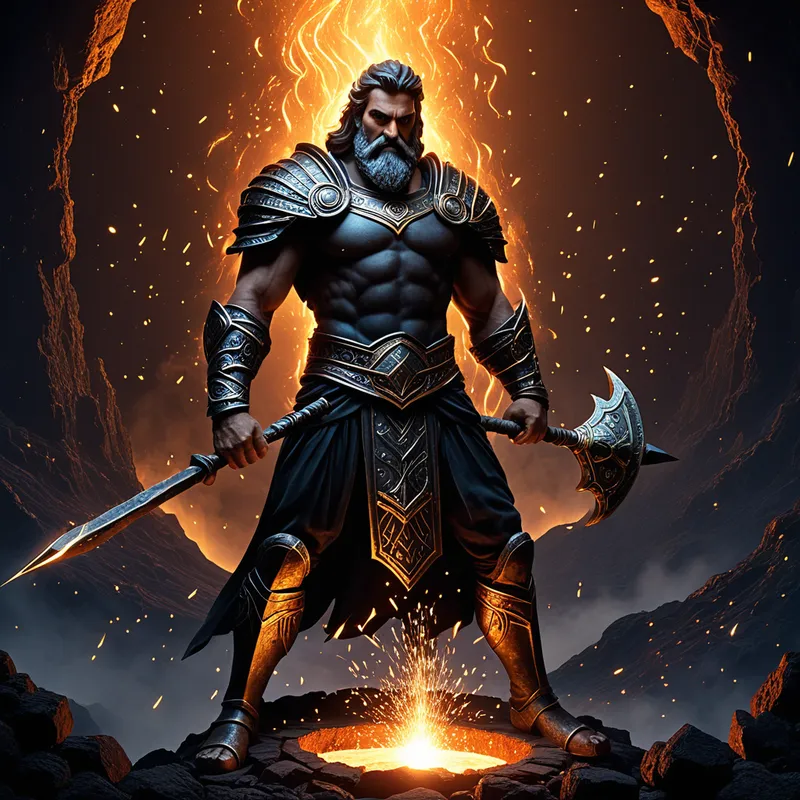
Hephaestus' Forge Myth Meaning & Symbolism
The myth of the exiled god who transforms volcanic fire and personal pain into divine artifacts, binding creation and destruction in his subterranean forge.
The Tale of Hephaestus' Forge
Hear now the tale of fire beneath the earth, of the god who walks with a limp and a heart of flame. It begins not in the golden light of Olympus, but in a fall from grace. When the queen Hera bore a son who was not the perfect image of divine beauty, her pride turned to ice. She cast the infant god from the heavenly heights, and he tumbled, a falling star, for a day and a night until he struck the wine-dark sea.
The sea-nymphs Thetis and Eurynome found him in the foaming depths, his leg shattered, his divine blood mingling with the salt. They took him to a secret grotto, and there, in the echoing dark, the seed of his genius was planted. With shells and coral, he crafted his first trinkets—pins that held the ocean’s spray, brooches that captured the light of abyssal fish. For nine years he labored in silence, his hands learning the language of material, his spirit forging a pact with hidden fire.
His return to Olympus was not a plea, but a masterpiece of cunning craft. He sent his mother a gift: a throne of unparalleled beauty, inlaid with gold and gems. When Hera sat upon it, invisible fetters sprang forth, binding her fast. No god could loose them. Only the maker held the key. Zeus himself bargained, promising a place among the Twelve if the smith would free his queen. Thus, Hephaestus returned, not as a cast-off, but as a power.
And so he descended again, not to the sea, but deeper, to the roots of the world. He built his true home within the volcano Aetna (or Lemnos). Here was his kingdom. The air itself was thick and hot enough to chew. Rivers of fire, the Cabeiri, danced at his command. Cyclopes, giant one-eyed sons of earth, heaved bellows that sounded like the mountain’s own breath. Here, the anvil’s ring was the heartbeat of the world.
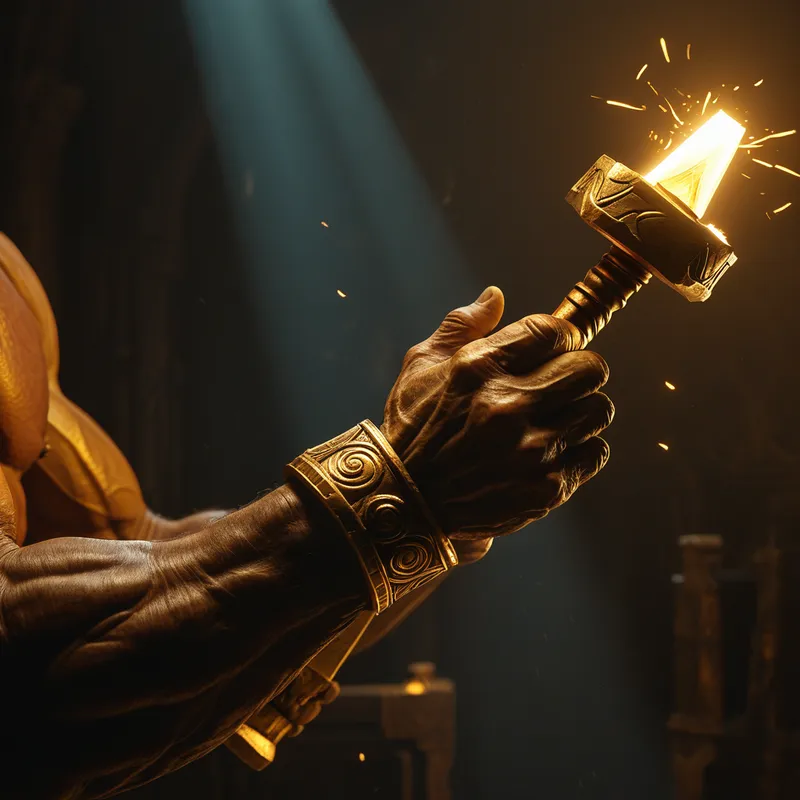
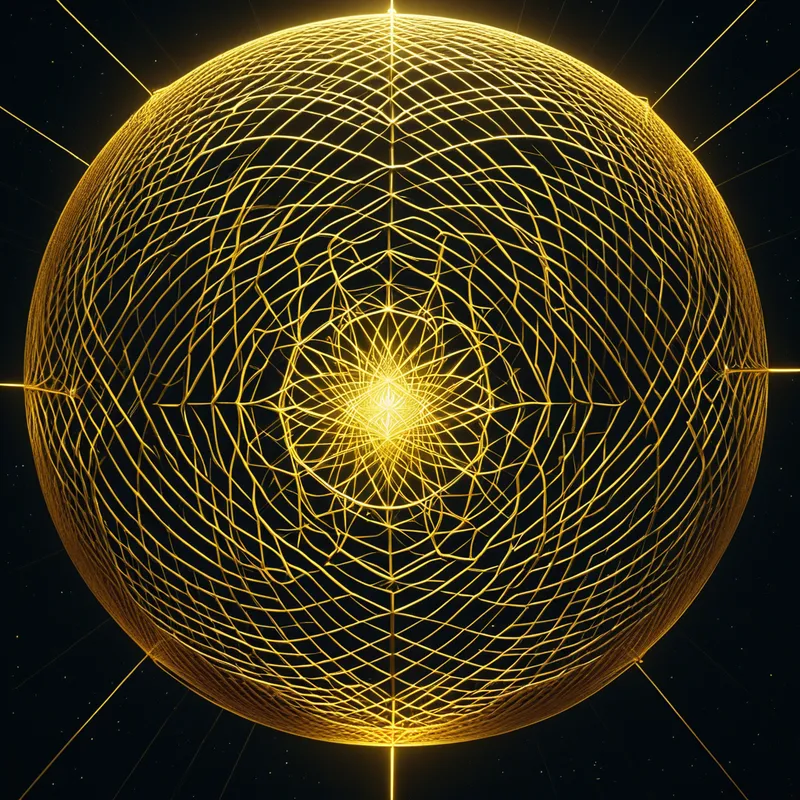
From this crucible of pain and isolation flowed wonders that shaped destiny. He forged the thunderbolts that upheld Zeus’s order. He crafted the inextricable net that ensnared Aphrodite and Ares in their betrayal—a perfect, unbreakable web of revelation. He built Talos, the bronze giant that patrolled the shores of Crete. He shaped Pandora from clay and water, giving her form and voice. His hammer fell in a rhythm older than the gods, a rhythm of making from breaking, of binding what is scattered, of giving sublime form to the raw chaos of the earth’s core.
Cultural Origins & Context
The myth of Hephaestus is woven from the very fabric of ancient Greek society, a culture that venerated the beautiful and the whole, yet held a profound, necessary space for the transformative power of the flawed artisan. His stories are primarily preserved in the epic poetry of Homer and the later Homeric Hymns, told and retold by bards at feasts and festivals. He was not a god of lofty ideals, but of tangible, necessary reality. His cult centers were often located near active volcanic regions like Lemnos and Sicily, where the earth’s fiery interior was visibly, terrifyingly present.
His societal function was dual. For the city-state, he was the divine patron of all craftsmen—blacksmiths, potters, sculptors—those whose skilled hands built civilization from raw material. His lameness was not merely a detail of pity; it symbolized the cost of craft, the physical sacrifice and deformation that often accompanied deep, focused work with fire and heavy tools. Simultaneously, on a cosmic level, he represented the necessary, chthonic counterbalance to the celestial Olympians. While they ruled from the bright sky, he governed the creative-destructive fires below, reminding the Greek mind that creation is never a purely clean, intellectual act. It is born from heat, pressure, violence, and often, from a place of exile.
Symbolic Architecture
Hephaestus is the archetype of the wounded creator. His forge, buried deep within the earth, is the symbolic heart of the unconscious psyche—a place of immense heat, pressure, and transformative potential that is inaccessible to the conscious, daylight mind (Olympus). His exile is not a punishment but a prerequisite for his power.
True creation is not born in the palace of approval, but in the volcanic cave of exile, where the raw materials of the self are subjected to the soul’s own fire.
His physical lameness symbolizes the creative defect—the perceived flaw, trauma, or limitation that becomes the unique point of leverage, the source of one’s distinctive strength and perspective. The fire he commands is not just physical flame, but the libido or psychic energy that fuels transformation. The artifacts he creates—the unbreakable net, the living automata, the thunderbolts—are symbols of psychic objects: complexes, defense mechanisms, and talents forged in the unconscious to navigate the world. The net, especially, represents the intricate, often unconscious patterns we weave that can both trap us and reveal profound truths.
The Dreamer's Resonance
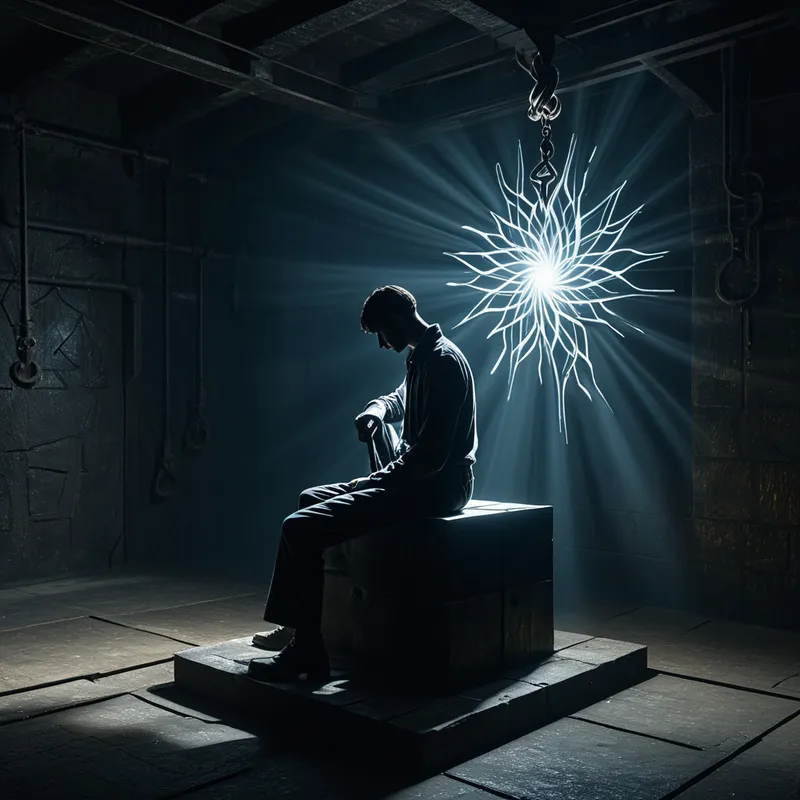
When the motif of Hephaestus’s Forge arises in modern dreams, it signals a profound somatic and psychological process underway. The dreamer may find themselves in a basement, a furnace room, a hidden workshop, or a volcanic landscape. There is often a sense of intense, isolating heat and the rhythmic, compelling sound of hammering.
This is the psyche’s workshop where shadow integration occurs. The “metal” being hammered is the unprocessed emotional material—shame, rage, grief, a sense of inadequacy (the “lameness”). The dreamer is not avoiding this painful material but is actively, if unconsciously, engaged in working it. The somatic feeling is one of pressured containment, of being in the crucible. There may be a solitary figure present (the dreamer’s own Hephaestus-self), often seen from behind, focused entirely on the task. This dream pattern suggests the ego is not in charge; the creative, transformative process is autonomous and deep. The dreamer is forging a new psychic structure—a new way of “holding” themselves—from the raw ore of their suffering.
Alchemical Translation
The myth of Hephaestus provides a masterful model for the alchemical process of individuation—the journey toward psychological wholeness. It maps the opus contra naturam, the work against one’s born nature, which is actually a work of returning to one’s deepest nature.
The first stage is The Fall (Exile): the conscious ego’s idealized self-image (Hera’s desire for a perfect child) is shattered. We are cast out from naive identification with collective standards of perfection and success. This descent is necessary.
The second stage is The Descent into the Forge (Nigredo): We land in the dark, chaotic, and fiery depths of the unconscious (the sea, then the volcano). This is a period of confusion, depression, or “melting down” where old structures dissolve.
The anvil of the soul is found only where the fire burns hottest; what is forged there carries the strength of the abyss and the memory of the fall.
The third stage is The Application of Fire and Hammer (Albedo/Citrinitas): Here, with conscious effort (the hammer) and the heat of passionate engagement (the fire), we begin to work on our base material. Our wound (the lameness) is not healed in the sense of being erased; it becomes the focal point of our craft, the seat of our unique authority and perspective.
The final stage is The Creation of the Sacred Object (Rubedo): The transformed self is not a repaired version of the old, but something entirely new—a crafted, conscious artifact. This is the “inextricable net” of self-knowledge that binds our contradictions, the “thunderbolt” of focused will, or the “automaton” of a healthy complex that serves the psyche. The once-exiled part becomes the central, creative faculty, and the individual returns to the world not to fit in, but to contribute their singular, forged-in-fire creation. The forge remains active within, a permanent inner sanctuary where the work of self-creation is lifelong.
Associated Symbols
Explore related symbols from the CaleaDream lexicon: