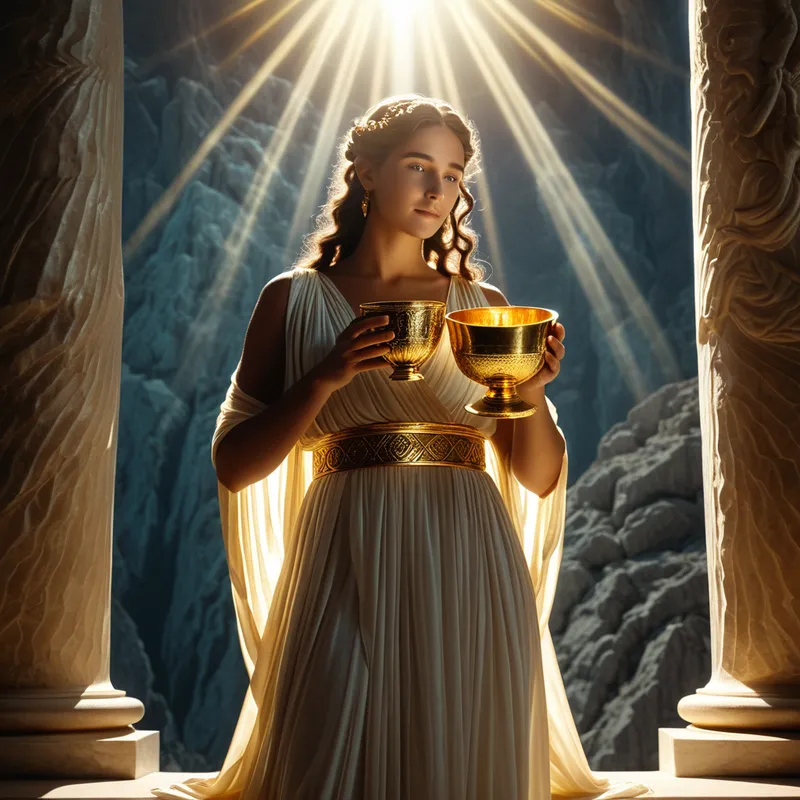
Hebe's nectar cup Myth Meaning & Symbolism
The myth of the goddess Hebe, who served the gods ambrosia until her fall, spilling the cup of eternal youth and losing her divine station.
The Tale of Hebe's nectar cup
Hear now the tale of the cup that was never meant to fall, the vessel of golden dawn held in the hands of eternal spring. Before the halls of Zeus, where the air shimmers with the breath of forever, there moved Hebe. She was the very blush of the world’s beginning, her footsteps leaving traces of blooming asphodel, her laughter the sound of a fountain untouched by time. Her duty was the highest grace: to bear the chalice of nectar and the platter of ambrosia to the assembled deities, to sustain their divine vigor and endless reign.
She moved among them, a vision of effortless service. To Athena, she offered clarity; to Apollo, she poured inspiration; to her mother, Hera, she presented the cup of sovereignty. The nectar was not mere drink; it was the distillation of cosmos itself, the liquid proof of their eternity. Hebe was the keeper of this covenant, her grace ensuring the unbroken circle of divine power.
But on a day when the laughter on Olympus was a little too loud, when the gods were deep in a tale of a mortal hero's folly, the unthinkable happened. Hebe, gliding across the polished floor of heaven, her focus perhaps drifting for a heartbeat towards the earthly world below, caught the hem of her silken robe upon an unseen flaw in the marble. A stumble—a gasp that silenced the hall—and the golden cup, that sacred grail, tumbled from her hands. It did not clatter; it sang a single, discordant note as it struck. And the nectar, that liquid light, spilled in a slow, radiant arc onto the cold stone, where it pooled like captured sunset before seeping away into nothingness.
The silence that followed was heavier than any thunder. The golden stain on the floor was a blasphemy. In that moment, the flawless vessel had broken; the eternal spring had faltered. The gaze of Zeus was not angry, but profoundly grave. The covenant of perfect service was shattered. Hebe, the embodiment of untarnished youth, had shown herself capable of a mortal flaw. Her grace, in that spilled cup, was irrevocably spent. With a decree that echoed with finality, she was relieved of her sacred office. The cup passed to another, and Hebe, the goddess of youth, stepped out of the central light of Olympus, her myth forever defined by that single, luminous spill.

Cultural Origins & Context
The myth of Hebe is not a grand epic of monsters and quests, but a poignant vignette preserved in the fragments of poets like Homer and the later compilations of mythographers. It functioned as a foundational aition—a story explaining why things are the way they are. For the Greeks, it explained a shift in divine order: why the beautiful young goddess was replaced as cupbearer by the Trojan prince Ganymede, a narrative that also reflected themes of conquest and changing favor.
More deeply, it served a societal and psychological function. In a culture that venerated arete (excellence) and the flawless execution of one's role, Hebe's stumble was a potent reminder of the fragility of perfection, even among the gods. It humanized the divine, showing that even the personification of youth could experience a "fall" from grace. The story was likely told not to condemn, but to illustrate a universal truth: that roles change, stations are lost, and the pure state of untested youth must eventually give way to something else. It framed the transition from maidenhood to marriage (Hebe was later given in marriage to the deified hero Heracles) as a necessary, if sometimes awkward, evolution.
Symbolic Architecture
At its heart, Hebe's myth is an allegory of the vessel and its contents. She is the perfect cup, and her service is the pouring forth. The spilled nectar represents a rupture in the containment of a perfect, eternal state.
The cup is the form; the nectar is the essence. To spill the nectar is to confront the terrifying, liberating truth that the essence cannot be perfectly contained by any form forever.
Hebe symbolizes the archetype of the kore, the eternal maiden, whose identity is defined by her pristine, serving function. Her stumble is the intrusion of the human, the mortal, the real into the ideal. Psychologically, this represents the moment when a person's identified role—the perfect child, the flawless caregiver, the eternal optimist—fails them. It is the crack in the persona. The nectar, the divine vitality she carried, is not lost to the universe, but it is lost to her in that form. The myth suggests that the essence (our vitality, our spirit) must find a new vessel when the old one proves inadequate.
The replacement by Ganymede is crucial. He is not a born god but a mortal elevated, a youth who experienced suffering and abduction before his apotheosis. He represents a different kind of service—one earned through experience, not merely inherent grace. The transition from Hebe to Ganymede marks a shift from innate, static perfection to a perfection that has integrated the knowledge of fallibility.

The Dreamer's Resonance
When this myth stirs in the modern unconscious, it often manifests in dreams of spilled liquids, broken containers, or profound social embarrassment in a formal setting. The dreamer may find themselves at an important event, tasked with carrying a precious, fragile object, only to fumble and drop it before a silent, judging audience.
Somatically, this can correlate with feelings of sudden heat (shame), a clutching in the chest, or a literal stumble upon waking. Psychologically, this dream pattern signals a process of de-integration. The conscious personality structure—the "cup" the dreamer has built to hold their sense of self, worth, or purpose—has developed a crack. The life force (the nectar) that was once comfortably contained is now escaping, feeling wasted or lost. This is not a pathology, but a necessary crisis. The psyche is announcing that the current role or identity has become constricting; the perfect caregiver is exhausted, the eternal youth feels like a costume. The dream invites the dreamer to acknowledge the spill, to grieve the lost grace of the old form, and to begin the search for a new, more resilient vessel.

Alchemical Translation
The alchemical journey modeled here is the transmutation of grace. Hebe's initial state is the prima materia of pure, unconscious youth. The stumble is the essential nigredo—the blackening, the humiliation, the "death" of the old identity. The spilled nectar is the painful but necessary dissolution where the fixed form is broken open.
The fall from grace is not the end of grace, but its migration from the external role to the internal substance.
Her relief from duty is the albedo, the whitening, a period of emptiness and wandering. Stripped of her defining function, who is she? This is a sacred, if lonely, liminal space. Her eventual marriage to Heracles—the hero who endured suffering and achieved apotheosis—represents the rubedo, the reddening, or the new coniunctio. Here, grace is no longer a service performed for others in a celestial hierarchy, but is integrated into a partnership. It becomes relational, earned, and tempered by experience.
For the modern individual, this myth maps the path from being the "golden child" to becoming a complex adult. It is the transformation of an identity based on perfect performance into an identity rooted in resilience. The individuation task is to stop trying to re-gather the spilled nectar back into the broken cup—a futile effort in perfectionism and shame—and instead to recognize that the nectar has soaked into the earth of one's being. The vital essence is now fertilizer for a different kind of growth. One must forge a new chalice, not of flawless gold, but of fired clay and repaired kintsugi, strong enough to hold a more human, more compassionate, and ultimately more durable kind of divinity.
Associated Symbols
Explore related symbols from the CaleaDream lexicon: