
Hearth Goddesses Myth Meaning & Symbolism
A global tapestry of goddesses who guard the sacred hearth, embodying the transformative fire that forges home, community, and the soul's deepest sanctuary.
The Tale of Hearth Goddesses
Listen. Before cities, before empires, there was the dark. Not an empty dark, but a living, breathing dark of forest and plain, of wind that bit to the bone and a silence so deep it echoed. In that dark, the people huddled. Their breath was mist, their hunger a constant companion. Then, one among them—a woman with eyes that held the memory of summer lightning—did a brave and foolish thing. She did not flee the terror of the night. She challenged it.
She gathered the driest twigs, the most brittle leaves. She took a hard stone and a piece of iron, and in the deepening twilight, she struck. Once. Twice. A shower of cold sparks. Again. And then, a tiny, gasping ember, a fleck of orange so fragile it seemed a sigh would kill it. She cupped her hands around it, her breath a gentle wind. She fed it whispers and tinder. And it grew. It became a tongue, then a flickering heart, then a roaring, dancing spirit of light and heat.
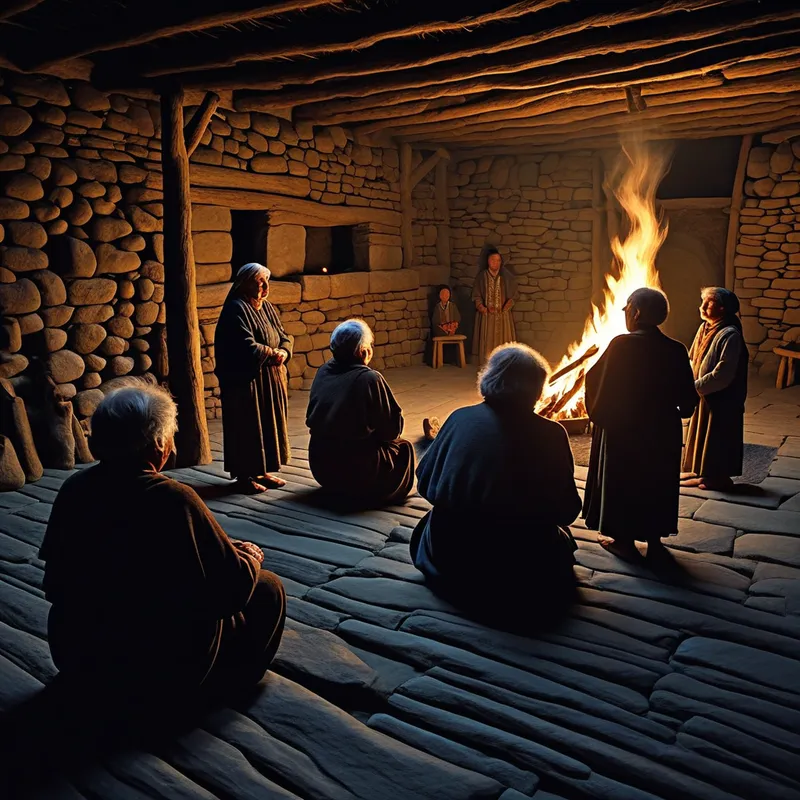
This was the first hearth. And the woman who tended it became the first priestess of its flame. She was known by many names, in many tongues, in the countless clearings of the world. In the frozen North, she was Frigg, spinning fate by the fire’s light. In the sun-baked lands of the Mediterranean, she was Hestia, the still center to whom the first and last offering was always made. Across the sea, she was Vesta, her eternal flame guarded by chosen ones, the heartbeat of an empire. In the ancient Japanese home, she was Kamado no Kami, watching over the rice pot. Among the Slavs, she was the Domovoy, a small, ancestral spirit living behind the stove.
Their tale is not one of epic battles with monsters, but of a relentless, quiet war against the outer chill and the inner void. The conflict was the creeping cold, the despair of hunger, the fear that the light would not return. The rising action was the daily ritual: the feeding of the flame, the grinding of grain by its light, the sharing of stories as its shadows leapt on the walls. The resolution was not a finale, but a sustained note—the warmth in the belly, the safe sleep of a child, the circle of faces made whole by the shared glow. The heroism was in the tending. The magic was in the transformation of raw, cold nature into cooked food, hardened clay, forged metal, and bonded community. The goddess was the hearth, and the hearth was her living body, the navel of the world in every home.
Cultural Origins & Context
This is not a single myth from a single culture, but a primordial pattern etched into the human psyche at the dawn of domestication. The hearth goddess archetype emerged wherever humans transitioned from nomadic survival to settled life, roughly 10,000 years ago. The fixed hearth became the literal and spiritual center of the dwelling—the first altar.
The myth was passed down not in grand epics recited in halls of power, but in the daily, mundane liturgy of the home. It was told by grandmothers showing granddaughters how to bank the coals for the night. It was enacted by fathers kindling the morning fire. Its priests and priestesses were the matriarchs and keepers of the home. In cultures like ancient Rome, the myth was elevated to a state cult with the Vestal Virgins, where the health of the sacred public flame was synonymous with the health of the Republic. In most others, it remained profoundly domestic. Its societal function was foundational: to sacralize the core activities of human survival—cooking, crafting, gathering, and nurturing—and to root the identity of the family or tribe in a tangible, living center. The hearth was the first temple, and its goddess the first deity of belonging.
Symbolic Architecture
The Hearth Goddess is an archetype of immense symbolic density. She represents the axis mundi of the personal world, the still point around which the chaos of life orbits.
The hearth is not merely where the fire is kept; it is where the raw and scattered elements of existence are gathered, subjected to transformative heat, and reconstituted into nourishment and meaning.
Psychologically, she symbolizes the Ego’s Container. Just as the hearth contains the wild, consuming potential of fire and channels it into usable warmth, the ego-structure contains the blazing, chaotic energies of the unconscious and translates them into conscious, livable reality. The goddess is the tending consciousness itself.
The sacred fire symbolizes Transformation Through Limitation. Raw meat becomes food, soft clay becomes pottery, loose ore becomes a tool—all through the contained, focused application of fire. This mirrors the psychological process where raw emotion, trauma, or potential must pass through the "fire" of conscious attention and discipline to become integrated strength, wisdom, or art. The hearth, as a fixed, defined space, also represents Sanctuary and Boundaries. It defines an "inside" from an "outside," creating the psychological condition necessary for introspection, intimacy, and identity formation.

The Dreamer's Resonance
When this myth stirs in the modern unconscious, it often manifests in dreams of houses, with a particular focus on the kitchen or a fireplace. To dream of a neglected, cold hearth—filled with ashes, or boarded up—suggests a profound disconnection from one’s inner center. The dreamer may be experiencing burnout, a loss of passion ("the fire has gone out"), or a feeling of being spiritually "un-homed," adrift without a core identity or safe internal space.
Conversely, dreaming of kindling a fire in a hearth, especially with difficulty or great care, points to an active, somatic process of reigniting one’s vital spark. It is the psyche working to restore warmth, motivation, and a sense of inner purpose. A dream of tending a robust, healthy hearth while others gather round indicates a healthy, functioning ego-structure that is successfully containing and transforming life’s energies, creating psychological nourishment and community for the self and others.
These dreams are not about literal homemaking. They are the psyche’s report on the state of its own central processing unit—the inner sanctum where experience is "cooked" into understanding.
Alchemical Translation
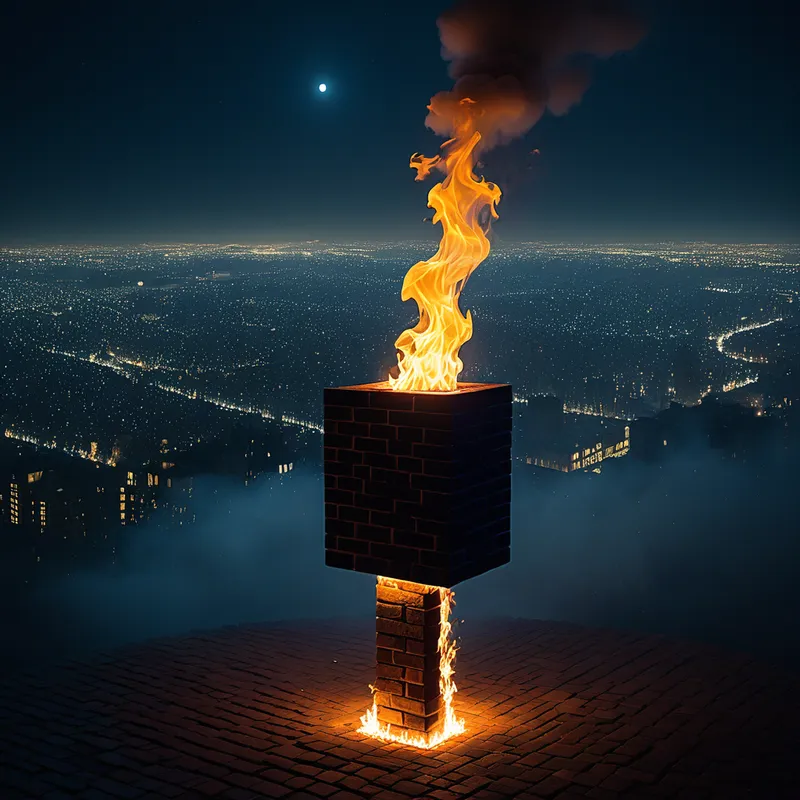
The alchemical journey modeled by the Hearth Goddess myth is the opus of contained calcination. In alchemy, calcination is the process of burning a substance to ashes in a crucible, breaking it down to its essential salts. This is not a destructive wildfire, but a controlled, purposeful fire.
The individuation process requires a crucible—a hearth of the soul—where the base materials of our inherited complexes, personal traumas, and inflated identities can be subjected to the slow, enduring heat of self-awareness until they are reduced to their essential truth.
For the modern individual, this translates to the courageous work of creating and maintaining an inner sanctuary. This is the psychological hearth—a practice of regular introspection, meditation, or journaling where one "tends the fire" of consciousness. Here, the raw events of the day and the chaotic emotions of the unconscious are brought to the hearth. We don't let them rage uncontrolled (a psychological house fire), nor do we smother them (a cold, depressive hearth). We hold them in the container of mindful attention—the goddess’s bowl.
In this sacred inner space, the "cooking" happens. Resentment, through the fire of honest reflection, can be transmuted into the understanding of a boundary needed. Grief, through the sustained heat of compassion, can be alchemized into deeper empathy. Even joy is made more nourishing when fully savored at the hearth of gratitude. The goal is not to become a solitary ascetic, but to become like the Hearth Goddess herself: a stable, warm center capable of transforming primal fuel into sustenance, and thus attracting and nurturing the wholeness of one’s own being and one’s right community. The triumph is not in a single heroic deed, but in the daily, humble, profound return to the flame, ensuring that within us, the light never goes out.
Associated Symbols
Explore related symbols from the CaleaDream lexicon: