Hawaiian Canoe Traditions Myth Meaning & Symbolism
A myth of divine creation, sacred knowledge, and the canoe as a vessel for navigating both the vast Pacific and the deeper currents of the human psyche.
The Tale of Hawaiian Canoe Traditions
Listen. The story does not begin with a man, but with a need. The need was a lament, carried on the salt wind across the empty, heaving breast of Moana. The people of the high green islands were bound, their world a circle of surf and cloud. They dreamed of horizons.
Then came the whisper in the wao akua, the realm of the gods. It spoke to the kahuna kalai waʻa. He entered the forest not with an axe, but with a prayer. He laid his hands upon the trunk of the great koa and listened. The tree spoke of its own journey: from a seed riding the wind to a giant touching the sky. It consented to a greater voyage.
The felling was a ceremony, a birth. The adze, the koʻi, bit into the wood not as destruction, but as revelation. The kahuna saw the canoe sleeping within the log, as a child sleeps within the womb. For days, months, he chanted and carved, his sweat mingling with sawdust, his prayers shaping the curve of the hull. This was not construction; it was a summoning.
But a canoe of one hull is unstable, a mind of one thought. It lists and drowns in the great swells. The vision was incomplete. The answer came from the akua. Kū provided the second great koa. Now, two hulls lay side by side like siblings. Then came the most sacred act: the binding.
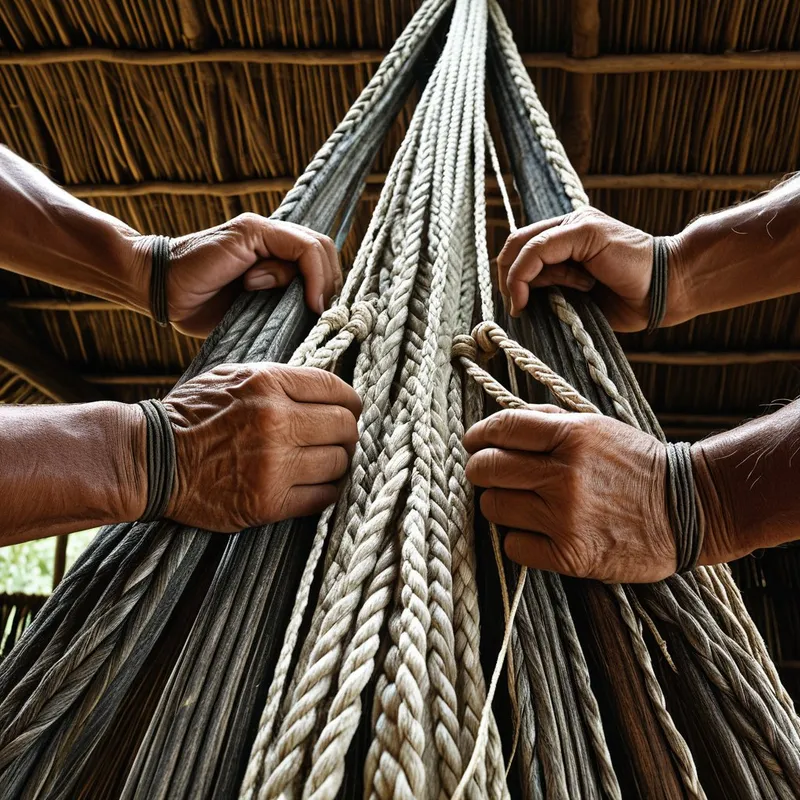
The ʻaha, miles of sennit cord painstakingly braided from the coconut husk, became the sinew of the vessel. Each pass of the cord, each intricate knot, was a prayer for strength, for unity. The two hulls, lashed to the crossbeams, were no longer separate. They became one entity, balanced, resilient, capable of bearing the weight of a people and their future. The canoe, the waʻa, was born—a creature of forest and ocean, of divine inspiration and human hand.
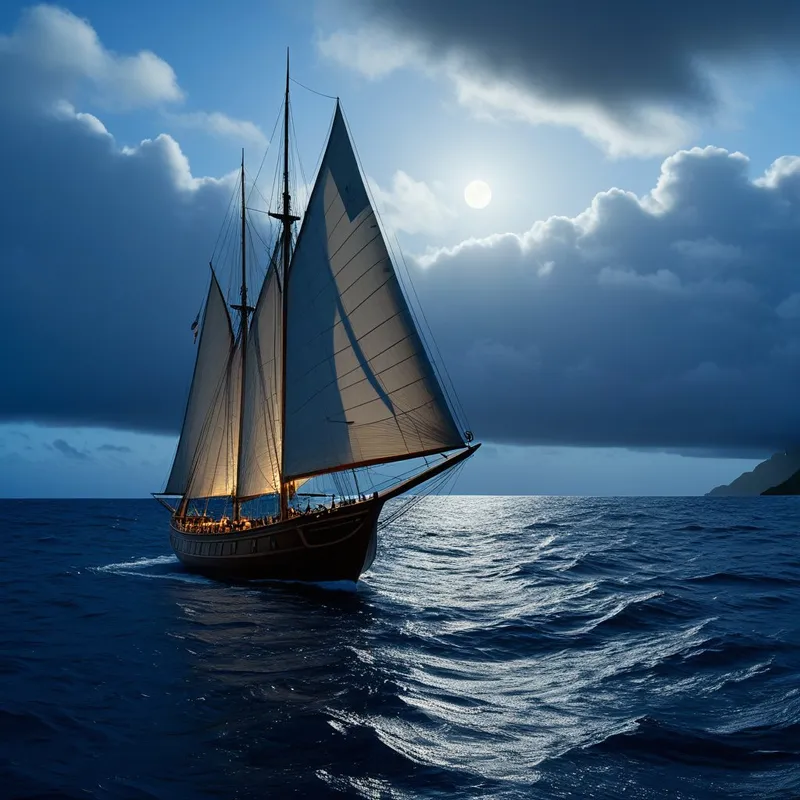
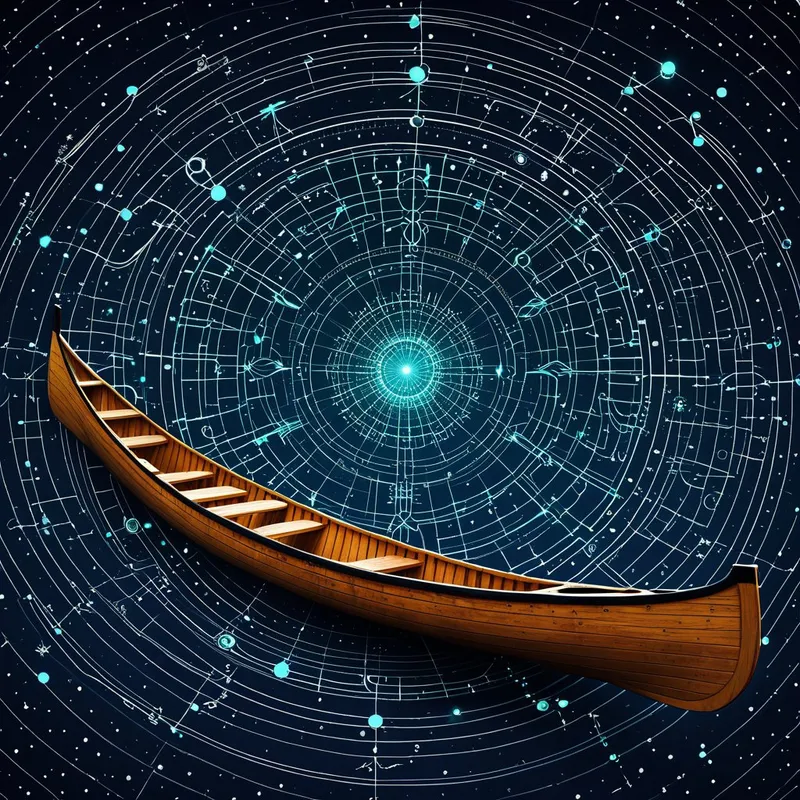
Finally, the hoʻokele approached. He did not look to the empty horizon. He looked up. He memorized the star path of Hōkūleʻa, felt the swell patterns in his bones, watched the flight of the kōlea. He learned the language of the sea. When the sails of woven pandanus caught the wind, the canoe did not simply move. It sang. It became a needle, stitching the separated islands of the world back into the great cloak of Moana. The people were bound no longer.
Cultural Origins & Context
This is not a single myth with one protagonist, but a living tradition—a constellation of stories, chants (oli), and sacred practices that formed the backbone of Polynesian civilization. The knowledge was not held in books but in the hands, voices, and memories of specialized guilds. The kahuna kalai waʻa was both engineer and priest, his work preceded by rituals to Kū. The hoʻokele was a cosmic scientist, his mind a living library of astronomy, meteorology, and oceanography.
The societal function was absolute: survival, expansion, and connection. The voyaging canoe was the spacecraft of the Pacific, enabling the greatest migration in human history. Its creation modeled the ideal society: different elements (the foresters, the craftsmen, the navigators, the sailors) bound together by a common purpose (ʻaha) and vision, navigating a perilous but abundant world. To know the canoe traditions was to know how to live.
Symbolic Architecture
At its core, the mythos of the canoe is a profound symbol of the constructed psyche. The raw, unconscious material (the great koa log) is not enough. It must be consciously shaped by disciplined effort (the koʻi) and sacred intent.
The single hull is the ego, alone and unstable on the seas of the unconscious. The second hull is the neglected self, the shadow, or the deep instinct. Wholeness is not found in choosing one, but in the sacred binding of the two.
The ʻaha represents the ego function—not as a ruler, but as a connector. It is the conscious attention, the will, and the enduring patience that binds opposing forces into a functional unity. The canoe itself becomes a symbol of the Self, the complete personality that can undertake the great journey. It is a vessel crafted from both nature (wood) and culture (knowledge), capable of navigating the unknown.
The hoʻokele's art symbolizes oriented consciousness. He does not control the ocean (the unconscious), but he learns its language. He navigates by the fixed stars (transpersonal guiding principles, archetypes) while reading the ever-changing waves and winds (the immediate contents of the psyche).
The Dreamer's Resonance
When this mythic pattern stirs in modern dreams, it often signals a profound process of psychic construction or re-orientation. Dreaming of building a boat, especially one that feels sacred or ancient, suggests the dreamer is in the process of crafting a new structure for their life or identity from raw, inner material.
A dream of being on a canoe, particularly if it is a double-hulled voyaging canoe, may speak to a newfound—or desired—balance. Perhaps two major life domains (work and home, logic and intuition) are being successfully lashed together. Conversely, a dream of a canoe breaking apart or being adrift may reflect a feeling that one's life structure is failing, that the binding ʻaha of purpose has frayed.
Dreams of navigating a vast, featureless ocean mirror the existential condition of modern life. The appearance of a hoʻokele figure, or the sudden ability to read the stars, points to the emergence of an inner guiding function, an intuitive wisdom that knows the way even when the path is not visible.
Alchemical Translation
The alchemy here is one of conjunction and navigation. The prima materia is the unshaped potential of the self, the "great log" of our innate being. The first stage (nigredo) is the felling—the often-painful realization that our current form is insufficient for the journey ahead, that we must be shaped.
The carving (albedo) is the long, meticulous work of self-examination and discipline, clarifying who we are. But the crucial, transcendent phase (rubedo) is the binding. This is the integration of opposites: conscious and unconscious, masculine and feminine, thinking and feeling, individual and collective.
The goal is not to become a perfect, polished hull, but to become a seaworthy vessel. The test of the alchemy is not in the harbor, but in the open sea.
Finally, the navigator's art represents the individuated consciousness in action. It is the ability to hold a course toward one's own North Star (the Self's purpose) while adapting to the constant flux of life's conditions. One learns to trust the deep, non-rational knowledge—the feel of the swell, the path of the bird, the ancient star map etched in the soul. The myth teaches that we are all both the kahuna kalai waʻa building our vessel and the hoʻokele steering it across the inner Moana, bound for horizons our waking minds have yet to imagine.
Associated Symbols
Explore related symbols from the CaleaDream lexicon: