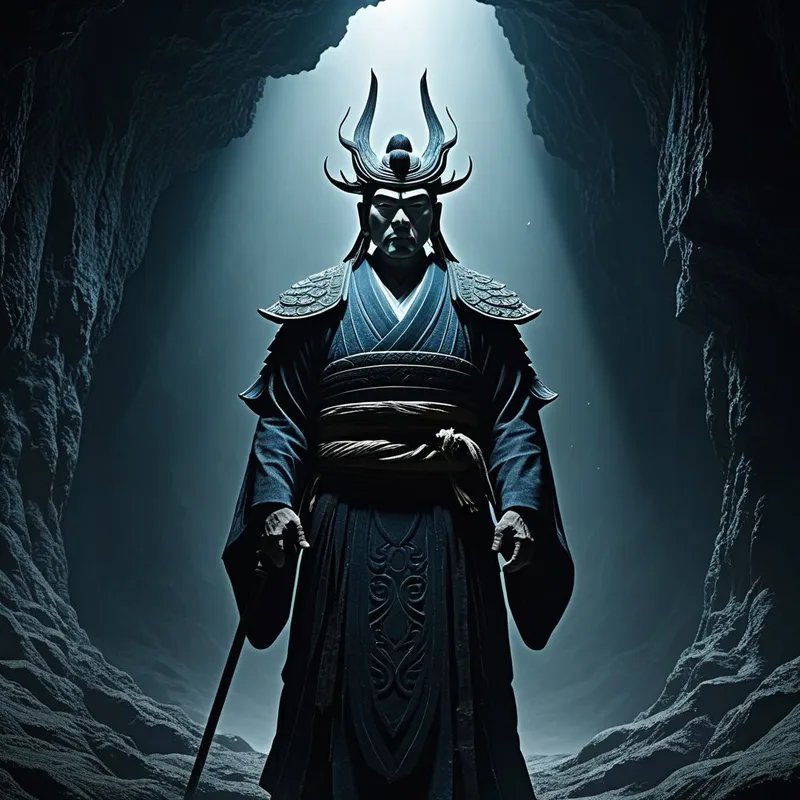
Hara Myth Meaning & Symbolism
A myth of divine transgression, cosmic pollution, and the ultimate purification that births the sacred landscape of Japan.
The Tale of Hara
Listen, and hear the story of the first great sorrow, the first great cleansing, the birth of the land from a god’s grief.
In the time when the heavens were fresh and the earth was young and unformed, the divine pair, Izanagi and Izanami, stirred the brine of the sea with a jeweled spear. From the droplets that fell, the eightfold islands of Japan were born. They walked this new land, and from their union came the kami of wind, of mountains, of rivers, and of the green things that grow. But in giving birth to the kami of fire, Kagutsuchi, Izanami was burned terribly. She descended into the land of Yomi, the shadowy underworld, and was lost to the world of light.
Izanagi’s heart was a stone in his chest. He could not bear the silence of the world without her. Driven by love and a terrible longing, he journeyed to the very root of things, to the entrance of Yomi, a gaping cavern that breathed out a chill of decay. He called into the darkness, “My beloved! The lands we have made are not yet finished. Return with me!”
From the depths, her voice echoed, faint as a memory. “You have come too late, my lord. I have eaten of the hearth of Yomi. To return now would defile all you have made.” But Izanagi pleaded, and at last, Izanami bid him wait while she pleaded with the kami of Yomi. “Do not look upon me,” she warned.
Time stretched in that lightless place. Fear, that cold serpent, coiled in Izanagi’s belly. What if the rulers of Yomi held her? What if she was changed? Unable to bear the uncertainty, he broke off a tooth from the comb in his hair, lit it as a torch, and pushed into the chamber.
The flame revealed her. Izanami was there, but not as he remembered. Her fair form was swollen and rotting, host to the Eight Thunders, which writhed and growled within and upon her. The sight was an abomination, a violation of all that was pure and ordered. Izanami shrieked in shame and fury. “You have seen my defilement! You have shamed me!” She commanded the Yomotsu-shikome, the ugly women of Yomi, to chase him.
Terror gave wings to Izanagi’s feet. He fled back through the caverns, the shrieking hounds of Yomi at his heels. He threw down his headdress—it became grapes, which they stopped to devour. He threw down his comb—it became bamboo shoots, which delayed them further. But still, Izanami herself pursued, a tide of corruption and wrath.
He reached the boundary, the Yomotsu-hirasaka, and heaved a great boulder to seal the pass, forever dividing the living from the dead. From the other side of the stone, Izanami’s voice, now filled with a bottomless grief and rage, promised to strangle a thousand of his people each day. Izanagi, his own heart breaking, declared he would cause fifteen hundred to be born each day.
Exhausted, polluted by his contact with death, Izanagi knew he was tainted. He must be cleansed. He came to a river mouth at Ahakihara in Tachibana and stripped his garments. He entered the waters. And from the acts of his purification, from the items he cast off and the parts of his body he washed, new and mighty kami were born. From the mist of his breath, from the water in his eye, from the washing of his nose, three of the most central deities of the Shinto pantheon came into being: Amaterasu, the resplendent sun; Tsukuyomi, the lord of the night; and Susanoo, the wild and turbulent storm.
Thus, from the profound pollution of grief and the underworld, through the sacred act of harae, the world was not merely cleansed, but enriched and completed by deities of even greater power and luminosity.

Cultural Origins & Context
This narrative, known as the myth of Izanagi and Izanami and culminating in the Harae of Izanagi, is recorded in Japan’s oldest chronicles, the Kojiki (712 CE) and the Nihon Shoki (720 CE). These texts were commissioned by the imperial court to establish a divine lineage for the sovereign, tracing it back to Amaterasu, born from this very purification.
The myth served a foundational societal function. It established the ontological primacy of purity (harae) and pollution (kegare). Death was the ultimate kegare, and the myth provided a divine precedent for the elaborate purification rituals that became, and remain, central to Shinto practice. It was not a story told merely for entertainment, but a sacred charter that explained why rituals of cleansing were necessary for both individuals and the community to maintain harmony with the kami and the natural world. The priests (kannushi) and ritualists were the custodians of this narrative, re-enacting its principles in every act of misogi and haraigushi.
Symbolic Architecture
At its core, this is a myth about the unavoidable encounter with the shadow of existence—death, decay, and the corrupted aspects of love—and the transformative power of confronting and purifying that encounter.
Izanagi’s journey to Yomi represents the conscious ego’s descent into the personal and collective unconscious, a realm where what was once loved and life-giving (Izanami as creatrix) has become terrifying and disintegrated. His transgression—looking when forbidden—is the psychological necessity of seeing the repressed truth, however ugly. One cannot integrate what one refuses to see.
The pollution of Yomi is not evil, but a fundamental truth of existence: all things cycle through life, death, and decay. To deny this cycle is to live in illusion; to be overwhelmed by it is to be trapped in despair.
The frantic flight is the psyche’s instinctive recoil from this overwhelming content. But the myth insists that flight is not enough. One reaches a boundary (the great boulder) where a separation must be made. This is the act of conscious differentiation: “This (death, decay, unconscious identification) is not me. I choose the world of light and generation.” Yet, the encounter leaves a stain. The subsequent Harae is the critical, alchemical stage. It is not a simple washing away, but a creative dissolution. The polluted self is broken down in the waters of the unconscious (the river), and from its very substance, new, more complex and potent psychic forces are born—the solar consciousness of Amaterasu (clarity, order), the reflective nature of Tsukuyomi (introspection), and the chaotic, creative energy of Susanoo (the unruly life force).

The Dreamer's Resonance
When this myth stirs in the modern dreamer, it often manifests as a profound somatic experience of defilement followed by a compulsive need for cleansing. The dreamer may find themselves in a decaying, labyrinthine place (a forgotten basement, a murky swamp) pursued by a shapeless horror or a corrupted version of a loved one. The feeling is one of visceral pollution—skin crawling, a sense of being stained by a guilt or grief that feels ancient and inescapable.
This dream pattern signals that the psyche is processing a deep encounter with its own “Yomi”—perhaps a traumatic memory, a buried grief, a shameful act, or the shocking recognition of mortality or failure in oneself or another. The pursuit is the psychological content demanding integration; it will not stay repressed. The dreamer is in the stage of Izanagi’s flight. The healing comes when the dream narrative allows for, or the waking mind initiates, a symbolic act of harae. This might appear in the dream as finally reaching a cleansing waterfall, stripping off filthy clothes, or even a simple, powerful image of clear, running water. The body often leads the way out of such states, craving literal showers, swims in natural bodies of water, or rituals like mindful bathing, signaling the psyche’s innate drive toward purification and renewal.

Alchemical Translation
For the individual on the path of individuation, the myth of Hara provides a master blueprint for psychic transmutation. The process is not one of avoiding darkness, but of navigating it ritually to recover a greater wholeness.
First, there is The Descent: One must willingly, or by life’s circumstances, enter into contact with one’s own shadow—the unlived life, the repressed anger, the unprocessed loss. This is the visit to Yomi. Then comes The Unveiling: the painful, often shameful recognition of what that shadow contains. Like Izanagi lighting his torch, consciousness turns toward what has been hidden. This sight triggers The Chaos of Recoil: a period of psychological turmoil, anxiety, or depression—the flight from the pursuing furies. The ego feels besieged by unconscious content.
The alchemical key is the next step: The Ritual Boundary. One must consciously enact a separation, saying, “This experience happened to me, it is part of my story, but it does not define my essential being.” This is the boulder at Yomotsu-hirasaka. Finally, and most crucially, is The Creative Purification.
The goal is not to return to a naive innocence before the descent, but to dissolve the experience in the waters of deep reflection and emerge reconstituted, with new faculties born from the ordeal itself.
This is the harae. In psychological terms, it is the sustained work of therapy, journaling, art, or meditation that does not seek to erase the painful encounter, but to metabolize it. From the washed “pollution” of grief, one might find a newfound compassion (a caregiver archetype). From the integration of shame, a more authentic voice (a creator). From the accepted chaos, a resilient vitality (an explorer). The myth assures us that our deepest defilements, when confronted with courage and ritually processed, contain the very seeds of our greatest strengths and our most luminous consciousness. The sun goddess herself is born from a god’s cleansed tear.
Associated Symbols
Explore related symbols from the CaleaDream lexicon: