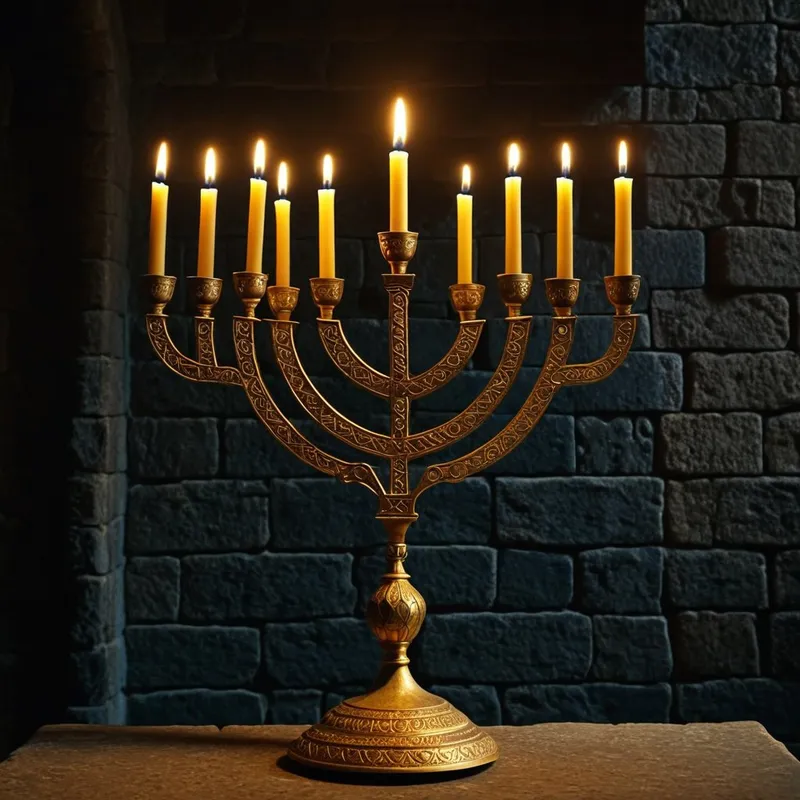
Hanukkah Miracle Myth Meaning & Symbolism
A small cruse of sacred oil, meant for one day, burns for eight, symbolizing the miraculous endurance of identity and spirit against overwhelming forces.
The Tale of the Hanukkah Miracle
Listen, and let the darkness gather close. For this is not a tale of sunlit fields, but of shadows that sought to swallow a people whole.
The air in Judea was thick with the smoke of foreign altars. The great Holy Temple in Jerusalem, the beating heart of a nation, stood violated. Not by siege, but by a more insidious conquest. The statues of foreign gods leered from its sacred courts. The air, once fragrant with the incense of devotion, now reeked of sacrificed swine—a deliberate defilement meant to break the spirit, to extinguish the unique flame of a people. This was the work of the Seleucid King, whose decree was not merely political, but spiritual annihilation: Assimilate. Forget. Vanish.
But in the hills, a fire refused to die. It was not a bonfire, but a smoldering ember in the hearts of a family—the Hasmoneans, led by Judah the Hammer. Theirs was a desperate, guerilla war, not for land alone, but for the soul. They fought the glittering, overwhelming armies of assimilation with little more than ragged faith and fury. And against all odds, they prevailed. The foreign idols were toppled, the gates of the Temple breached once more by its own children.
Yet, the victory felt hollow in the cavernous, desecrated silence of the Sanctuary. The great Menorah, symbol of divine wisdom and national consciousness, lay dark, its golden branches cold. To rekindle it was the first act of rededication—Hanukkah itself. But they searched the ravaged storerooms and found only chaos. Then, in the debris, a single, small clay cruse of oil was discovered. It was sealed with the unbroken stamp of the High Priest, pure and untouched by the profanation. But it was enough for only one day. The process to prepare new, ritually pure oil would take eight.
Here, in that moment of crushing paradox—triumph laced with impending despair—the choice was made. They would light it anyway. With trembling hands, they poured the scant oil, lit the wicks, and watched the flame catch. It was a gesture of defiant hope, a commitment to light one candle in the overwhelming dark, even if it was destined to gutter and die by morning.
But the flame did not die. It burned, clear and steady, through the first night, and the second. It burned for eight full nights, a duration beyond nature, beyond reason. In that sustained, impossible light, the darkness of the Temple was not just dispelled; it was transformed. The single cruse had become a wellspring. The act of faith had summoned a response from the depths of existence itself. The miracle was not a spectacle in the sky, but a quiet, persistent yes echoing in the heart of a reclaimed home. The light lasted just long enough for the new light to be made.
Cultural Origins & Context
The story emerges from the historical crucible of the 2nd century BCE, a period of intense cultural collision between Hellenism and Jewish tradition. The primary source is the Books of the Maccabees, preserved not in the Hebrew Bible but in the Catholic and Orthodox Old Testament. Interestingly, the Talmud, the central text of Rabbinic Judaism, focuses almost exclusively on the miracle of the oil, while the military victory of the Maccabees is given less emphasis.
This shift in focus is profoundly telling. The rabbis of the Talmudic era, living under Roman rule, were less interested in glorifying armed rebellion and more in articulating a spiritual principle for a people in diaspora. The myth was passed down not as a call to arms, but as a paradigm for spiritual survival. Its societal function was, and remains, to answer a perennial question: How does a small, distinct people maintain its identity and inner light against the pressures of a dominant, often hostile, culture? Hanukkah became the festival that models the answer: through unwavering dedication (Hanukkah means dedication) to one's inner truth, and the trust that such dedication calls forth sustenance from unseen dimensions.
Symbolic Architecture
At its core, the myth is an archetypal drama of consciousness besieged by the unconscious, of identity threatened by assimilation. The Temple is not just a building; it is the temenos, the sacred inner sanctuary of the Self. Its desecration represents a state of psychic colonization, where foreign complexes (Hellenistic values, in this case) have overrun the ego's central authority, demanding the suppression of one's authentic nature.
The miracle is not that light defeats darkness, but that a tiny, focused flame of consciousness, once lit with pure intent, discovers it is connected to an infinite source.
The single cruse of oil symbolizes the seemingly inadequate resources of the ego. It is our limited willpower, our fragile faith, our small, pure core of intention that feels insufficient for the long journey of healing or individuation. The eight days transcend the cycle of the mundane week, pointing to a reality beyond ordinary cause and effect—the realm of the Self, the transcendent totality of the psyche. The act of lighting with only one day's supply is the ultimate psychological gamble: committing to the process of becoming whole, even when you cannot see the path to completion.
The Dreamer's Resonance
When this mythic pattern stirs in the modern dreamer, it often manifests as dreams of finding a precious, hidden resource in a ruined or cluttered place. One might dream of discovering a single, working lightbulb in a derelict house, or a clean spring in a polluted landscape. Somatically, this can coincide with a feeling of profound exhaustion paired with a sudden, inexplicable surge of energy or clarity—the "second wind" in a life struggle.
Psychologically, this dream signals a critical juncture in a process of individuation or recovery. The dreamer is in a state of "re-dedication"—perhaps after a period of burnout, depression, or moral compromise. The ego has cleaned out the "temple" of bad habits or toxic influences but feels depleted, unsure it has the stamina to maintain the new, healthier state. The dream assures that the initial, pure commitment itself activates a deeper, sustaining energy from the Self. It is the psyche's way of saying, "You have done the hard work of clearing the space. Now light the light. The endurance will be provided."
Alchemical Translation
The alchemical process mirrored here is the multiplicatio—the miraculous multiplication of substance. The base material (the mundane self, the desecrated temple) undergoes a separatio (the Maccabean revolt, clearing out foreign impositions) and a purificatio (cleansing the Temple). But the climax is not in the fighting or the cleaning; it is in the humble, faithful application of the prima materia, the pure, hidden oil of one's essential nature.
The oil burns not by its own quantity, but by its quality of connection. So too, the individual psyche endures not by egoic willpower alone, but by aligning its small flame with the eternal light of the Self.
For the modern individual, the Hanukkah myth models the path of psychic transmutation through dedication to a seemingly impossible standard of inner truth. We are all, at times, Judah Maccabee, fighting the internalized voices of cultural expectation that demand we extinguish our unique flame. We are all the priests, searching the rubble of our disappointments for that one sealed cruse of pure intention. The miracle occurs in the daily re-lighting. It is the practice—the eight nights, the sustained commitment—that alchemically transforms the "one day's worth" of courage into a lasting state of illuminated being. We do not become giants who need no light. We become vessels who, through dedicated action, discover we are forever connected to the source of all light.
Associated Symbols
Explore related symbols from the CaleaDream lexicon: