Haka Origin Myth Meaning & Symbolism
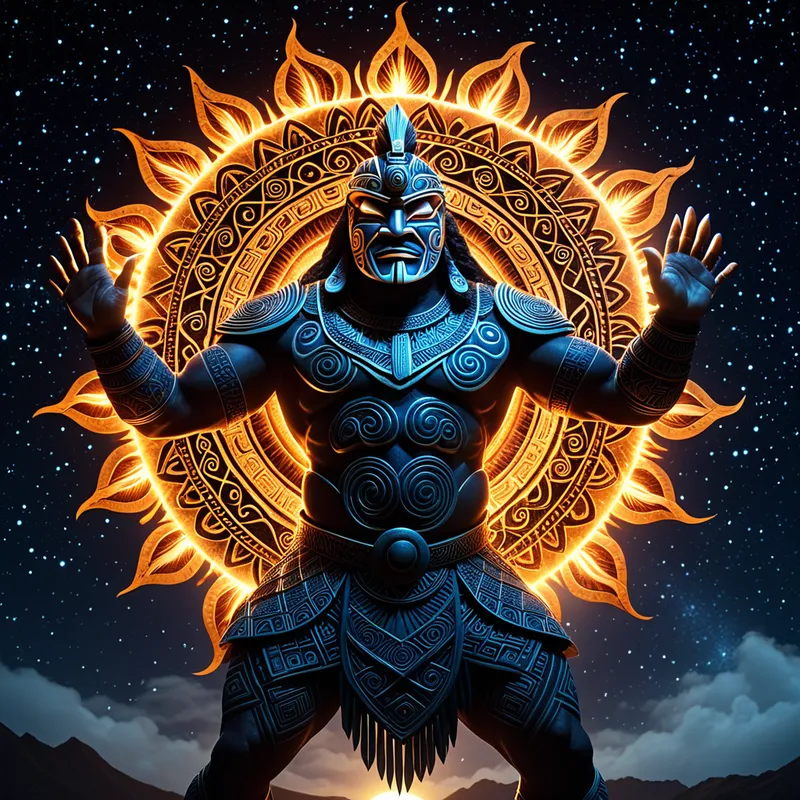
The myth of Haka's origin tells of the sun god Tama-nui-te-rā, whose fiery energy is embodied in the first, life-affirming war dance.
The Tale of Haka Origin
Listen. Before the world settled into its rhythms, when the sky was a raw canvas and the earth still breathed its first deep sighs, there lived the sun, Tama-nui-te-rā. He was not a distant ball of fire, but a being of immense, restless energy. Each day, he strode across the vault of Ranginui, his heat a blanket, his light a spear. And each night, he descended into the embrace of Papatūānuku, the earth, to rest.
But his journey was not gentle. His passage was a trial, a daily battle against the clinging mists and the cool, deep shadows of the world. His energy was so vast, so untamed, that it threatened to scorch the land bare or be swallowed whole by the damp dark. He needed a vessel, a rhythm, a form to contain his fury and his gift.
One evening, as he sank toward the western edge of the world, his light caught the form of a woman on the shore. This was Hine-raumati, the Summer Maid. She did not flinch from his gaze. Instead, she began to move. Her feet stamped upon the sand, not in anger, but in a powerful, welcoming cadence. Her hands slashed the air, carving patterns of acceptance. Her eyes were wide, her tongue thrust forth in a challenge that was also an invitation. Her voice rose not in a song, but in a deep, guttural chant—a karanga of the body.
She was dancing the very essence of his heat, the pulse of his light, the struggle of his daily death and rebirth. In her movements, Tama-nui-te-rā saw his own power reflected, not as destruction, but as life. He saw the tension between sky and earth, fire and water, light and dark, given form and sound. Hine-raumati’s dance was a conduit. It did not diminish his energy; it focused it, made it conscious, made it communicable.
From that twilight union of celestial fire and earthly presence, the first Haka was born. It was not invented; it was revealed. It was the sun’s own vital force, mana, and his relentless daily struggle, captured in the human frame. The stomp echoed his footfall across the heavens. The slapped thighs were the crack of his heat on the land. The bulging eyes (pūkana) mirrored his own blazing gaze. The thrust tongue (whetero) was the final, defiant gesture against the night. This was the primal template: a ritual of immense life force, acknowledging the shadow of death to affirm existence itself.

Cultural Origins & Context
This origin story is part of the vast, living tapestry of whakapapa and pūrākau. It was not a performance for outsiders but a foundational truth held within the hapū and iwi, passed down by kaumātua and tohunga. Its telling was an act of transmitting mana and identity.
The Haka’s function was, and is, multifaceted. It was a war dance (peruperu) to unify warriors, summon collective courage, and intimidate foes with the displayed mana of the group. It was also a ritual of welcome (powhiri), a celebration of life at weddings, and a profound farewell at tangihanga (funerals), where it served to express grief, honor the dead, and fiercely affirm the continuity of life in the face of loss. In every context, it was a physical manifestation of the group’s spirit, history, and connection to the cosmic drama of its origins.
Symbolic Architecture
At its core, the myth presents Haka as the alchemical vessel for raw cosmic energy. Tama-nui-te-rā represents the undifferentiated, potentially destructive life force—the libido or primal psychic energy of Jungian psychology. Hine-raumati represents the conscious human vessel—the ego and the body—that can receive, shape, and express this force without being consumed by it.
The dance is the crucible where the fire of the unconscious is tempered by the form of consciousness.
The Haka ritualizes the ultimate human paradox: we are mortal creatures (Papatūānuku) who contain a spark of the immortal and divine (Tama-nui-te-rā). The fierce expressions are not merely for an enemy; they are a confrontation with our own limitations, our mortality, and the vast, often terrifying, energies within us. The coordinated group movement symbolizes the necessity of culture, tradition, and community to safely channel these potent forces. The Haka makes the invisible mana visible, giving intangible spirit a tangible, thundering form.
The Dreamer's Resonance
When this mythic pattern stirs in the modern dreamer, it often signals a confrontation with one’s own raw, undirected power or rage. To dream of performing a haka, or seeing one performed in a charged, personal setting, points to a somatic and psychological process of integration.
The dreamer may be experiencing a surge of creative energy, long-suppressed anger, or a passionate life force that feels too big, too dangerous, for polite daily life. The body in the dream becomes the dance floor for this conflict. The stomping feet may correlate with a need for grounding, for connecting this rising energy to the earth of one’s reality. The shouted chant is the voice finally finding its tone, moving from internalized whisper to externalized declaration. This dream is the psyche’s attempt to create its own ritual vessel—its own Haka—to hold and direct a powerful emerging content of the unconscious, preventing it from manifesting as uncontrolled outburst or somatic illness.
Alchemical Translation
For the individual on the path of individuation, the Haka origin myth is a masterclass in psychic transmutation. The “sun god” energy is analogous to the powerful, often chaotic, drives of the unconscious—the shadow, the animus/anima, the Self. Left untended, this energy can “scorch” the conscious personality (inflate the ego) or be “swallowed by the dark” (lead to depression, enervation).
Individuation is not the elimination of one’s inner fire, but the learning of its sacred dance.
The alchemical work is to become Hine-raumati. One must develop the conscious capacity (the “dance”) to face this inner sun, to not flinch from its heat, but to meet it with form and rhythm. This involves giving structured expression to powerful emotions through art, ritual, physical exertion, or conscious dialogue with the unconscious (e.g., active imagination). The pūkana (fierce face) is the courage to look at what is within. The whetero (thrust tongue) is the defiant affirmation of one’s right to exist and express, even in the face of inner or outer critics. The collective rhythm translates to integrating these personal energies into one’s social roles and relationships in a healthy, empowered way. The result is not a pacified self, but a potentiated self—a person whose vital force is fully owned, channeled, and alive.
Associated Symbols
Explore related symbols from the CaleaDream lexicon:
- Sun — The undifferentiated life force, cosmic energy, and conscious will that must be ritualized and integrated, as embodied by Tama-nui-te-rā.
- Dance — The sacred form and rhythmic practice that channels primal energy into conscious expression, transforming chaos into communicative power.
- Fire — The raw, transformative, and potentially destructive energy of the spirit and emotion that the Haka seeks to contain and direct.
- Ritual — The prescribed, communal form that safely mediates between the individual and the overwhelming powers of the cosmos and the unconscious.
- Warrior — The archetype of courage, discipline, and focused power required to face inner and outer challenges, central to the Haka's spirit.
- Mountain — The enduring strength, connection to ancestors (mana), and unshakable presence embodied in the firm, grounded stance of the performers.
- Shadow — The dark, fearsome aspects of the self and the inevitability of death that the Haka directly confronts and integrates through its fierce performance.
- Thunder — The audible, shocking manifestation of power and presence, mirroring the stomping feet and shouted chant that announce one's existence.
- Heart — The center of courage, passion, and life force that is physically slapped and rhythmically activated during the performance.
- Origin — The myth points to a foundational, primal moment where human expression and divine energy became one, defining a cultural and psychic genesis.
- Rebirth — The Haka enacts the daily rebirth of the sun, symbolizing the cyclical triumph of life over death, energy over entropy, in every performance.
- Pride — The fierce, collective affirmation of identity, lineage, and spiritual power that is the emotional core of the Haka's challenge.