Griffins of the Hyperboreans Myth Meaning & Symbolism
A tale of sacred gold guarded by griffins in a land beyond the north wind, where Apollo dwells and mortals seek a treasure that is not theirs to take.
The Tale of Griffins of the Hyperboreans
Listen, and hear of a land that lies beyond the reach of mortal maps, beyond the fury of the North Wind himself. This is Hyperborea. Here, the sun’s chariot lingers, and the air is forever sweet with the scent of blooming asphodel. It is the sacred precinct of Apollo, where he retreats in the deep winter of our world, and where his favored people live in bliss, free from toil, age, and strife.
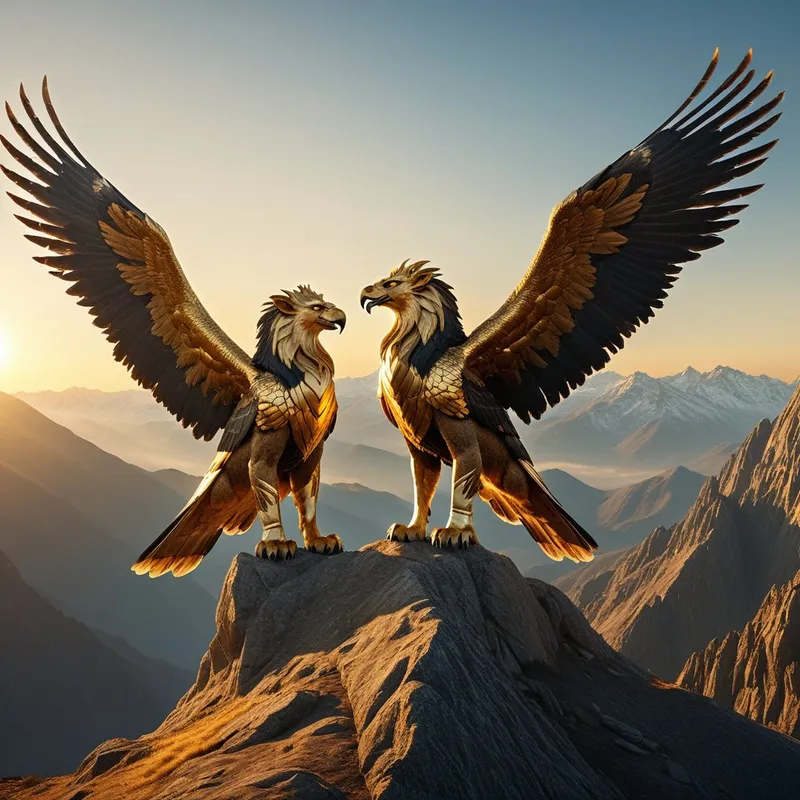
But on the fringes of this paradise, where the blessed plains rise into the jagged teeth of the Rhipaean Mountains, a different kind of watch is kept. Here dwell the guardians. Not men, not gods, but creatures born of earth’s most potent essences: the Griffins. Their bodies are tawny lions, mighty and terrestrial; their heads and wings are of the eagle, sovereigns of the sky. Their eyes are like chips of amber, seeing with a clarity that pierces both shadow and deceit. And what they guard is the very marrow of the sun: veins of gold that run through the stone, glittering like frozen light.
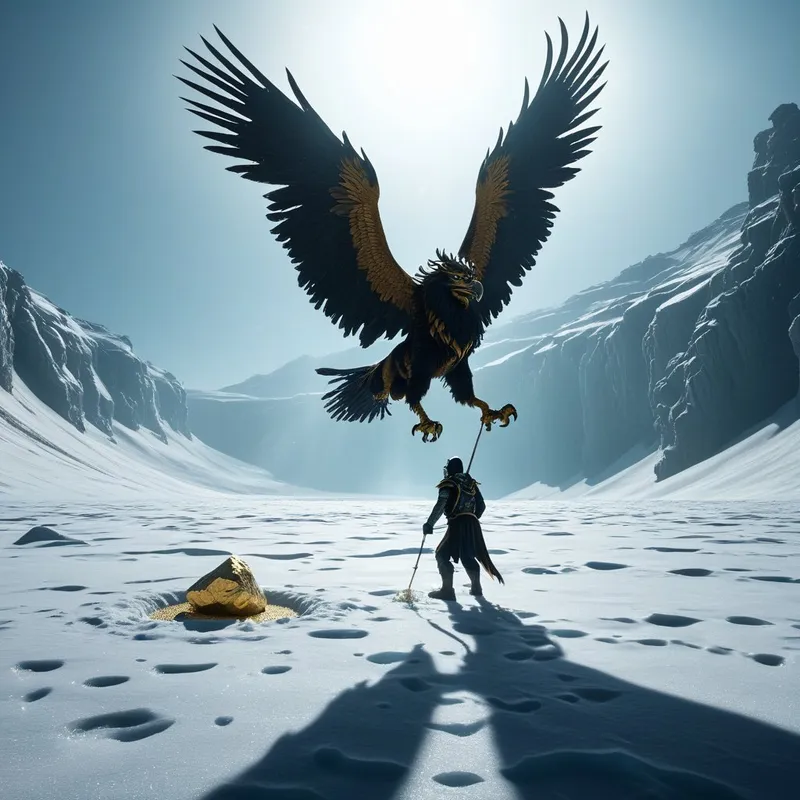
From the south, beyond the mountains, comes the covetous murmur. The Arimaspians, a race of men with a single eye set in the center of their foreheads, have heard the tales of this gold. Their vision is narrow, focused only on possession. They are master horsemen, and in the dead of night, or under the grey cloak of a storm, they would ride. The thunder of their horses’ hooves would echo in the passes, a profane drumbeat against the sacred silence.
Then would come the answering cry—a sound that was neither roar nor shriek, but a terrifying fusion of both, a vibration that shook the snow from the peaks. The Griffins would descend. A blizzard of feathers and fury, talons like curved swords, beaks that could snap spear-shafts of oak. The battles were swift, brutal, and absolute. The gold remained, speckled with frost and untouched, where it lay. The Arimaspians, those who survived, would retreat, their numbers fewer, their obsession undimmed. The cycle was as eternal as the seasons: the desire, the assault, the fierce, feathered justice. The gold was not a treasure to be owned, but a testament to be witnessed, a boundary stone between the possible and the divine. It was the sun’s own hoard, and the Griffins were its unwavering, terrible priests.
Cultural Origins & Context
This myth reaches us not as a single, cohesive epic, but as fragments of awe and speculation from the edges of the known world. Our primary sources are the adventurous historians and geographers like Herodotus and the poetic naturalist Pseudo-Aristotle, who collected travelers' tales from the far north. The story functioned as a brilliant piece of speculative ethnography and natural philosophy. For the Greeks, the Hyperboreans represented the ultimate "Other"—a people living in a perfected state, mirroring the Golden Age. The Griffins and their conflict with the Arimaspians explained several mysteries: the origin of Scythian gold, the strange creatures reported by nomadic traders, and the inherent danger of transgressing into lands belonging to the gods.
It was a border myth in every sense. It defined the limits of human ambition and the sanctity of divine space. The tale was likely told in symposia and by logographers, less as a religious doctrine and more as a wondrous "what if?" that reinforced Greek cosmological ideas. It placed their god Apollo in a specific, albeit unreachable, geography and populated the blank spaces on their maps with creatures that embodied the fierce purity of the elements they bridged: earth (lion) and air (eagle).
Symbolic Architecture
The myth is a perfect, stark diagram of a sacred boundary. Each element is a symbol in a profound psychological and cosmic equation.
The Hyperborea itself is the archetypal Self, the state of integrated being. It is wholeness, peace, and alignment with divine principle (Apollo). It is not a place to be conquered, but a state to be approached with reverence.
The gold is not wealth; it is solidified meaning, the luminous core of the psyche that cannot be seized, only earned through transformation.
The Griffins are the magnificent guardians of this inner sanctum. Psychologically, they represent the synthesized power of instinct (the lion) and spirit (the eagle). They are the protective, often fierce, function of the psyche that guards the nascent, vulnerable Self from premature exposure or crude exploitation. They are not evil; they are necessary. Their violence is the psyche's immune response to psychic theft.
The Arimaspians, with their single eye, symbolize one-sided consciousness. They are pure desire, pure ambition, devoid of the binocular vision needed for wisdom. Their cyclopean gaze sees only the object (the gold), not the context (its sacredness), the guardian, or the consequences. They represent the ego's attempt to raid the treasures of the unconscious for its own aggrandizement, without undertaking the required journey of integration.
The Dreamer's Resonance
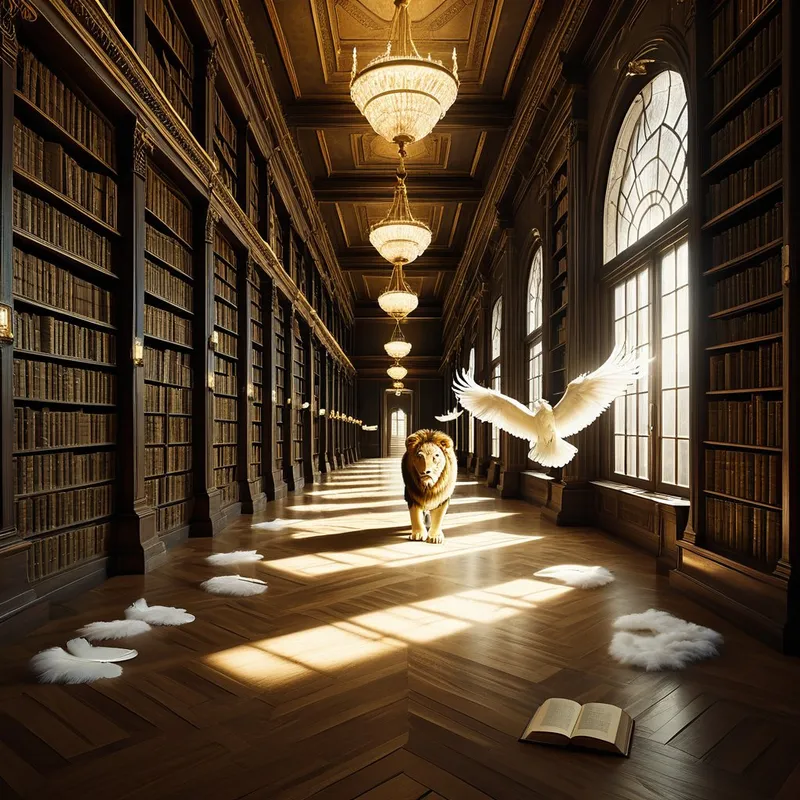
When this myth stirs in the modern dreamer, it often manifests as a profound sense of tantalizing proximity to something vitally important, coupled with an equally powerful sense of prohibition or danger. You may dream of a breathtakingly beautiful landscape—a pristine garden, a silent library, a sunlit temple—that holds a central, glowing object of immense value. As you move to touch it or take it, a sudden, overwhelming force intervenes. It might be a sudden storm, the growl of an unseen beast, the ground giving way, or the arrival of a formidable, hybrid creature.
Somatically, the dreamer often awakens with a racing heart, a feeling of awe mixed with terror, or a deep, frustrated longing. Psychologically, this indicates that the conscious mind (the Arimaspian rider) is nearing a core, Self-related content—a talent, a memory, a truth, a creative spark (the gold). However, the approach is all wrong. It is acquisitive, not receptive; entitled, not humble. The guardian griffins of the psyche activate to block this crude approach, forcing the ego back. The dream is a message: The treasure you seek is real, but the path you are on will lead only to conflict and dismemberment. You must change your approach.
Alchemical Translation
The individuation process modeled here is not one of heroic conquest, but of recognized relationship. The goal is not to slay the griffin and plunder the gold. That is the path of inflation and psychic disaster. The alchemical work is to transform the Arimaspian ego.
First, the ego must be humbled. Its one-eyed, raiding stance must fail repeatedly. This failure is not punishment but initiation. It forces a crisis: continue the futile assault, or stop and truly see.
Second, the ego must learn to behold the guardian not as an enemy, but as a constituent part of the wholeness it seeks. The lion’s strength and the eagle’s vision are qualities the ego itself lacks. The task becomes one of integration, not defeat. Perhaps the seeker learns to still the horse of impulsive action. Perhaps they offer something—not a bribe, but a sign of respect—like music for Apollo, or an admission of limitation.
The transmutation occurs when the desire to have is replaced by the willingness to be in relation to. The gold then ceases to be an external object and begins, slowly, to illuminate the seeker from within.
Finally, the boundary itself transforms. It is no longer a forbidden wall, but the threshold of a sanctuary. The griffin, recognizing the change in consciousness, may step aside, not as a defeated foe, but as a fulfilled function. The individual does not "get" the gold; they are admitted to its presence. They may dwell, for a time, in a personal Hyperborea, where the inner conflict ceases, and the gold simply is—a part of them, and they, a part of the sacred landscape. The myth teaches that our greatest treasures are protected by our fiercest instincts, and only by making peace with those guardians do we earn the right to come home.
Associated Symbols
Explore related symbols from the CaleaDream lexicon: