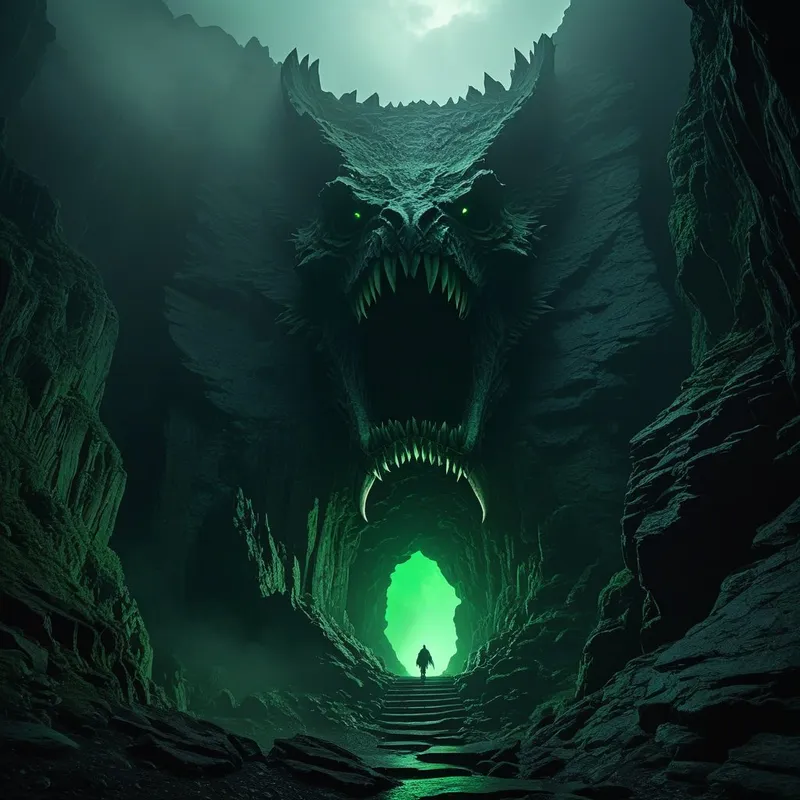
Grendel's Cave Myth Meaning & Symbolism
A hero descends into a monstrous cave to confront the outcast Grendel, discovering that the beast and the kingdom are reflections of a single wounded soul.
The Tale of Grendel's Cave
Listen. Listen, and let the hearth-fire grow low, for the tale I tell is not for the light. It is a story of the borderlands, of the place where the king’s mead-hall ends and the wild mere begins.
In the days of the King Hrothgar, there stood a hall called Heorot. Its timbers were high, its gables gold-tipped, and within, the sound of the harp and the scop’s song was a beacon against the world’s dark. But from the fens and moors beyond the stockade, a sound answered it. Not music, but a gnashing. Not song, but a groan of profound, unutterable loneliness. This was the sound of Grendel.
He was a creature of the border-marches, shaped like a man but wrought on a terrible scale, his skin like toughened bog-leather. He was a descendant of Cain, they whispered, kin-killer, forever exiled. And the joy of Heorot was a torment to him, a feast of light from which he was forever barred. So, when the shadows grew long and the last cup was drained, Grendel came. He came not as an army, but as a blight. The great door, barred with iron, meant nothing. He would enter in silence, a stain of darkness in the hall, and with a hunger that was more than physical, he would take warriors from their beds, crushing life with a despairing grip, bearing their broken forms back into the night.
For twelve winters, this was the rhythm of the land: day’s joy, night’s terror. Heorot stood empty in the dark, a monument to fear. The kingdom’s soul was poisoned, its courage turned inward to festering dread. All knew the source: the cave under the mere. None dared seek it. It was a place of cold water, tangled roots, and a lightlessness so complete it felt ancient.
Then came a hero from over the sea, Beowulf. He heard of Hrothgar’s plight and offered his strength. That night, as was his custom, Grendel came. But Beowulf awaited him, unarmed, trusting in the grip of his hands. What followed was not a duel of swords, but a raw, desperate wrestling of beings. The hall shook. Benches shattered. And with a superhuman wrench, Beowulf tore Grendel’s arm from its socket. With a shriek that held more anguish than rage, the creature fled, bleeding out its life into the mere, seeking the only home it had: the cave.
But the tale does not end with a monster’s flight. For in the cave’s depths waited another—Grendel's Mother. Her grief was a silent, colder, more terrible thing than her son’s rage. To avenge him, Beowulf had to do what none had done: he had to follow the blood-trail down. He dove into the stagnant mere, sinking through a world of dim, grasping weeds and watching serpents, for hours descending, until he found the opening—a sheer rock face leading into an air-pocket, into the very womb of the terror.
Her lair was a hall of a different kind: a water-hall, lit by a ghostly fire, strewn not with treasure but with the relics of her son’s long pain. The battle here was fiercer, closer, more final. Swords forged in the world of light shattered on her hide. It was only by seizing a giant’s sword from her own hoard—a weapon of the ancient, pre-human world—that Beowulf could strike her down. And there, in the dim glow, beside the corpse of the mother and the body of her son, he saw the true source of the kingdom’s torment: not a monster, but a legacy of exile. He cut off Grendel’s head, a grim trophy, and ascended, bringing the darkness into the light, ending the twelve-year winter of fear.

Cultural Origins & Context
The myth of Grendel’s Cave is not a simple monster-slaying tale from the Fairy Tale canon. It is a foundational border myth, told by scops and elders at the gathering of clans, always at the edge of the known world. Its function was societal psycho-hygiene. In a culture defined by the comitatus and the bright circle of the hearth, it gave a name and a shape to the chaos that lay beyond the firelight.
The story was passed down not just to entertain, but to model a specific cultural imperative: the necessity of confronting the "outside." The monster is not from a distant land, but from the nearby mere. The threat is intimate, a corruption born from the community’s own unacknowledged exile of its "unacceptable" parts. The myth served as a ritual in narrative form, allowing the tribe to collectively experience, through the hero’s journey, the re-integration of a terrifying projection. By hearing of Beowulf’s descent and return, the community itself performed a symbolic cleansing, reaffirming that order (Midgard) could only be maintained by periodically facing the chaos (Ginnungagap) that pressed at its edges.
Symbolic Architecture
At its core, Grendel’s Cave is not a geographical location but a psychic state. It represents the unconscious in its most rejected, festering, and personified form.
The cave is the inverted hall. Where Heorot is structure, song, and conscious identity, the cave is formlessness, mournful silence, and the repressed shadow.
Grendel himself is the embodied shadow of the kingdom. His sensitivity to the joy of Heorot is key—he is not evil in a cosmic sense, but in agony. He is what the community has cast out: its capacity for rage, its untamed grief, its "Cain" nature of envy and violence. He is the part of the collective psyche deemed monstrous, forced to live in the swamp of repression, who then returns to devour the very community that created him. Beowulf’s initial victory—ripping off the arm—is a partial, conscious victory over the shadow’s overt manifestations. But the arm left behind in Heorot is a symbol that the work is unfinished; the root remains below.
The descent to the cave, to Grendel’s Mother, is the journey to the root. She symbolizes the Great Mother in her terrible, avenging aspect. She is the deeper, older, more primal layer of the unconscious from which the personal shadow (Grendel) was born. She is the psychic matrix that holds and nurtures the wound. Confronting her requires a descent into the watery, feminine realm of instinct and emotion, and the victory necessitates using a weapon from within that realm—the giant’s sword. This signifies that the ego cannot integrate the deep unconscious with its own tools; it must be humbled and use the power native to the depths themselves.

The Dreamer's Resonance
When this myth activates in the modern psyche, it often manifests in dreams of profound intrusion and required descent. The dreamer may not see a literal Grendel, but they feel its presence: an overwhelming sense of being stalked by a depression, a rage, or a shame that arrives in the "night" of their life, siphoning their vitality (libido). The dream-Heorot—their job, their relationship, their self-image—feels violated.
The critical dream sequence is the compelled journey to the source. This may appear as:
- Finding a hidden basement or cave beneath one's modern house.
- Being pulled into a deep body of water (the mere) with a specific, terrifying destination.
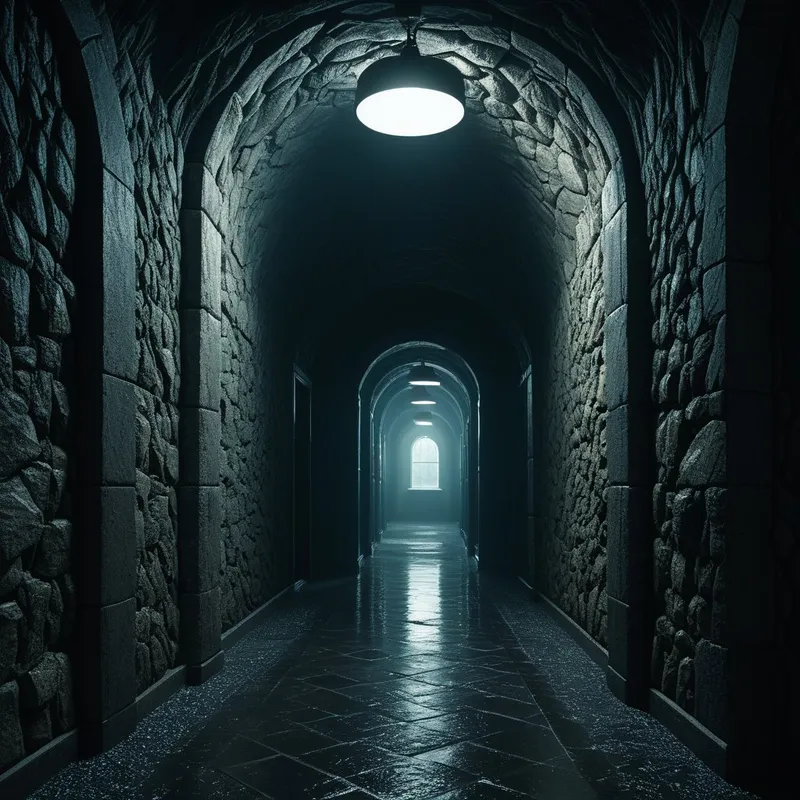
- Discovering that a familiar, well-lit corridor ends in a dank, primitive cavern.
The somatic experience is one of cold dread, pressure, and constriction, mixed with a paradoxical sense of necessity. This is the psyche signaling that the symptom (the nightly attack) can no longer be merely defended against; its lair must be found. The dreamer is being prepared, as Beowulf was, to leave the realm of the known ego and enter the landscape of the symptom’s origin. The fear is not of the monster, but of the cave—the terrifying interiority where the monster is merely the guardian.
Alchemical Translation
The myth of Grendel’s Cave is a precise map of the individuation process, specifically the stage of shadow-work.
The alchemical vessel is not the hero, but the entire mythic landscape. The putrefaction occurs in the stagnant mere; the transmutation begins at the cave’s threshold.
First, the Recognized Nigredo: The joyous hall (the conscious personality) is poisoned. Life becomes repetitive, haunted, joyless. This darkening is necessary—it is the prima materia, the initial suffering that forces the ego to acknowledge it is not whole.
Second, the Voluntary Descensus: Beowulf’s choice to dive into the mere is the ego’s agreement to undertake the perilous inner work. This is the solutio—dissolving into the unconscious, the watery realm. The hero must relinquish control and be led by the blood-trail (the affective clue, the pain itself) to the source.
Third, the Coniunctio in the Deep: The battle in the cave is not a destruction, but a fierce engagement. Using the giant’s sword—the insight or strength found within the complex itself—represents a paradoxical integration. One does not defeat the mother-complex with willpower; one understands its necessity and severs its autonomous, destructive power by acknowledging its place in one’s history. Beowulf beheads Grendel in the cave, not in the hall. The integration happens at the source.
Finally, the Return with the Cauda Pavonis: The ascent with the head—a ghastly but undeniable trophy—is the bringing of consciousness to the unconscious content. The shadow is not eliminated; its truth is made visible. The kingdom’s relief is the psychic liberation that follows when a major complex is integrated. The hall can be rebuilt, not in ignorance of the mere, but with a hard-won knowledge of what dwells there. The individual is no longer at war with a part of themselves, and the energy once spent on nightly defense becomes available for life. The cave remains, but it is no longer a place of active terror; it is a known depth within the geography of the self.
Associated Symbols
Explore related symbols from the CaleaDream lexicon: