Gram Myth Meaning & Symbolism
A sword of destiny, forged by a god, broken by a king, and reforged for a hero to slay a dragon and awaken a valkyrie from an enchanted sleep.
The Tale of Gram
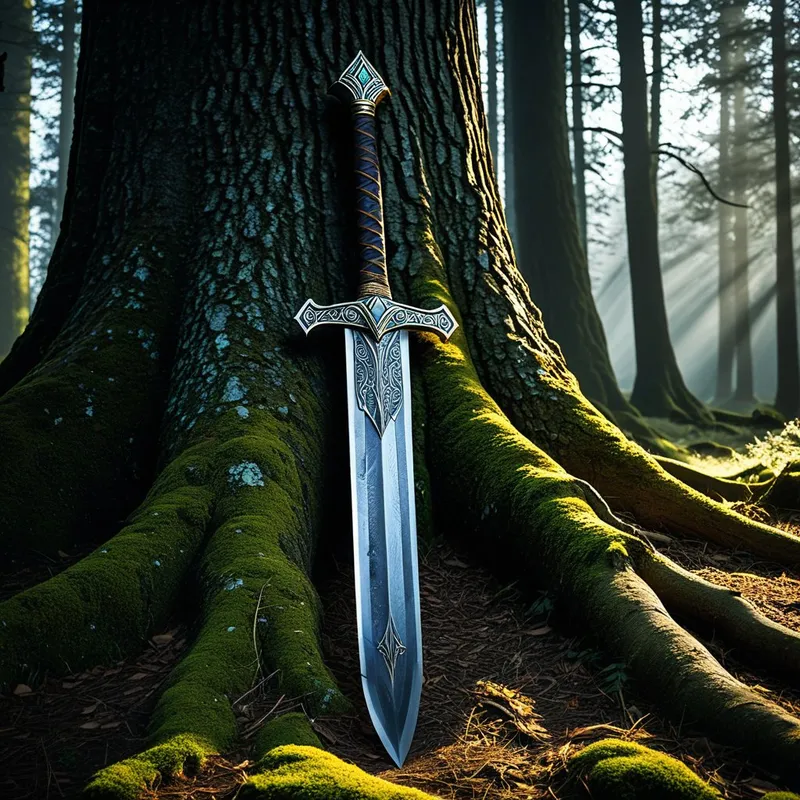
Listen, and hear the tale of the blade that sings with fate. In the hall of King Volsung, beneath the great Barnstokkr, the air was thick with mead and boast. A stranger entered, hooded and grim, with one eye that held the depth of all winters. This was Odin. Without a word, he strode to the heart-tree and thrust a sword, gleaming like a captured moonbeam, deep into its wooden heart. “The blade is for the one who can draw it forth,” he declared, his voice the grind of glaciers, and then he was gone, leaving only the scent of pine and iron.
The sword waited. Kings and champions strained, but the blade, named Gram, slept in the oak, unmovable as the roots of the world. Until the day Sigurd, son of Sigmund, came of age. His fingers touched the hilt, and the wood sighed. With a sound like the first crack of spring ice, he drew the sword free. It was light and terrible in his hand, humming with a promise of glory and grief.
But fate is a twisted path. Sigurd’s father, Sigmund, would later face King Lyngvi in battle. In the clash of shields, Odin appeared once more, and with a touch of his spear, Gram shattered on Sigmund’s shield. The king fell, and the broken shards of the god-forged blade were gathered, a legacy of metal and mourning.
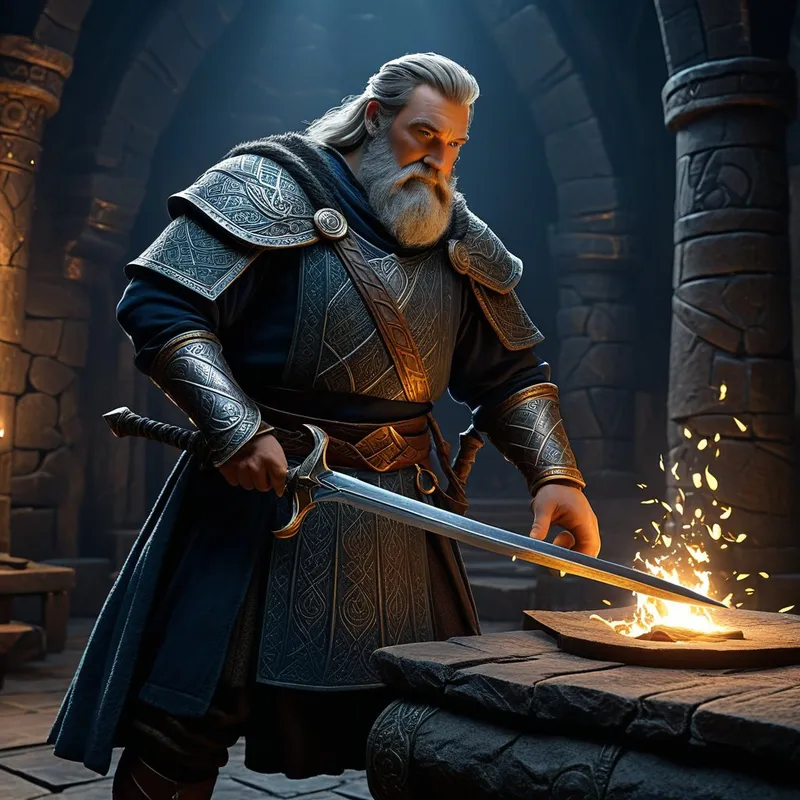
The pieces passed to Sigurd. He sought out the dwarf Regin, who burned with a secret hatred. “Re-forge my father’s sword,” Sigurd commanded. In the soot-black smithy, under a mountain’s weight, Regin worked. The bellows roared like a beast, the fire burned with stolen sunlight, and the fragments melted, wept, and became one again. The new Gram was keener, hungrier, its edge singing for a specific doom.
That doom coiled on the Glisten Heath, in the form of the dragon Fafnir. Sigurd dug a pit in the dragon’s path. The earth shook. A stench of poison and gold filled the air as the monstrous serpent slithered overhead. From below, Sigurd thrust Gram upward with all his might. The blade, born of a god’s will and a dwarf’s craft, pierced the scaled hide, and Fafnir’s life-blood, a river of ancient greed, poured into the pit.
With the dragon’s heart-roast upon his lips, Sigurd gained wisdom of birds. He heard their chatter of betrayal—Regin’s plot to kill him. And so, with the same reforged blade, Sigurd fulfilled another strand of fate, turning Gram on the treacherous smith. The sword, having slain a monster of greed, now ended a monster of envy. Its final great deed was to cut the ring of fire that imprisoned the valkyrie Brynhild, awakening her to a love and a tragedy that would echo into the twilight of the gods themselves.
Cultural Origins & Context
The saga of Gram is woven into the Völsunga Saga, a 13th-century Icelandic prose narrative that collects and codifies much older oral traditions. These stories were the lifeblood of the Norse world, recited in longhouses by skalds who were keepers of memory, genealogy, and law. The myth of Gram is not a simple adventure; it is a foundational narrative about the nature of power, lineage, and obligation.
In a culture where a warrior’s worth was tied to his ancestry and his armament, a sword like Gram was more than a tool. It was a physical manifestation of ørlög. Its bestowal by Odin directly ties the hero’s journey to the will of the divine, framing human action within a cosmic drama. The story served to validate the authority of ruling families (claiming descent from such heroes), to model the complex ideals of the hero (brave yet often doomed), and to explore the inescapable tensions between personal honor, familial duty, and the often-capricious designs of the gods. It was a mirror held up to a society that prized strength but was acutely aware of the fragility of fortune.
Symbolic Architecture
Gram is the archetypal Sword of Destiny. Its journey—from divine implantation, through shattering, to reforging—maps the lifecycle of the psychic force it represents: the directed will of the conscious ego, or the logos principle.
The sword is the focused will that cuts through confusion, but it must first be broken by a reality greater than itself.
Its initial placement in the Yggdrasil-like Barnstokkr symbolizes destiny rooted in the unconscious, waiting for the rightful consciousness (Sigurd) to claim it. Odin’s act of shattering it upon Sigmund’s shield represents the necessary failure of the untested ego. The father’s will cannot accomplish the son’s destiny; the old identity must break so a new, more resilient one can be forged.
The reforging by Regin is crucial. Regin represents the cunning of the unconscious, the shadowy nigredo where raw material is worked upon. The ego (Sigurd) must consciously engage with these darker, skilled, and potentially treacherous aspects of the psyche to reconstitute its power. The new Gram, used to slay the dragon Fafnir, is this integrated will confronting the ultimate shadow: the paralyzing, hoarding greed of the unconscious that sits upon the treasure of the Self.
The Dreamer's Resonance
To dream of a broken sword that must be reforged is to experience a profound moment of ego-fragmentation and potential renewal. Somatically, this may manifest as a feeling of weakness, a “broken will,” or a specific injury to the arms or hands—the instruments of our action in the world.
Psychologically, the dreamer is in the Regin-phase. The conscious personality has suffered a defeat or disillusionment (the sword is broken). The dream presents the task: the pieces are there, but they must be taken to the inner smithy. This is the work of shadow integration. The dreamer may encounter a cunning, untrustworthy, or skilled figure (the Regin archetype) who represents the neglected or despised aspects of their own psyche that hold the key to restoration. The heat of the forge is the emotional intensity required—anger, grief, determination—to melt down the old, rigid identity and re-form it into something more effective and true. The dream is a call to active, conscious participation in one’s own healing and empowerment.

Alchemical Translation
The myth of Gram is a perfect allegory for the Jungian process of individuation, specifically the stage of albedo following the nigredo. The shattered sword is the nigredo—the dark night of the soul, the dissolution of the persona, and the confrontation with meaninglessness.
Individuation does not mean perfection; it means becoming whole, which includes bearing the scars of the break.
The conscious ego (Sigurd) must descend into the workshop of the unconscious (Regin’s forge) and submit its broken pieces to the fire. This is the painful, meticulous work of analysis, of gathering disparate life-fragments—traumas, failures, talents, and dreams—and seeing them as essential material. The reforging is the synthesis, the creation of a tertium non datur: a new conscious attitude that is neither the naive optimism of the first drawing of the sword nor the despair of its breaking. It is a will tempered by suffering and informed by the wisdom of the shadow.
This new “Gram” is then used for its ultimate purpose: to slay the dragon of unconscious possession (Fafnir) and to awaken the sleeping anima (Brynhild). The integrated will cuts through the defensive, greedy inertia of the psyche to liberate the soul’s deepest value, even though that liberation leads to further, more complex stages of the journey. The myth teaches that our highest power is not given whole; it is returned to us in pieces after a necessary shattering, and we must find the craft within ourselves to make it whole again.
Associated Symbols
Explore related symbols from the CaleaDream lexicon: