Gordian Knot Myth Meaning & Symbolism
An intricate, divinely-sanctioned knot that promised an empire to whoever could untie it, until Alexander the Great cut it with his sword, forging his own destiny.
The Tale of Gordian Knot
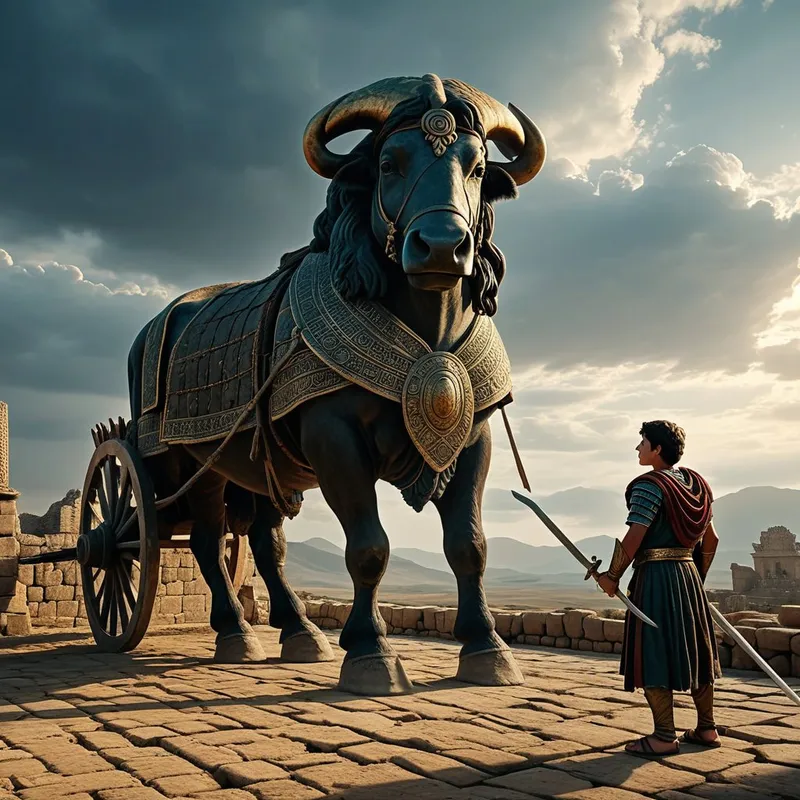
Hear now a tale of a knot that bound not just wood and bark, but fate itself. In the heart of Phrygia, where the dust of the high plains tastes of prophecy, there stood a city called Gordium. Its founder, a poor farmer named Gordias, was chosen by the gods. An eagle, the messenger of Zeus, landed upon the yoke of his ox-cart, a sign so potent that the oracles declared Gordias king. In awe and gratitude, he dedicated that humble cart to Zeus Basileus, tying it to a sacred post with a knot of cornel bark.
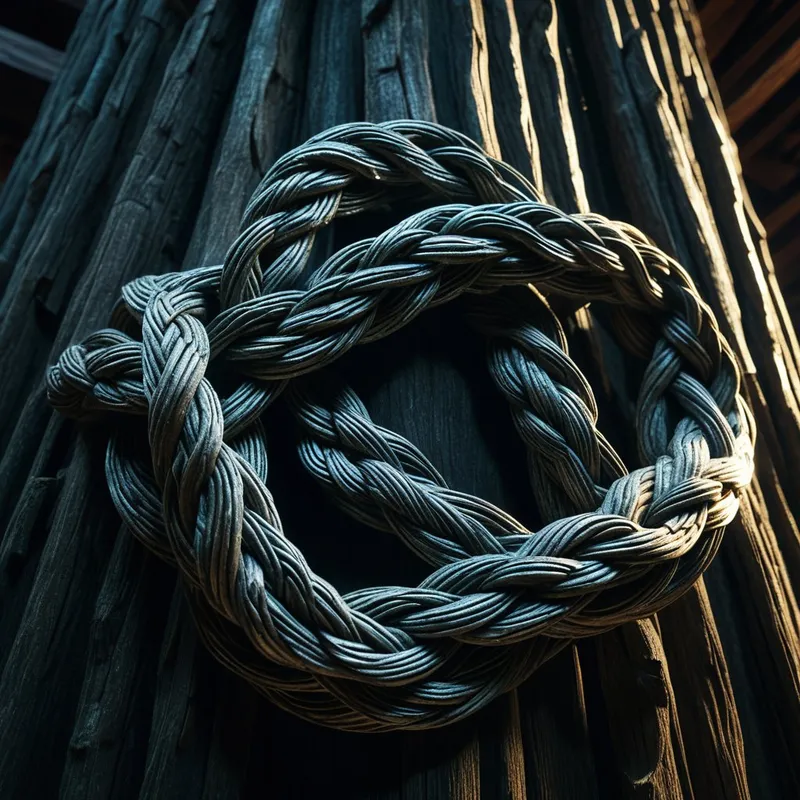
But this was no ordinary knot. It was woven with the cunning of the gods, its ends hidden deep within its own labyrinthine coils. The whisper traveled from oracle to king, from bard to soldier: He who can loosen the knot of Gordias shall rule all of Asia.
For generations, it sat in the citadel, a silent challenge. Kings and princes, wise men and cunning tricksters, made pilgrimage to Gordium. They would stand before the sacred cart, their fingers tracing the hardened, gleaming bark. They would push and pull, seeking a starting point that did not exist. Hours turned to days, their brows furrowed in concentration, then despair. The knot remained, a testament to divine inscrutability, its promise hanging in the air like unspent lightning.
Then came the storm named Alexander. He was young, his eyes holding the fire of Achilles and the ambition of the gods themselves. Having conquered the coast, he marched inland to Gordium. He entered the sanctuary, not as a hopeful suitor, but as a force of nature. The crowd, the priests, the very air grew still. He studied the knot, this physical manifestation of a riddle. He saw not a puzzle to be solved by the old rules, but a barrier to be removed.
A murmur rippled through the onlookers as he drew his sword. The steel flashed, a sliver of human will against a divine contrivance. With one decisive, thunderous stroke, he cleaved the knot in two. The severed ends fell apart, and the bark, once bound for eternity, clattered to the stone floor. The silence that followed was deeper than before, broken only by the echo of the blow. That night, the skies opened. Thunder roared—the approval of Zeus, some said. Alexander had not untied the knot. He had rendered its complexity irrelevant, and in doing so, seized the prophecy with his own hands.
Cultural Origins & Context
The myth of the Gordian Knot is primarily preserved in the histories of the Roman era, most notably in the works of Quintus Curtius Rufus and Plutarch, who drew upon earlier, now-lost sources. Its setting in Phrygia, a region at the crossroads of Greek and Near Eastern cultures, is significant. It represents a frontier of the known world, a place where Greek heroes tested themselves against ancient, foreign mysteries.
The story functioned on multiple levels for the Greco-Roman world. Historically, it served as a powerful piece of propaganda for Alexander the Great, legitimizing his campaign against the Persian Empire as a fulfillment of destiny, not mere ambition. Culturally, it resonated with a deep-seated appreciation for the contest of metis (cunning intelligence) against bie (raw force). The knot was a challenge of metis, but Alexander’s solution introduced a third, transcendent principle: decisive, sovereign action that changes the very terms of the game. It was a story told to illustrate the arrival of a world-historical individual, a man who does not play by the established rules but creates his own, thereby altering the trajectory of fate itself.
Symbolic Architecture
At its core, the Gordian Knot symbolizes the complexified problem. It is the institutional paralysis, the over-engineered system, the psychological impasse grown so dense with history, obligation, and fear that its original purpose is forgotten, and only its binding power remains. It represents a challenge that cannot be met on its own terms because its terms are designed for stasis, not resolution.
The knot is not evil, but it is ossified. It is destiny frozen into a puzzle. Alexander represents the eruptive force of consciousness—the logos or will—that refuses to be ensnared by complexity. His sword is not merely a weapon, but a symbol of discrimination, clarity, and decisive judgment.
The true knot is not in the cord, but in the mind that believes it must be untied in the prescribed way.
Psychologically, the myth maps the confrontation between the complex of the past (the intricate, sacred knot) and the assertive ego of the present (Alexander). The hero’s journey often involves facing a seemingly impossible task. The Gordian solution demonstrates that sometimes, the path forward is not through painstaking analysis of the problem’s self-created complexity, but through a radical re-framing that dissolves the problem’s foundational premise.
The Dreamer's Resonance
When the Gordian Knot appears in modern dreams, it rarely manifests as a literal knot of rope. It is more likely to be a dream of being trapped in bureaucratic software with no exit button, of trying to solve a math problem where the numbers keep shifting, or of being physically entangled in the very wires of one’s own home. The somatic feeling is one of constriction, frustration, and mounting panic—a sense that you are playing a game rigged against you.
This dream pattern signals a psychological process where the dreamer’s conscious mind is caught in a "complex"—a knot of emotions, memories, and perceptions—that has become autonomous and seemingly unsolvable. It often arises during life transitions (career change, relationship shifts, creative blocks) where old ways of thinking and behaving have created an intricate, self-perpetuating deadlock. The dream is the psyche presenting the bind in its raw, symbolic form. The anxiety is not about the knot itself, but about the perceived law that one must untie it, that one must find the perfect, socially-sanctioned, non-destructive solution. The dream asks: What are you so meticulously trying to untangle that might simply need to be cut away?

Alchemical Translation
The alchemical process mirrored in this myth is not the slow solve et coagula (dissolve and coagulate) of careful analysis, but the fiery, sudden operation of separatio—separation by the sword. In the journey of individuation, we inevitably encounter Gordian Knots within ourselves: identifications with roles (the dutiful child, the perfect employee), entrenched neurotic patterns, or loyalties to old wounds that have shaped our entire identity. We try to "untie" these by understanding their history, tracing every loop of cause and effect in therapy or introspection. This is necessary work.
But the myth introduces a more advanced, terrifying, and liberating stage. It is the moment when the ego, aligned with the Self (the inner sovereign), must perform a surgical strike. This is the cutting away of a toxic relationship despite social pressure, the abandonment of a safe career path to follow a calling, the conscious decision to stop ruminating on a past trauma and simply act from a new principle.
The alchemical sword does not destroy the gold; it severs the dross that obscures it.
This "cut" is not mindless violence. It is the application of conscious will to break a spell of complexity. It is the recognition that the power of the bind lies in our belief in its inviolability. The triumph is psychic emancipation. The severed ends of the knot do not vanish; they become inert material, no longer charged with fateful power. The individual, like Alexander, forges their own prophecy not by deciphering an old, external oracle, but by enacting a new, internal truth. The thunder that follows is the psychic energy, once bound in the knot, now released and available to the conscious personality, fueling the next phase of the journey.
Associated Symbols
Explore related symbols from the CaleaDream lexicon: