Golden Apples of the Hesperides Myth Meaning & Symbolism
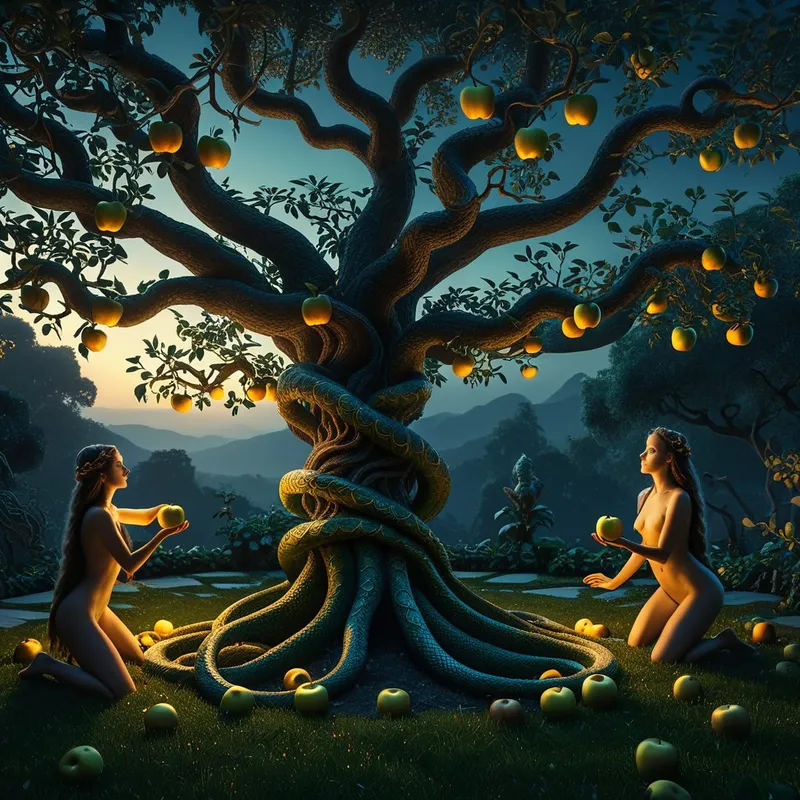
Hercules' final labor: to steal the immortal Golden Apples from a divine garden guarded by a dragon and the nymphs of the evening.
The Tale of Golden Apples of the Hesperides
Listen, and let [the veil](/myths/the-veil “Myth from Various culture.”/) of centuries thin. This is not merely a story of a strong man and a fruit. This is an account of [the world](/myths/the-world “Myth from Tarot culture.”/)’s edge, where the sun goes to rest and [the sky](/myths/the-sky “Myth from Persian culture.”/) bleeds into the wine-dark sea.
In the farthest west, beyond the knowing of mortals, lies a garden that is not a garden. It is the [temenos](/myths/temenos “Myth from Greek culture.”/) of Hera herself, a grove of eternal twilight. Here, the light is honeyed and heavy, and the air smells of citrus blossom and distant salt. This is the realm of the [Hesperides](/myths/hesperides “Myth from Greek culture.”/), sisters of the setting sun, whose songs are the whispers of dusk. They move like shadows through the orchards, not as gardeners, but as priestesses of a singular, radiant mystery: the Golden Apples.
These were no ordinary fruit. They were a wedding gift from Gaia to Hera, flesh of immortality, condensed sunlight given form. To guard this ultimate treasure, Hera placed a sentinel whose vigilance knew no sleep: [Ladon](/myths/ladon “Myth from Greek culture.”/), a dragon with a hundred flickering tongues and eyes that saw in every direction, whose coils were as strong as the roots of the world.
Into this divine, forbidden sanctuary steps a man marked by fate and fury: [Heracles](/myths/heracles “Myth from Greek culture.”/). His is the eleventh labor, a cruel jest by a king who thought this task impossible. “Fetch me [the Apples of the Hesperides](/myths/the-apples-of-the-hesperides “Myth from Greek culture.”/),” he was commanded. No map led there; no path was charted. [Heracles](/myths/heracles “Myth from Greek culture.”/) wandered, a brute force seeking a subtle secret, wrestling gods and prophets for clues. His journey was a long, bloody prelude to the garden’s gate.
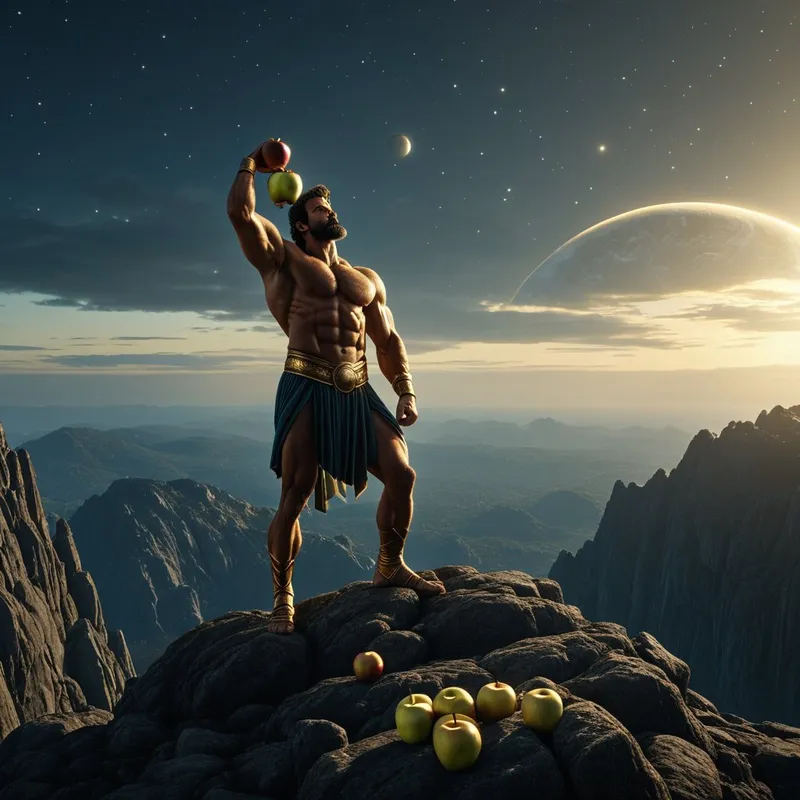
He did not conquer the garden by strength alone. Wisdom, or perhaps desperation, guided him. He found the Titan Atlas, who bore the weight of the celestial sphere upon his shoulders. Heracles, in a moment of cosmic bargaining, offered to shoulder the sky himself if Atlas would venture into his daughters’ garden and retrieve the apples. Atlas agreed, relieved of his eternal burden. He returned, the golden orbs glowing in his mighty hand. But a new danger arose: Atlas, feeling the freedom of unburdened shoulders, offered to deliver the apples himself, leaving Heracles trapped beneath the heavens. Through cunning, Heracles asked Atlas to take the weight back for just a moment so he could pad his shoulders. The Titan agreed, and Heracles, swift as thought, seized the apples and fled, leaving the sky and its weight where they belonged.
The apples were taken, shown to the king, and then, by divine decree, returned. They could not remain in the mortal realm. They were restored to Athena, who carried them back to the twilight garden, to the serpent and the singing [nymphs](/myths/nymphs “Myth from Greek culture.”/), completing a circle that no mortal hero could ever truly break.
Cultural Origins & Context
This myth is a late-blooming flower in the vast garden of Greek storytelling. It finds its most coherent form in the works of later mythographers like Hesiod and Apollodorus, synthesizing older, disparate fragments. The Hesperides themselves are deeply archaic figures, nymphs of the sunset, belonging to the poetic imagination of a people who lived by [the sea](/myths/the-sea “Myth from Greek culture.”/) and marked time by the sun’s journey. Their garden is the ultimate “elsewhere,” a narrative device to place the ultimate treasure at the literal edge of the known world.
The myth functioned on multiple levels. On one hand, it was a thrilling adventure story in the Heraclean cycle, showcasing not just strength but the [metis](/myths/metis “Myth from Greek culture.”/) (cunning intelligence) required for true heroism. On a deeper, societal level, it reinforced a core Greek concept: hubris and its limits. The apples represent divine property, the essence of immortality itself, which is categorically not for humans. Heracles’ success is temporary, contingent on trickery and divine permission. Their return underscores a fundamental law: some boundaries, especially those between mortal and immortal, are absolute. The tale was told to inspire awe and to teach respectful fear of the cosmic order.
Symbolic Architecture
[The Garden of the Hesperides](/myths/the-garden-of-the-hesperides “Myth from Global/Universal culture.”/) is not a geographical [location](/symbols/location “Symbol: The symbol of ‘Location’ signifies a sense of place, context, and the environment in which experiences unfold.”/); it is a psychic state. It represents the innermost sanctum of [the Self](/myths/the-self “Myth from Jungian culture.”/), the deeply guarded core of vitality and potential wholeness that Jung would call the Self. The Golden Apples are the [fruit](/symbols/fruit “Symbol: Fruit symbolizes abundance, nourishment, and the fruits of one’s labor in dreams.”/) of this wholeness—symbols of immortality, not of the [body](/symbols/body “Symbol: The body in dreams often symbolizes the dreamer’s self-identity, personal health, and the relationship they have with their physical existence.”/), but of the [psyche](/myths/psyche “Myth from Greek culture.”/)’s timeless, perfected state. They are the reward for a [life](/symbols/life “Symbol: The symbol of ‘Life’ represents a journey of growth, interconnectedness, and existential meaning, encompassing both the joys and challenges that define human experience.”/) fully integrated.
The treasure is always guarded by a dragon, for the psyche’s deepest value is protected by its most terrifying aspect.
Ladon, the hundred-headed [serpent](/symbols/serpent “Symbol: A powerful symbol of transformation, wisdom, and primal energy, often representing hidden knowledge, healing, or temptation.”/), is the archetypal [Shadow](/symbols/shadow “Symbol: The ‘shadow’ embodies the unconscious, repressed aspects of the self and often represents fears or hidden emotions.”/) and the [guardian](/symbols/guardian “Symbol: A protector figure representing safety, authority, and guidance, often embodying parental, societal, or spiritual oversight.”/) simultaneously. It is the coiled [mass](/symbols/mass “Symbol: Mass often symbolizes a gathering or collective experience, representing shared beliefs, burdens, or the weight of emotions within a community.”/) of our repressed fears, instincts, and primal energies that block access to our own golden core. It is not evil, but formidable, a necessary [boundary](/symbols/boundary “Symbol: A conceptual or physical limit defining separation, protection, or identity between entities, spaces, or states of being.”/). The Hesperides, the nurturing nymphs, represent the softer, alluring, yet still unconscious aspects of this inner [realm](/symbols/realm “Symbol: The symbol of ‘Realm’ often signifies the boundaries of one’s consciousness, experiences, or emotional states, suggesting aspects of reality that are either explored or ignored.”/)—the intuitive, feminine qualities that tend the potential for growth but are bound by the [guardian](/symbols/guardian “Symbol: A protector figure representing safety, authority, and guidance, often embodying parental, societal, or spiritual oversight.”/)’s law.
Heracles’ labor is [the ego](/myths/the-ego “Myth from Jungian culture.”/)’s arduous [journey](/symbols/journey “Symbol: A journey in dreams typically signifies adventure, growth, or a significant life transition.”/) toward this center. His initial brute force fails; he cannot simply fight his way in. He must enlist Atlas, the bearer of the world. This is the critical symbolic turn: to reach the [treasure](/symbols/treasure “Symbol: A hidden or valuable object representing spiritual wealth, inner potential, or divine reward.”/), one must first consciously bear the burden of one’s own world—the [weight](/symbols/weight “Symbol: Weight symbolizes burdens, responsibilities, and emotional loads one carries in life.”/) of one’s responsibilities, sufferings, and [reality](/symbols/reality “Symbol: Reality signifies the state of existence and perception, often reflecting one’s understanding of truth and life experiences.”/)—and then, through a perilous negotiation with the very [structure](/symbols/structure “Symbol: Structure in dreams often symbolizes stability, organization, and the framework of one’s life, reflecting how one perceives their environment and personal life.”/) of that burden (Atlas), gain indirect access.
The Dreamer’s Resonance
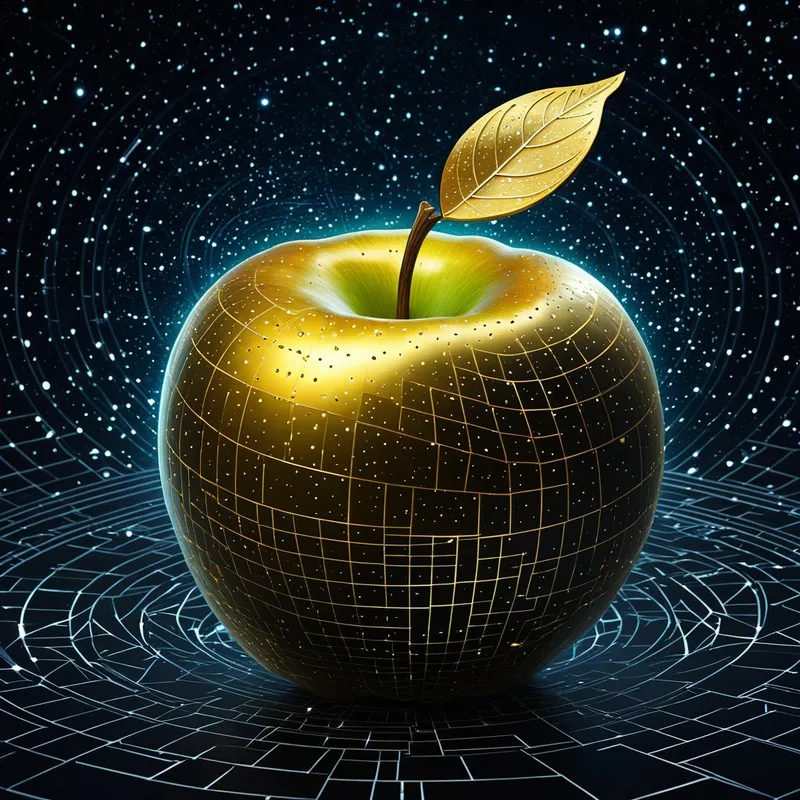
When this myth stirs in the modern dreamer, it signals a profound turning point in the inner journey. To dream of a radiant, [forbidden fruit](/myths/forbidden-fruit “Myth from Christian culture.”/) in a walled garden is to feel the call of the Self. The dreamer is being shown their own potential for wholeness, shimmering just out of reach.
The somatic experience is often one of simultaneous longing and frustration. The garden may feel intimately familiar yet impossibly distant. The guardian serpent may appear not as a classical dragon, but as a menacing figure, a locked door, a snarling animal, or an overwhelming feeling of dread or paralysis that arises precisely when the “apple” is nearly within grasp. This is the psyche’s immune response, the Ladon within, activating to protect a fragile, nascent state of being from a consciousness not yet ready to integrate it. The dream is mapping the resistance that must be understood, not stormed.
Alchemical Translation
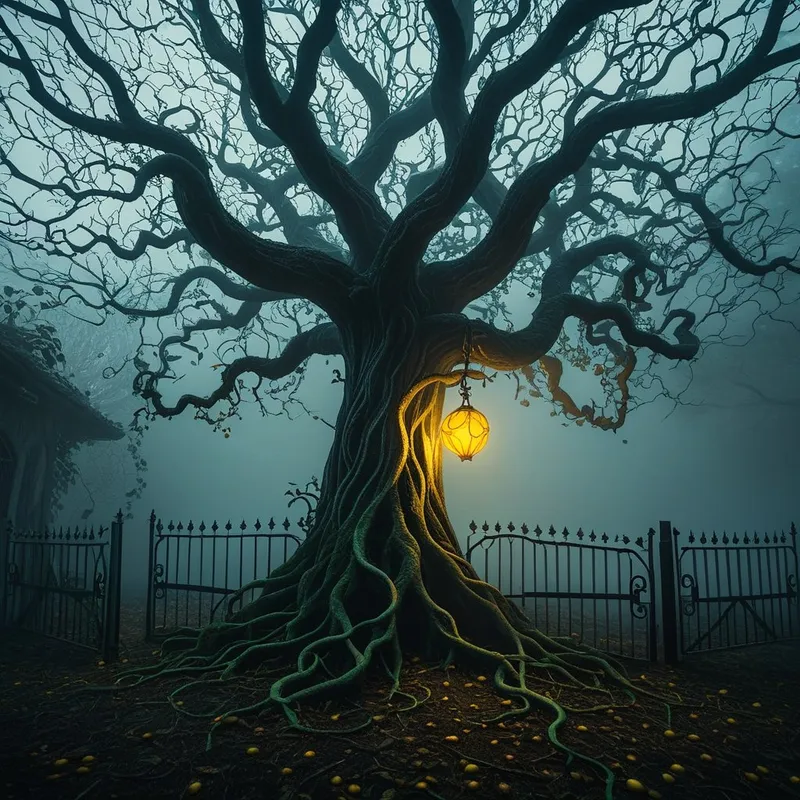
The myth of the Golden Apples is a perfect allegory for the individuation process. The labor assigned by a petty king (the oppressive demands of the [persona](/myths/persona “Myth from Greek culture.”/) or the complex-ridden ego) becomes the catalyst for a transformative quest.
The initial stage is [nigredo](/myths/nigredo “Myth from Alchemical culture.”/)—the blackening. Heracles’ wandering, confusion, and battles represent the ego’s dissolution and confrontation with the shadowy contents of the unconscious. He is stripped of simple solutions. The encounter with Atlas is the albedo—the whitening, a moment of illuminating insight. The ego (Heracles) must consciously accept and hold the totality of its psychic reality (the sky). This act of supreme responsibility creates [the vessel](/myths/the-vessel “Myth from Alchemical culture.”/) for change.
The treasure is never taken by direct assault; it is received only after the bearer has exchanged his burden for a greater one.
The retrieval of the apples is the citrinitas—the yellowing, the dawning of the symbolic “gold.” But the process is not complete with possession. The final, crucial stage is the [rubedo](/myths/rubedo “Myth from Alchemical culture.”/)—the reddening. The apples must be returned. This is the myth’s deepest alchemical secret: the achieved wholeness (the Self) cannot be possessed by the ego as a trophy. Heracles gives them up. The integration is complete only when the ego relinquishes its claim to the treasure, allowing the newfound wholeness to reside in its proper, sacred place within the greater psyche. The hero does not keep the immortality; he is changed by his contact with it. He returns to the world, having held the sky and touched the golden fruit, forever altered. The labor ends not with ownership, but with a sacred return, completing the circle of the Self.
Associated Symbols
Explore related symbols from the CaleaDream lexicon: