Goibniu Myth Meaning & Symbolism
The myth of Goibniu, divine smith of the Tuatha Dé Danann, forges weapons of destiny and hosts a feast of immortality, embodying the sacred craft of resilience.
The Tale of Goibniu
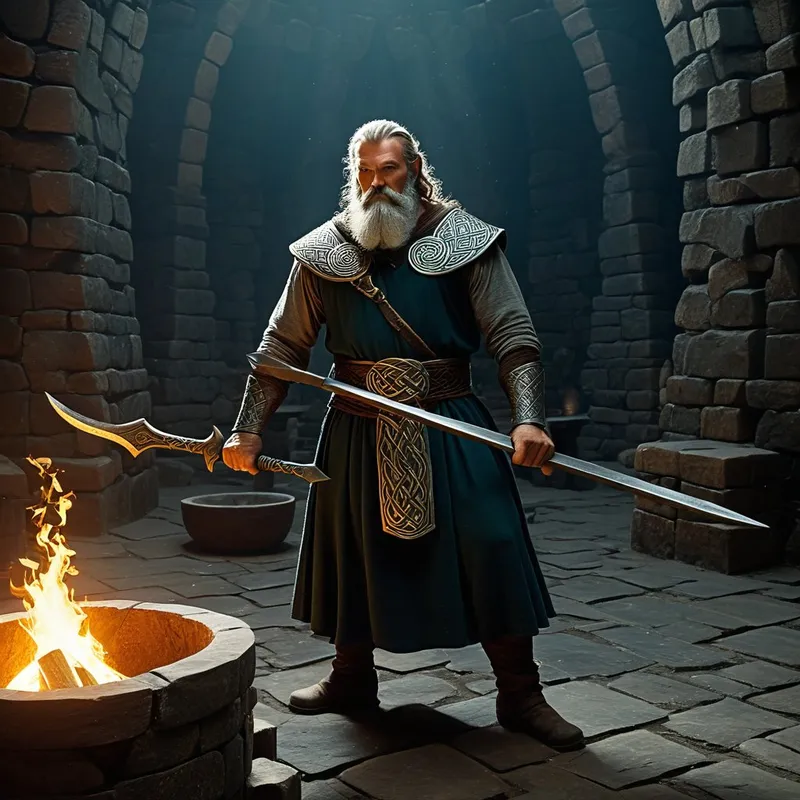
Listen, and hear the tale of the unbreakable craft, the fire that does not consume, and the feast that defies death. In the mist-shrouded times before memory, when the world was still singing its first song, the Tuatha Dé Danann came to the shores of Éire. They were a people of deep magic, and among them walked three brothers of profound skill: Goibniu, the smith; Luchta, the wright; and Creidhne, the brazier. But it is Goibniu of whom we sing.
His forge was not of mere stone and bellows. It was a heart of the world, a cavern where the breath of the earth met the lightning of the sky. The ring of his hammer was a heartbeat, steady and sure. When the great war with the Fomorians darkened the horizon, a shadow of dread fell upon the people. The enemy was vast, cruel, and wielded weapons of brute force.
The Dagda, the good god, came to the forge. The air smelled of ozone and hot iron. "Goibniu," he said, his voice like distant thunder. "Our warriors are brave, but their spears shatter, their swords bend. We need a craft that cannot be broken by their chaos."
Goibniu did not look up from the white-hot metal on his anvil. His eyes reflected the molten flow. "They will have it," he said, and his next strike sent a shower of sparks that lit the cavern like a constellation being born. He forged the Spear of Lugh, a weapon that thirsted for battle and could not be subdued. With Luchta crafting the shafts and Creidhne fashioning the rivets, they created spears and swords of such perfection that with a single thrust, a warrior could slay his foe, and the weapon would return to his hand, unbloodied and eager.
But the Fomorian witch, Bres, learned of this. He sent a spy, a lone assassin named Ruadan, son of Bres and Brigid, to pierce the heart of the Tuatha Dé's strength. Ruadan crept into the forge as Goibniu, covered in the grime of creation, was quenching a newly finished blade. With a cry of treachery, Ruadan hurled a poisoned spear. It struck Goibniu in the chest, a wound that would kill any mortal god.
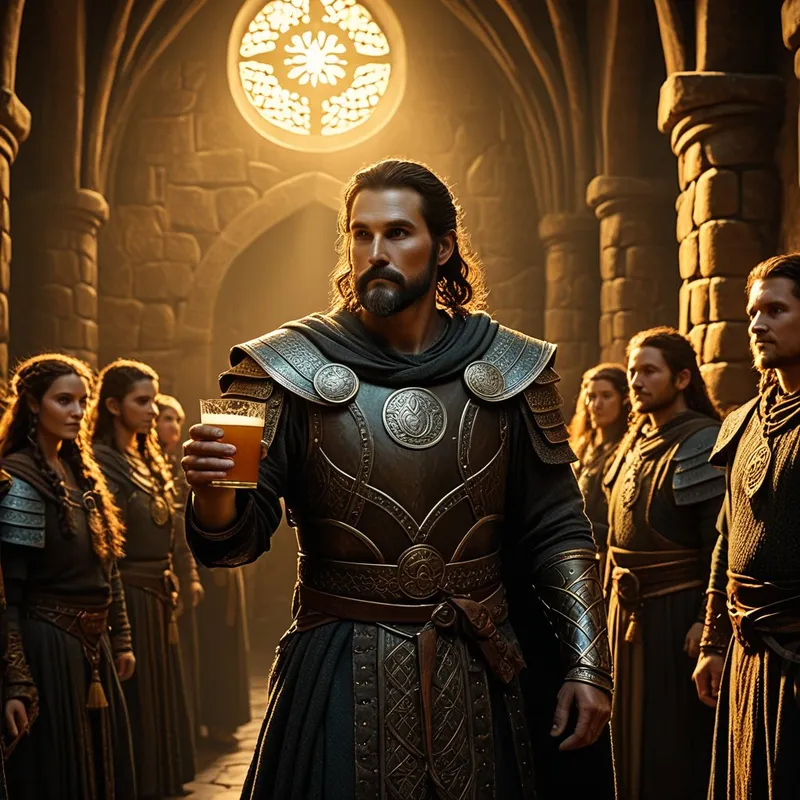
Goibniu staggered, but did not fall. He pulled the spear from his own body, the poison sizzling against his divine flesh. He looked not at his wound, but at the weapon in his hand, judging its poor craft. Then, he cast it aside. "This will not do," he murmured. He walked, steady as his own anvil, to the great cauldron that always simmered at the forge's edge. This was no ordinary vessel, but the Undry. From it, he drew not water, but a deep, red, life-giving ale. He drank one long draught.
The wound closed. The poison vanished like mist in sunlight. His strength returned, greater than before. The assassin fled, but the tale of the smith who could not be killed spread like forge-fire. And so, Goibniu instituted the Fled Goibnenn. Any warrior of the Tuatha Dé who partook of the feast—the succulent pork he himself hunted, and the magical, red ale from his cauldron—would be healed of all wounds and protected from death in the coming battle. Thus, armed with unbreakable weapons and fortified by an undying feast, the People of the Goddess Danu stood firm. Their resilience was forged, literally and spiritually, in the sacred fire of the smith.
Cultural Origins & Context
The figure of Goibniu emerges from the rich, oral tapestry of early Irish literature, primarily preserved in medieval manuscripts like the Lebor Gabála Érenn (The Book of Invasions) and the Cath Maige Tuired. He is a member of the Trí Dé Dána (Three Gods of Skill), a triad embodying the essential, civilization-building arts of metalwork, carpentry, and fine craftsmanship.
His myth was not mere entertainment. In a pre-industrial society, the smith held a liminal, almost magical status. He mastered the elemental forces of earth (ore), fire, and water (quenching), transforming raw, chaotic material into objects of order, utility, and beauty—ploughshares, cauldrons, and weapons. Goibniu’s myth elevates this vital social role to a cosmic principle. He was the divine patron of craft guilds, and his story functioned as a charter myth, sanctifying the smith's art, ensuring its success, and protecting its practitioners. The feast, or fled, was a central institution in Celtic culture for bonding, oath-taking, and redistributing wealth. Goibniu’s eternal feast thus symbolizes the ultimate social and spiritual ideal: a community sustained by divine skill, perpetually renewed and protected from decay and conflict.
Symbolic Architecture
Goibniu is the archetypal principle of the Opus, the sacred work. His forge is the crucible of the self, where raw experience (the ore of life) is subjected to the intense heat of consciousness and the repeated blows of fate (the hammer). The process is not gentle, but it is purposeful.
The unbreakable weapon is not forged from avoidance, but from the willing submission of the self to the transformative fire.
His immortality is not a passive gift, but an active achievement. He is wounded by the "poisoned spear" of betrayal, failure, or trauma—the inevitable attacks from life's chaotic, Fomorian aspects. His healing comes not from ignoring the wound, but from confronting it with the specific antidote of his own craft: the ale of renewal drawn from his own cauldron of resources. This represents the profound psychological truth that resilience is built through application of skill to suffering. The feast he hosts is the symbol of this hard-won wholeness made communal; the integrated psyche not only heals itself but can nourish and protect other aspects of the personality (the "inner warriors").
The Dreamer's Resonance
When the pattern of Goibniu stirs in the modern unconscious, it often manifests in dreams of workshops, repair, or elemental transformation. You may dream of a forgotten basement or garage that contains a functional, hot forge. You might be tasked with fixing a broken but vital object—a clock, a lock, a vehicle—with intense focus. There is a somatic quality of heat, rhythmic pounding, or the satisfaction of fitting a piece perfectly into place.
Psychologically, this signals a process of psychic reforging. The dreamer is in a phase where a core structure of the self—a belief, an identity, a coping mechanism—has been damaged or has proven inadequate ("the bent sword"). The unconscious is activating the creator archetype to undertake the repair. The "poison" in the dream might be a lingering resentment, a shameful memory, or a pattern of self-sabotage that has infected a life area. The Goibniu process does not seek to excise this poison through analysis alone, but to transmute it through a creative, disciplined act—through the "craft" of therapy, art, physical discipline, or dedicated work. The dream urges a move from passive suffering to active, skillful remaking.

Alchemical Translation
The individuation journey modeled by Goibniu is the path of the Conscious Craftsman. It moves us from being hapless recipients of fate's blows to becoming active shapers of our own substance. The first step is descending into the forge of the shadow—acknowledging the raw, unworked, and often rejected parts of ourselves (the base ore).
The second is applying the fire of attention and the hammer of will. This is the difficult, repetitive work of introspection, breaking down maladaptive patterns, and consciously choosing new responses. The "spear of the assassin" is any insight that wounds our ego-identity, showing us our fragility or complicity. The alchemical key is Goibniu's reaction: he examines the weapon itself. This translates to the ability to detach from the pain of an event and examine its structure, its "craft"—the dynamics, lessons, and inherent truths within the trauma.
Individuation is the feast one learns to host from the nourishment forged in one's own trials.
Finally, one draws from the internal cauldron—the well of inner resources, dreams, and symbolic life—to drink the "ale of renewal." This is the act of self-care and integration that seals the work. The outcome is not a life without wounds, but a personality that has developed an unbreakable craft: a resilient, adaptable, and creative consciousness capable of repairing itself and contributing its unique, well-wrought form to the world. You become both the smith and the sustenance, the artisan of your soul and the host of your own enduring feast.
Associated Symbols
Explore related symbols from the CaleaDream lexicon: