Gladiatorial Games Myth Meaning & Symbolism
A myth of sand, iron, and blood where mortal combat becomes a sacred ritual of confronting fate, death, and the collective shadow of an empire.
The Tale of Gladiatorial Games
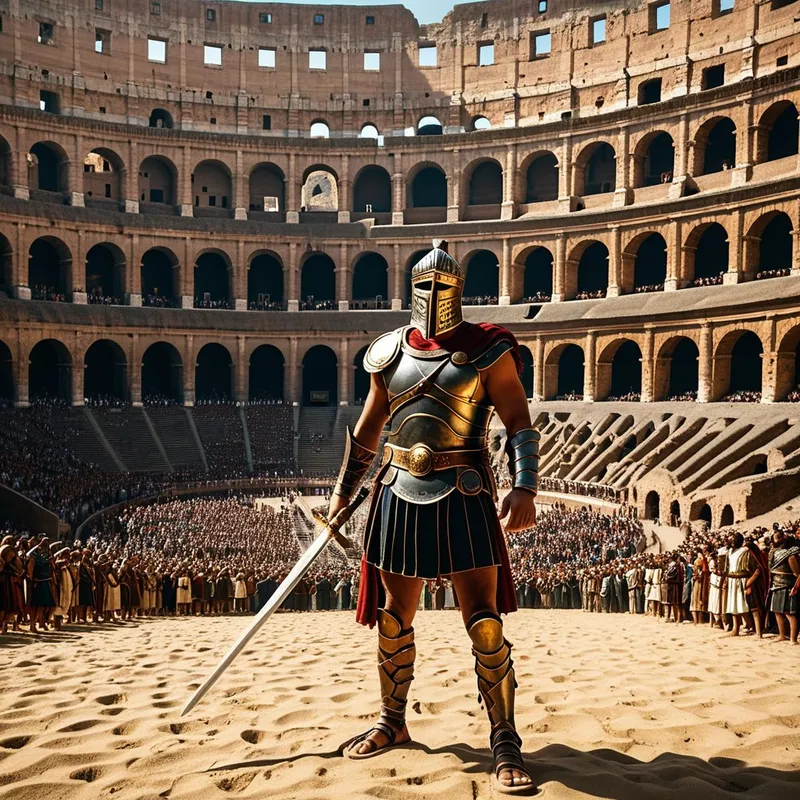
Hear now the roar that is not a roar of beasts, but of the city itself—a great, heaving breath drawn from a hundred thousand throats. The air in the Amphitheatrum Flavium is thick with the scent of sand, sweat, and spice, hot under the relentless eye of the sun. This is not merely a place of stone; it is a living throat, a sacred pit where the gods of state and the gods of the underworld meet in the dust.
Into this circle of fate strides the murmillo. His world has shrunk to the feel of the grip on his short sword, the weight of the helmet on his brow, the glimpse of the world through a narrow visor. Across the sand stands his opposite, the retiarius, a dancer of death with a net that whispers of fishermen and a trident that echoes the sea. They are not enemies by birth, but by design, paired by the lanista like living pieces on a divine game board.
The herald’s trumpet cuts the din. There are no words, only the signal. The dance begins—not a brawl, but a terrible, precise ritual. The retiarius casts his net, a woven shadow seeking to entangle and doom. The murmillo pivots, his heavy shield a wall, his movements a prayer to Mars for strength and to Fortuna for grace. Iron rings on iron. The sand drinks the first drops of blood, a libation to the ground.
The crowd is a single, pulsing entity. Their cries are not for cruelty alone, but for virtus—the display of manly courage. They cry "Habet!"—"He is hit!"—with the detachment of priests noting an omen. The combatants fight not just for life, but for a quality of death: an honorable end, a moment of transcendent courage that will etch their name, however briefly, into the memory of Rome.
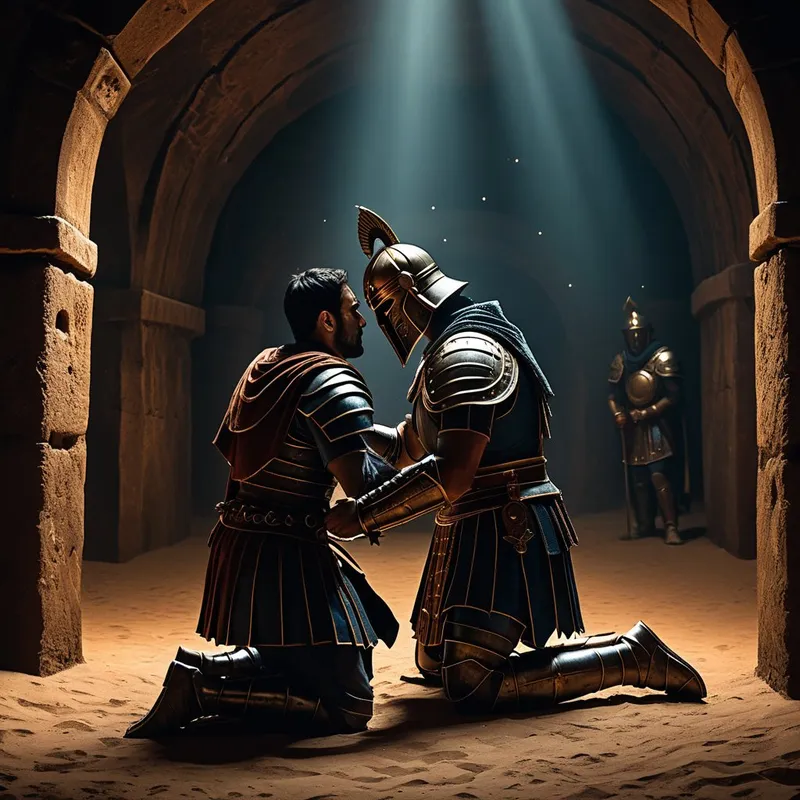
The climax approaches. The murmillo, wounded, finds a reserve not of muscle, but of spirit. He turns the retiarius’s agility against him, closing the distance where the net is useless. A final, desperate lunge. The sword finds its mark. The retiarius falls. Silence, for a heartbeat. Then, ten thousand thumbs turn upward or downward, an appeal to the emperor, who sits in the place of Pontifex Maximus, the bridge between mortal and divine. The emperor’s thumb extends. Mercy. The victor stands over the vanquished, not in triumph, but in a solemn, shared understanding. They have performed the rite. The gods are satisfied. The sand is sanctified once more.
Cultural Origins & Context
The gladiatorial games, or munera, did not originate as mere popular entertainment. Their roots were deeply funerary and religious. They began as blood sacrifices offered at the tombs of wealthy aristocrats, a ritualistic combat intended to honor the dead with the manes (spirits of the departed) and to demonstrate the family’s piety and social power. This sacred origin never fully dissipated; even at the height of the Imperial games, the events were framed as sacred to the deified emperors and the state gods.
The myth was not passed down in a single epic poem but was performed, relentlessly and publicly, for centuries. The storytellers were the gladiators themselves, the lanistae who managed them, and the editors who financed the spectacles. Its societal function was multifaceted: it was a brutal reinforcement of Roman values like discipline, contempt for death, and martial prowess; a visceral demonstration of imperial power and the Pax Romana that controlled both order and chaos; and a potent safety valve, channeling the violence and anxieties of the mob into a highly regulated, symbolic container—the sand of the arena. It was the shadow of the Roman peace, given form and ritual.
Symbolic Architecture
At its core, the arena is a profound symbol of the confrontation with the shadow. The gladiator, often a slave, criminal, or outsider, represents the part of the self that society—and the conscious ego—has condemned, enslaved, or pushed to the margins. Yet, in the arena, this despised element is given arms and a code. It is forced to fight for its life, and in doing so, it can display the highest virtues of the culture that rejects it.
The sand is the temenos, the sacred precinct where the unacceptable parts of the self are not suppressed, but are forced into a ritual combat for the sake of consciousness.
The crowd symbolizes the collective psyche—the overwhelming, often unconscious pressures of society, family, and internalized values. Their roar is the voice of the collective superego, demanding performance, judging worth, and offering a fleeting, conditional approval. The emperor, granting life or death, represents the ultimate authority of the Self (in the Jungian sense), the central organizing principle that ultimately decides what aspects of the psyche will be integrated and what must be sacrificed.
The different gladiator types—the heavily armored murmillo versus the agile retiarius—symbolize the clash of psychic opposites: defense versus offense, order versus chaos, solidity versus fluidity. Their combat is the internal conflict necessary for growth.
The Dreamer's Resonance
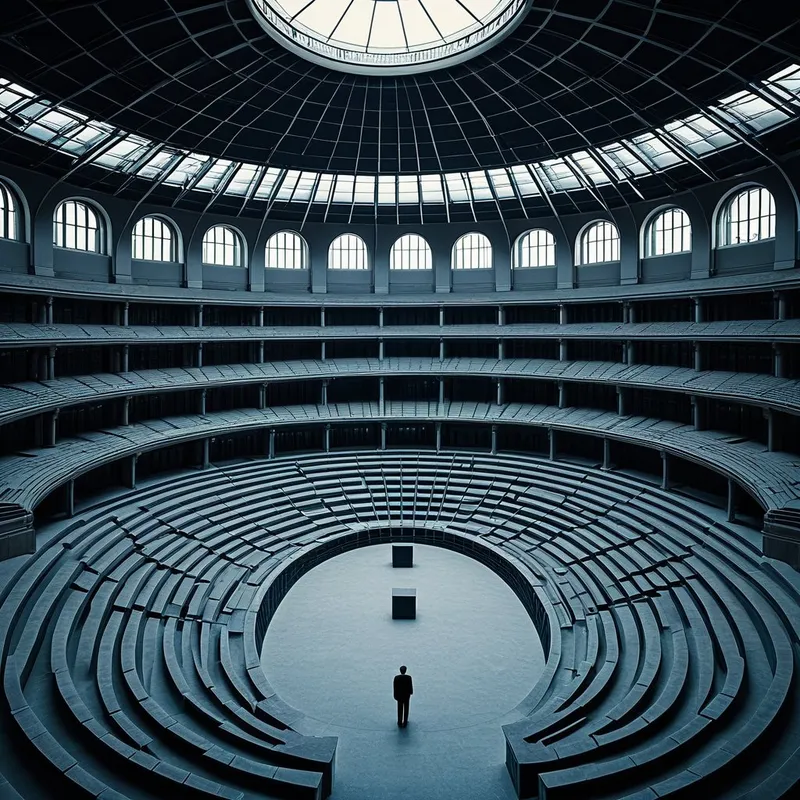
When this myth stirs in the modern dreamer, it rarely appears as a literal historical reenactment. Instead, one may dream of being forced to perform in a high-stakes, public competition where failure seems fatal—a crucial business presentation that feels like a battle, a family gathering where one must defend their life choices, or a stark, circular space where one confronts a hostile, shadowy version of themselves.
The somatic experience is key: the feeling of being trapped, exposed, and scrutinized, with a pounding heart and a sense of grim focus. This is the psyche signaling a critical moment of individuation. The "arena" is a life situation where an old part of the self (a dependency, a fear, a repressed anger) must be faced and fought with full conscious attention. The dream is not about literal violence, but about the unavoidable, often brutal, psychic effort required to stand for one’s own truth against internalized or external pressures. The fear is of being metaphorically "killed"—shamed, rejected, or annihilated—by the crowd’s judgment.
Alchemical Translation
The alchemical process mirrored here is mortificatio and separatio—the killing and separating of elements to extract their essence. The gladiator, as a symbol of a complex or an aspect of the shadow, must "die" in its old, unconscious form. This is not a physical death, but the death of an old attitude. The ego that enters the arena (the daunting life challenge) is not the same ego that leaves.
The triumph is not in survival alone, but in the quality of consciousness forged in the confrontation. The victor earns not spoils, but a fragment of integrity.
The modern individual undergoing this "gladiatorial" process is engaged in a sacred, if terrifying, ritual of self-definition. One must take up arms (consciousness, will, discipline) against those parts of oneself or one’s life that feel alien and threatening. The "crowd’s" approval—whether from parents, peers, or social media—must be witnessed but ultimately surrendered to the authority of one’s own inner "emperor," the deeper Self. The goal is integration: the retired gladiator, scarred but free, who has taken the virtus displayed in combat and used it to build a life of authentic authority. The sand of the arena, where everything was risked, becomes the fertile ground for a new, more conscious existence. The ritual is complete not when the enemy is destroyed, but when the combatant understands that the enemy was a necessary teacher in the art of becoming whole.
Associated Symbols
Explore related symbols from the CaleaDream lexicon: