Ghosts/Spirits Myth Meaning & Symbolism
A journey through the universal human story of the restless dead, the unquiet spirit, and the thin veil between the living world and the world of memory.
The Tale of Ghosts/Spirits
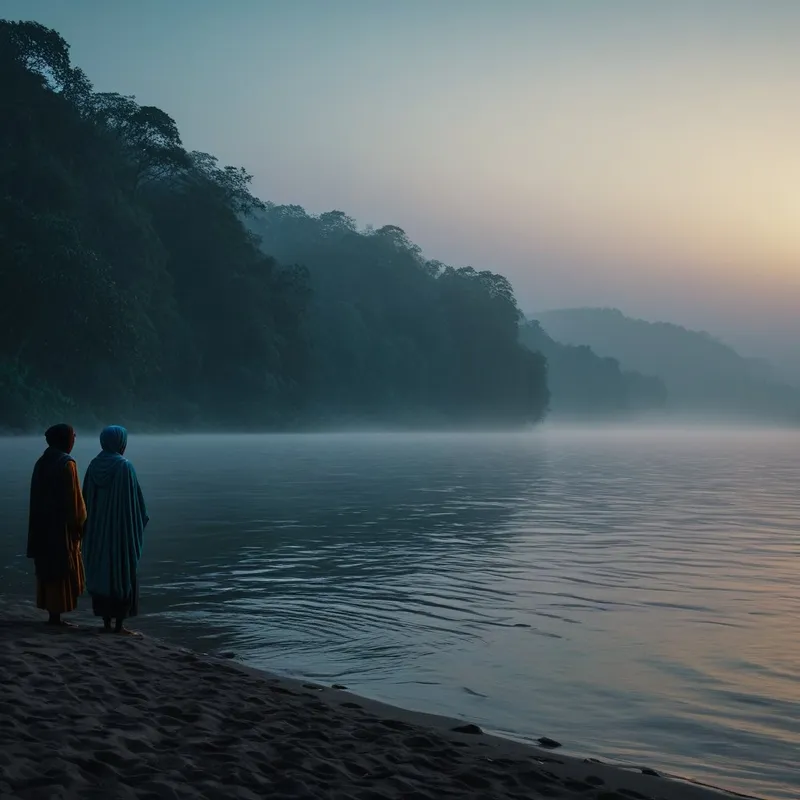
Listen. The world is not one, but two. There is the world of sun and soil, of breath and beating hearts. And there is the other world, the world of shadow and echo, of memory and wind. Between them stretches a veil, thin as a moth's wing, vast as the night sky. It is not a wall, but a mist. And through this mist, they sometimes wander.
They are the ones who did not cross. The soldier who fell on a foreign field, his eyes still searching for the path home. The mother who left in a whisper, her song half-sung, her hand still reaching for a child's cheek. The betrayed, the forgotten, the ones whose stories were cut with a knife's edge, leaving a frayed and bleeding thread. Their feet find no purchase in the soft earth of the afterlife; they are caught in the in-between, in the borderlands of longing.
They walk where they lived. You feel them as a chill where no window is open, a scent of ozone and old roses. You see them from the corner of your eye—a shape at the foot of the stairs, a reflection in a dark window that is not your own. They are not whole. They are a fragment of a laugh, a loop of anguish, a single moment of terror or love fossilized and replaying in the empty house of the world. They knock on the doors of the living with the soft tap of a branch, with the sigh in the wires.
Some mean no harm. They are merely lost, tracing the fading map of a life now over. Others are hungry. They feed on warmth, on attention, on the vivid terror or pity they stir. They are the unresolved equation, the unpaid debt, the oath sworn in blood and broken. They cling to places, to objects—a locket, a battlefield, a threshold where a last word was spoken.
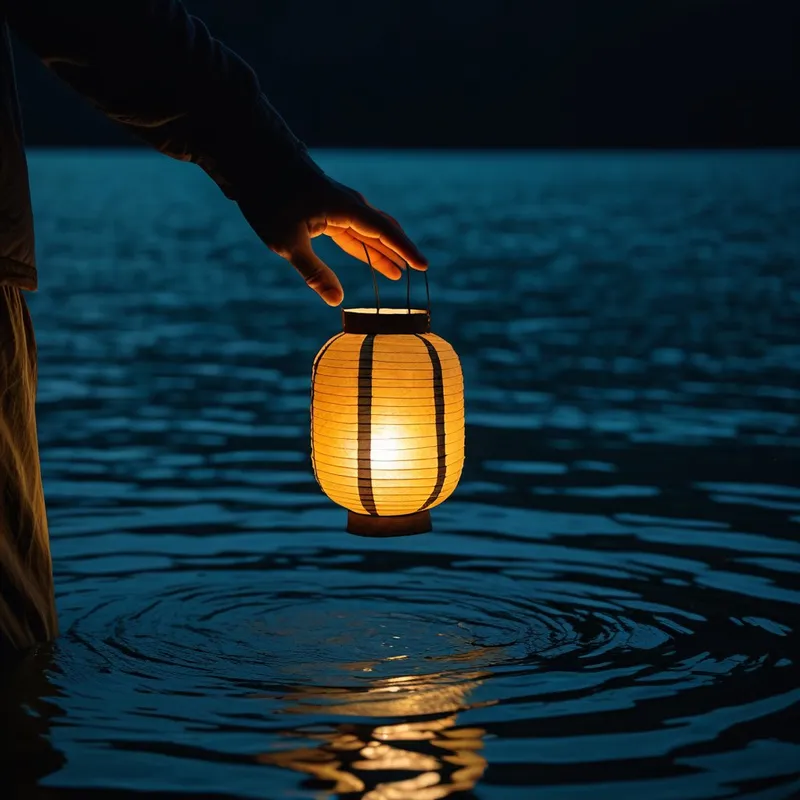
And so, the living learn the rituals. They light candles to become beacons in the mist. They set out plates of food and cups of wine, sustenance for a journey. They speak the names aloud, weaving the frayed thread of a story back into the family tapestry. They burn paper money, paper houses, paper horses—sending substance into the insubstantial realm. They gather at the crossroads, at the riverside, at the appointed time when the veil is thinnest, and they call. They guide. They remember.
For that is the only true exorcism, the only magic that can mend the tear: to witness the story. To say, "I see you. I name you. Your pain is remembered." And sometimes, if the memory is strong enough and the love pure enough, the flickering figure at the edge of the woods will, at last, turn away. The cold spot in the room will warm. The knocking will cease. The thread, finally, is tied off. The ghost becomes an ancestor. The spirit finds its shore. And the veil, for a moment, settles back into place, whole and silent once more.
Cultural Origins & Context
The myth of the ghost is perhaps humanity's oldest and most persistent story, found in every culture that has pondered death. It is not a single myth but a vast, interconnected web of folklore, ritual, and belief that forms a core part of our symbolic language for the unknown. From the <abbr title="In ancient Mesopotamian belief, a restless, often malicious spirit of the dead">etimmu</abbr> of Mesopotamia to the <abbr title="The Japanese concept of a vengeful ghost, often female, with long black hair and a white burial kimono">onryō</abbr>, from the ancestral <abbr title="The revered spirits of deceased family members in many African Traditional Religions">Shona vadzimu</abbr> to the sorrowful <abbr title="In Celtic folklore, a spirit or apparition foretelling a death, often seen as a crying woman">banshee</abbr> of Ireland, the ghost is a universal archetype.
These stories were not mere entertainment; they were functional cosmology. They were told by firelight by elders and shamans, encoded in funeral rites and festival calendars like the Mexican <abbr title="The Day of the Dead, a celebration where the dead are welcomed back to the world of the living">Día de Muertos</abbr>, the Chinese <abbr title="The Hungry Ghost Festival, when restless spirits are believed to roam the earth">Zhongyuan Jie</abbr>, or the European All Souls' Night. Their societal function was multifaceted: to explain the unexplainable (strange sounds, sudden chills, dreams of the deceased), to enforce social contracts (warning against broken oaths, improper burial, or dishonoring ancestors), and to provide a framework for managing grief and memory. The ghost myth taught the living how to relate to the dead, creating a protocol for separation that maintained the integrity of both worlds.
Symbolic Architecture
Psychologically, the ghost is the embodied symbol of the unassimilated past. It represents that which has been severed from consciousness but has not been integrated or released. It is the psychic energy of a trauma, a loss, a secret, or an unlived life that remains "undead"—neither properly buried in the tomb of memory nor transformed into wisdom.
The ghost in the attic is not a visitor from the grave, but a memory that the house of the self has refused to live with on the ground floor.
The <abbr title="A location where the veil between worlds is thin, such as a crossroads, bridge, or shoreline">liminal space</abbr> it haunts is the threshold of awareness. The haunting repetition of its actions mirrors the neurotic loops of the unconscious, where unresolved conflicts replay endlessly. The ghost's coldness symbolizes emotional withdrawal, the freezing of a moment in time. Its invisibility yet palpable presence is the perfect metaphor for the shadow aspect—known only by its effects, its eerie knock on the door of our conscious mind.
The Dreamer's Resonance
When a ghost walks in modern dreams, it is rarely about literal fear of the dead. It signals that something from the dreamer's own psychic history is "knocking," seeking acknowledgment. Dreaming of a familiar deceased person may point to unfinished emotional business or a quality of that person (their strength, their sadness) that the dreamer needs to reclaim or understand. Dreaming of an unknown, pursuing ghost often personifies a growing anxiety, a guilt, or a repressed truth that is gaining strength in the shadows and is now demanding an audience.
The somatic experience in the dream—the chilling air, the paralysis, the muffled sound—is the body keeping score of psychological tension. The dream-ghost’s insistence is the Self's attempt to bring a fragmented piece of personal history back into the light of consciousness, to stop the endless, lonely haunting in the internal corridors of the mind. The dream is an invitation to perform the ritual: to stop, turn, and face what has been following you.

Alchemical Translation
The alchemical process modeled by the ghost myth is that of solve et coagula—to dissolve and recombine. The ghost is the prima materia, the leaden, haunting weight of the unprocessed past. The journey of the myth is the individuation path from haunted to whole.
The work is not to destroy the ghost, but to host it. To offer it a seat at the table of the self and listen to its story until it is no longer a terror, but a teacher.
First, one must confront the cold spot—the avoided memory, the buried grief, the disowned passion. This is the lighting of the candle in the dark room. Then, one must name it—articulate the pain, the loss, the fear with conscious language. This is the speaking of the ancestor's name. Finally, one must integrate its essence—not the literal event, but the psychic energy trapped within it. The ghost of a lost love transforms into a capacity for deeper connection. The ghost of a failure becomes resilience. The spirit of a forgotten joy becomes a reawakened creativity.
In this alchemy, the restless, hungry phantom is transmuted. It ceases its lonely haunting at the threshold and crosses over into the psyche's sacred grove, becoming an ancestor spirit—a guiding, remembered part of one's own depth and history. The veil mends not by forgetting, but by a profound, compassionate remembering. The house of the self is no longer haunted; it becomes inhabited, fully and courageously, by all the stories of who you are.
Associated Symbols
Explore related symbols from the CaleaDream lexicon: