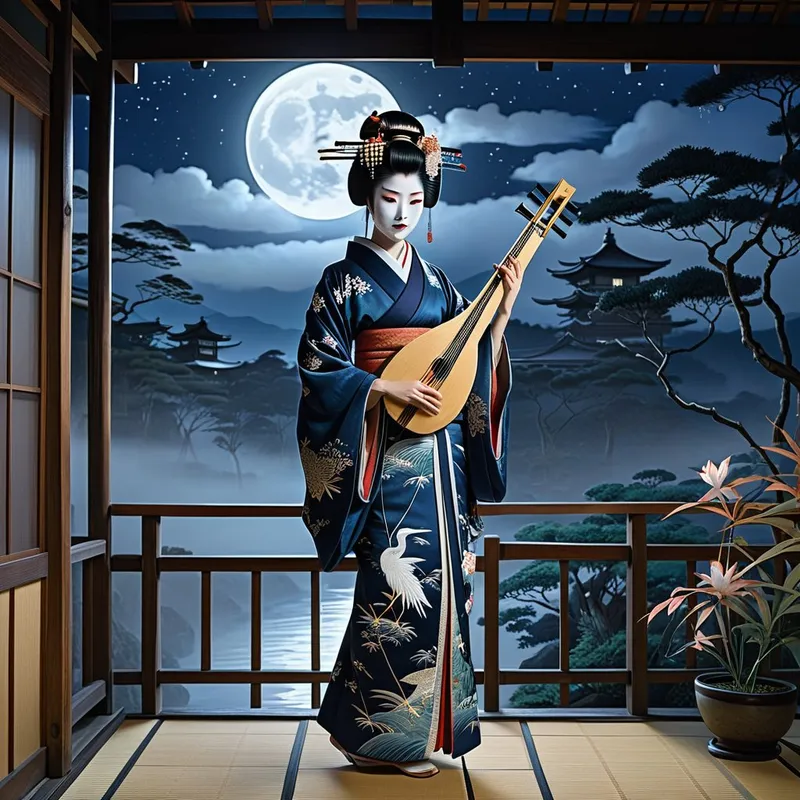
Geisha Myth Meaning & Symbolism
A myth of the woman who becomes a living vessel for art, mastering the ephemeral to create moments of suspended, perfect beauty.
The Tale of Geisha
Listen, and you will hear the whisper of silk against tatami, the ghost of a note from a shamisen hanging in the humid night air. This is not a tale of gods on mountaintops, but of a mortal artistry so refined it brushes the divine.
In the floating world of hanamachi, where cherry blossoms fell like silent snow and lanterns glowed like captive fireflies, a transformation was wrought. It began not with a birth, but with a choice, or perhaps a destiny accepted. A girl, often young, crossed the threshold of an okiya. Here, she ceased to be merely herself. She was given a new name, a poetic fragment—Harusame, perhaps, or Tamami—a shell into which a new soul would be painstakingly built.
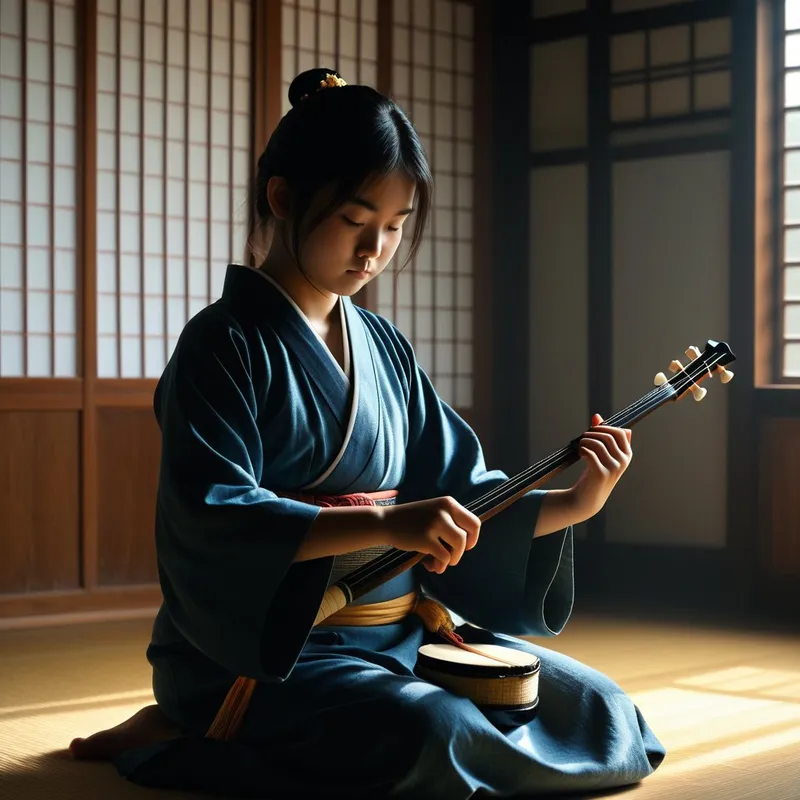
The years that followed were a silent epic of discipline. Her world became the keiko-ba, a space of relentless repetition. Fingers bled learning the shamisen’s demanding strings. Feet ached, mastering the precise, sliding steps of dance, each movement a word in an ancient, physical language. She learned to sing the melancholic kouta, to play the subtle games of conversation, to pour sake with a grace that made the act a ceremony. Her teachers were stern, the mirrors unforgiving. The girl was being unmade, layer by layer, to be rebuilt as a vessel.
Then came the night of her misedashi. The final layer was applied: the oshiroi, painting her face into a perfect, impassive moon. The crimson of the lips, a deliberate, artful stroke. The weight of the shimada, pinned with kanzashi of tortoiseshell and silk. Finally, the furisode, a universe of silk wrapped tightly around her, each fold a boundary, each pattern a silent poem. The girl was gone. In her place stood the Geisha, a living ukiyo-e.
Her stage was the ochaya, a world of soft light and softer music. Here, she did not merely entertain; she orchestrated reality. With a glance, she directed the flow of conversation. With a subtle joke, she defused tension. Her dance was not a performance for spectators, but an invocation of a seasonal feeling—the longing of autumn, the fleeting joy of spring. She played not to showcase skill, but to create a shared, suspended moment, a perfect bubble in the stream of time. The greatest triumph was not applause, but the deep, contented silence that followed a perfectly sung ballad, where the ephemeral beauty she embodied became palpable, a shared secret in the lantern-lit room. She was the artist, and the evening itself was her masterpiece.
Cultural Origins & Context
The figure of the Geisha emerged from the vibrant, complex ecosystem of the Edo period (1603-1868) pleasure districts, most famously Kyoto's Gion Kobu. It is critical to understand she was distinct from the courtesan. While both inhabited the ukiyo, the Geisha’s primary currency was artistic skill, not sexuality. She was a professional hostess, musician, dancer, and conversationalist.
This "myth" is not a single narrative passed down by bards, but a living tradition built through rigorous apprenticeship and oral transmission. The myth-makers were the onee-san and teachers, passing down not just songs and steps, but an entire philosophy of presence and aesthetic discipline. The societal function was multifaceted: she was a preserver of high traditional arts (music, dance, poetry), a facilitator of business and social diplomacy in the ochaya, and a walking ideal of cultivated, restrained beauty. She represented a realm where social hierarchies could be temporarily softened within the rules of artistic appreciation.
Symbolic Architecture
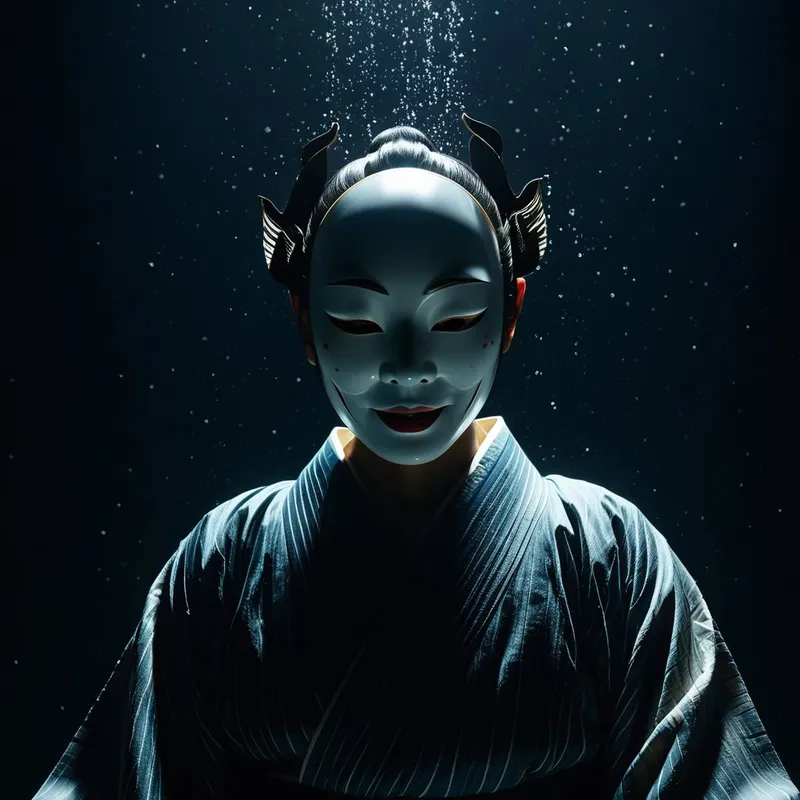
The Geisha is a profound symbol of the Persona taken to its absolute zenith. She is not a person hiding, but a self-created artifact. The white makeup is the ultimate blank slate, erasing the individual to make space for the archetype.
She represents the ultimate discipline of turning the raw material of the self—the body, the voice, the emotions—into a deliberate, beautiful form. This is not falsity, but a supreme craftsmanship of being.
Every element is symbolic. The restrictive kimono is the discipline that gives shape to grace. The nape of the neck, left unpainted, is the famous iroke—not a crude invitation, but a profound symbol of the human truth that must, and can only, peek through the artifice. It is the glimpse of the vulnerable, real self that makes the artistry poignant, not cold. The entire endeavor is a ritualized engagement with mono no aware, the poignant awareness of life’s transience. Her beauty is hyper-cultivated precisely because it, and the perfect moments she creates, are destined to vanish.
The Dreamer's Resonance
To dream of the Geisha is to encounter the archetype of the crafted self in your own psyche. It often appears during life transitions where one is learning a new role—a career change, parenthood, a new social identity. The dream may feel unsettling: you might be applying the white makeup and it won’t stick, or you’re wearing the magnificent kimono but don’t know the steps to the dance.
Somatically, this can manifest as a feeling of constriction (the kimono), a sore throat or jaw (the controlled voice and smile), or a profound fatigue in the limbs (the years of practice). Psychologically, this dream pattern signals the ego’s laborious process of building a competent Persona. The conflict is between the raw, untrained "maiden" (the girl who entered the okiya) and the demanding, perfect "artwork" (the debuted Geisha). The dream asks: What art are you trying to master? What part of your authentic self (the unpainted nape) are you allowing to remain visible, and what are you painting over?
Alchemical Translation
The Geisha’s path is a precise allegory for the alchemical process of Individuation. The nigredo, the initial blackening, is the girl’s entry into the okiya—the dissolution of her old, naive identity in the dark, difficult years of training. This is a necessary suffering, the burning away of impurity.
The albedo, the whitening, is the application of the oshiroi—the purification and crystallization of a new form. The skills learned are the rubedo, the reddening, the infusion of life and spirit into the form—the music, the dance, the wit. But the ultimate gold, the lapis philosophorum, is not the Geisha herself.
The philosopher’s stone is the moment she creates: the shared, timeless experience of beauty and connection. The true transmutation is from leaden, ordinary time into golden, meaningful experience.
For the modern individual, this myth teaches that Individuation is not about self-expression in the chaotic, raw sense. It is about the conscious, disciplined crafting of your being into an instrument capable of creating meaning—in your work, your relationships, your inner life. You must submit to the "practice room" of your own development, learn the subtle arts of emotional and social intelligence (your shamisen and dance), and understand that your most profound power lies not in asserting your ego, but in using your cultivated self to facilitate depth, beauty, and connection in the fleeting moments granted to you. The goal is to become, like the Geisha, a skilled artist of the present tense.
Associated Symbols
Explore related symbols from the CaleaDream lexicon: