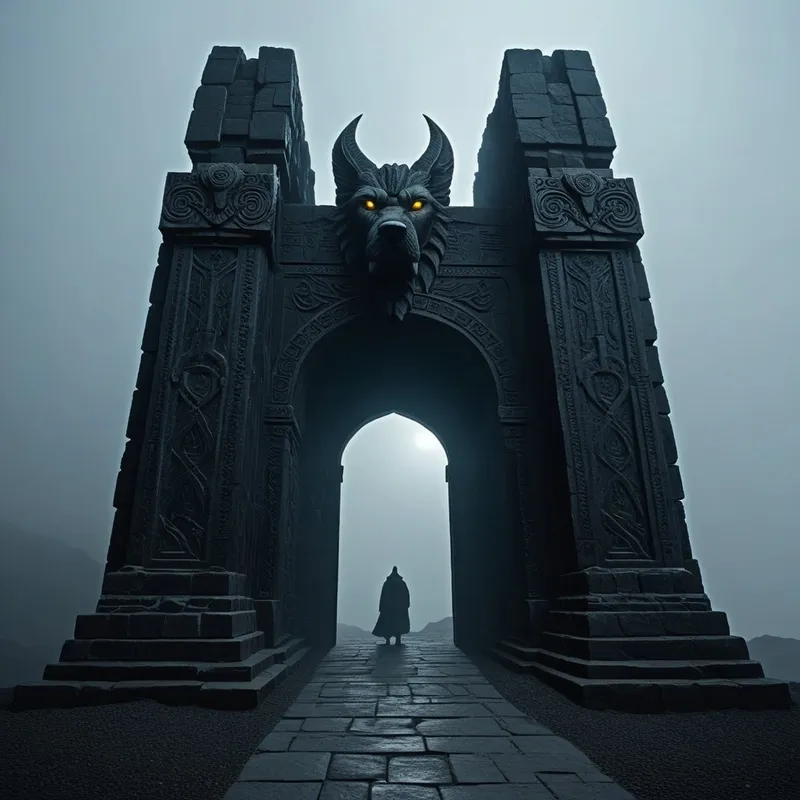
Gates of Hades Myth Meaning & Symbolism
The mythic threshold to the Greek underworld, a liminal space of dread and revelation, guarded by Cerberus and crossed only by the dead or the bravest heroes.
The Tale of the Gates of Hades
Listen, and hear of the place where the sun’s chariot never turns its golden wheels. It is a land of forgetting, a realm of whispers, and its border is marked by a gate that groans on hinges of eternal twilight.
To reach it, you must first cross the Acheron, its waters cold with the tears of a million souls. Charon, the ferryman, a figure of bone and shadow, poles his skiff through the clinging mist. His payment is a coin placed upon the tongue of the dead, a final toll for the living world. Beyond the river’s far bank, the land grows silent. The very air is heavy, a breath that does not nourish. And there, in a cleft of black rock where no plant grows, they stand: the Gates of Hades.
Forged from a metal that drinks the light, they are immense, towering, and cold to the soul’s touch. They are not meant for living eyes. Before them, a shape stirs in the gloom. It is Cerberus. Three heads, each with jaws that could crush stone, six eyes burning like banked fires. His growl is the sound of the earth cracking open. He is the final ward, the living lock, ensuring that what passes through these gates does not return.
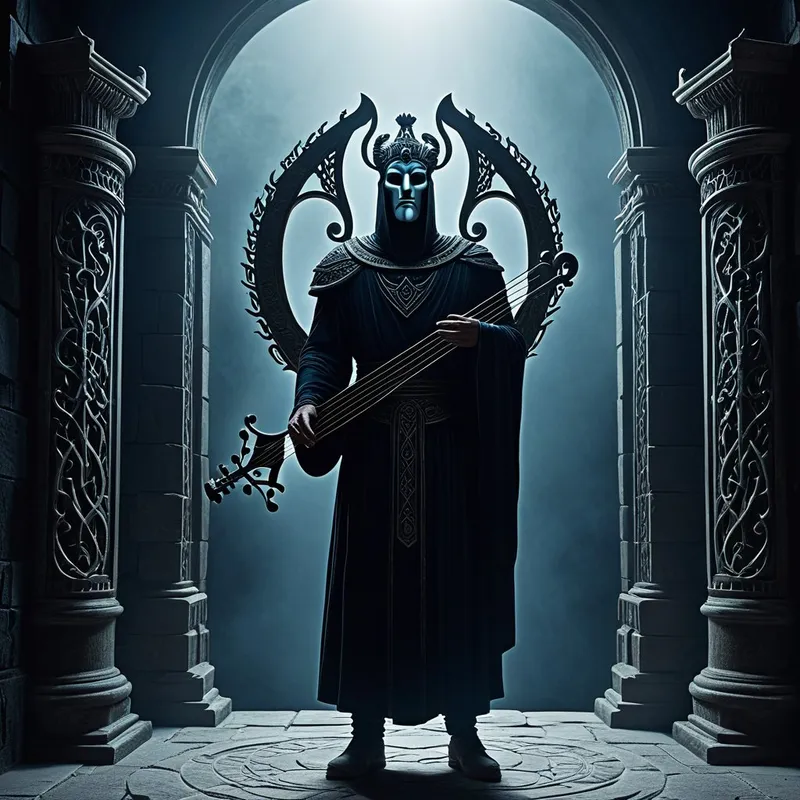
Yet, a few, driven by a love or a fury stronger than death itself, have dared to approach. The greatest of these was Orpheus. His grief was a sharper blade than any Cerberus possessed. With no weapon but his lyre, he stood before the beast and played. His music was not of this world or the next; it was the sound of pure longing. The savage heads drooped. The hellish growl softened into a whimper. The iron gates, sensing a plea not of defiance but of profound sorrow, swung open on silent hinges, granting passage to the one man whose heart was already in the kingdom of the dead.
Through that portal, he walked the Road of Hades, past the pale crowds of shades, to stand before the dark throne itself. His song moved the heart of Hades and his queen, Persephone. They granted his plea—a single thread of hope spun from music. “Lead her back,” they said, “but look not upon her until you both stand in the sun.” It was a test of the gate in reverse: a condition for exiting the realm of shadow. We know how that story ends. With the light of the world almost in reach, doubt seized him. A glance over his shoulder, and she was gone, pulled back through the unseen threshold forever. The gates had closed a second time, this time final, sealed by a human flaw.
Cultural Origins & Context
This myth was not a singular story but a pervasive cultural concept, woven into the fabric of Greek thought from the epic poems of Homer to the philosophical dialogues of Plato. The Gates functioned as the ultimate geographical and spiritual boundary in a cosmology that took the afterlife seriously. They were described in oral traditions by bards and later codified by poets like Hesiod.
Societally, the myth served multiple functions. It provided a concrete, albeit terrifying, answer to the universal question of what happens after death. It reinforced cultural values: the necessity of proper burial (to pay Charon), the finality of death (enforced by Cerberus), and the supreme difficulty of cheating fate. The rare success of a Heracles or the tragic failure of an Orpheus served as powerful reminders of the divine order. The Gates were a narrative device that marked the absolute point of no return, making any journey past them a tale of ultimate consequence.
Symbolic Architecture
The Gates are the quintessential symbol of the liminal. They are not the underworld itself, but its mouth, its moment of passage. Psychologically, they represent the threshold of the unconscious—the point where the ego’s familiar light fails and the vast, autonomous realm of the psyche begins.
To stand before the Gates is to confront the reality of all you have repressed, forgotten, or feared. It is the border of the known self.
Each element is a facet of this confrontation. The coin for Charon symbolizes the necessary sacrifice—a piece of one’s conscious identity or comfort—to begin the journey inward. Cerberus, the three-headed guardian, embodies the primal, defensive aggression of the psyche that resists conscious intrusion. His three heads may symbolize the past, present, and future anxieties that “snap” at anyone attempting to dredge up buried material. The act of passing through, whether by force (Heracles), art (Orpheus), or the quiet submission of death, represents the ego’s engagement with the depths.
The Dreamer’s Resonance
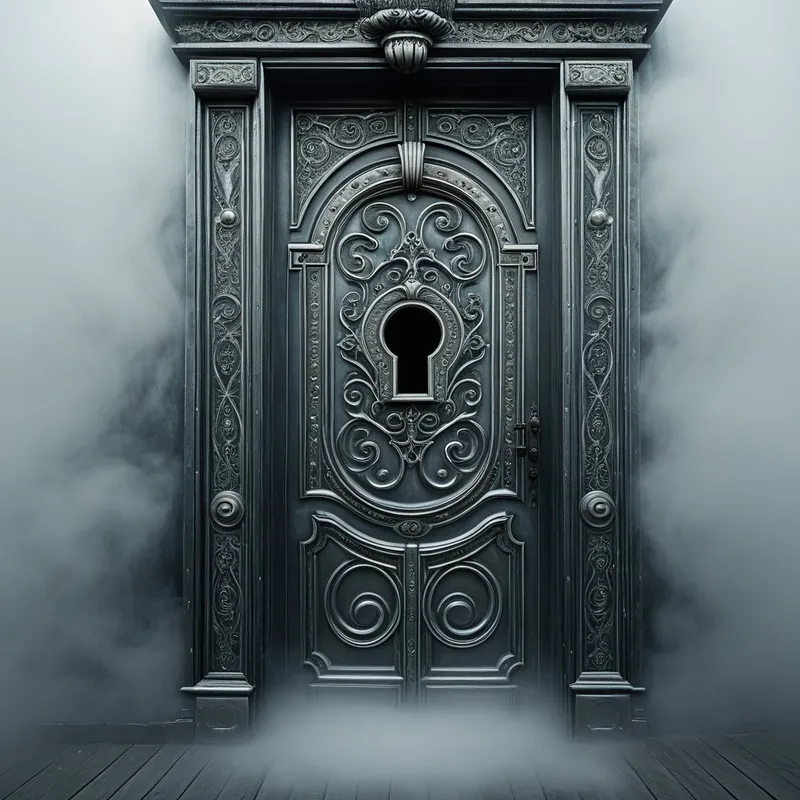
When this mythic pattern surfaces in modern dreams, it signals a profound psychological process is underway. Dreaming of a massive, imposing gate or door one cannot open often points to a felt barrier to self-knowledge or a transformative life change that is being resisted. A dream of successfully finding a key and opening such a gate may indicate a readiness to confront shadow material or integrate a new aspect of the self.
The somatic experience is key. The dreamer may feel the “Cerberus effect”: a rising, multi-fronted anxiety (health, career, relationships) that feels like a beast guarding the status quo. Alternatively, they may feel the “Orphic pull”—a deep, melancholic longing for something lost (a relationship, a passion, a former self) that draws them toward this inner threshold, even against their better judgment. The dream gate is an invitation and a warning, marking the beginning of a necessary, if daunting, descent.
Alchemical Translation
In the alchemical process of individuation—becoming one’s whole, unique self—the journey past the Gates of Hades is the stage of nigredo. It is the deliberate, courageous descent into the base matter of the psyche. The hero’s journey to the underworld is the ego’s quest to retrieve a vital value (Eurydice as lost anima, or a golden fleece of potential) that lies trapped in the unconscious.
The alchemical fire is not lit in the sunlight of consciousness, but in the darkness below. The gold of the integrated self is forged in the underworld.
The myth models the peril and the protocol. One must pay the fee (surrender a naive attitude), soothe or confront the guardian (face one’s neuroses and defenses), and navigate the inner landscape with a specific goal. The critical lesson, underscored by Orpheus’s failure, is that the treasure retrieved from the depths cannot be integrated through direct, staring ego-consciousness. It must be led out with faith, held in the peripheral vision of the soul, and allowed to emerge gradually into the light of day. To triumph is not to conquer the underworld, but to successfully negotiate with it and return, forever changed, bearing the gift of deeper self-knowledge. The Gates, then, are not an end, but the transformative beginning of the most important journey.
Associated Symbols
Explore related symbols from the CaleaDream lexicon: