Fuji Sengen Myth Meaning & Symbolism
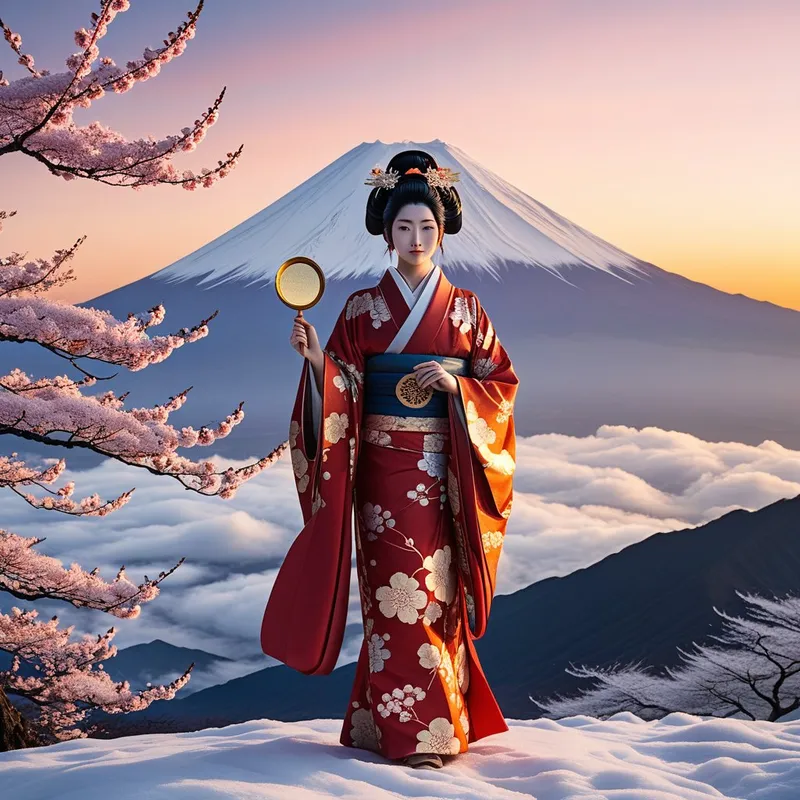
The myth of the goddess Konohanasakuya-hime, who pacifies a fiery mountain, embodying the sacred marriage of earth and sky, destruction and blossoming life.
The Tale of Fuji Sengen
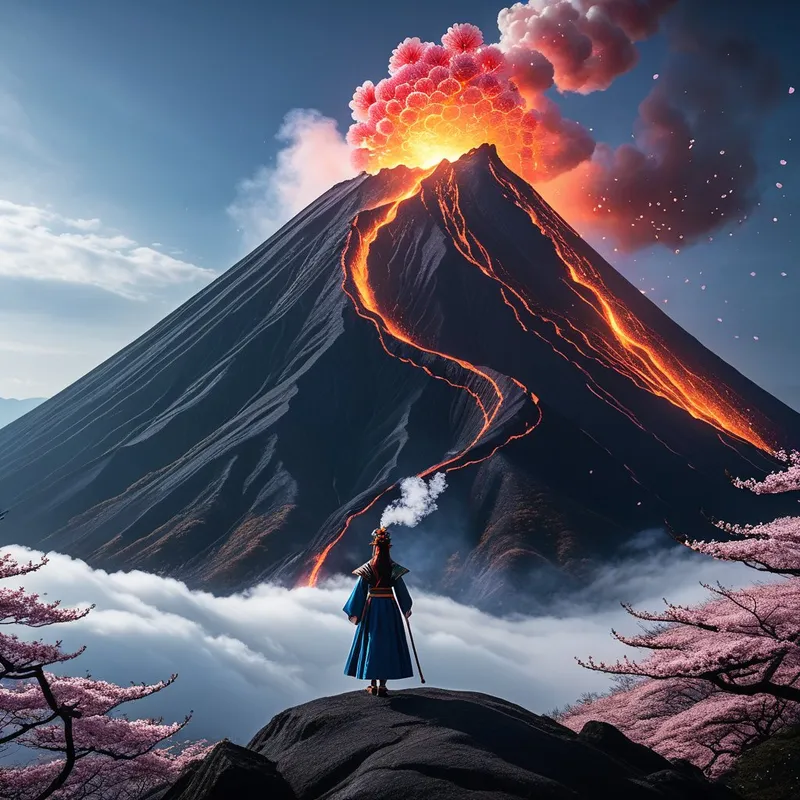
Listen, and hear the tale of the mountain that breathes fire and wears a crown of snow. In the age when the land was young and raw, the great peak we now call Fuji was a being of pure, unbridled rage. It was not a place, but a spirit—a kami of the deep earth, its heart a furnace, its breath plumes of choking ash that blotted out the sun. Rivers ran with boiling [water](/myths/water “Myth from Chinese culture.”/), and the ground shook with its terrible dreams. The people fled from its slopes; it was a god of destruction, untamed and fearsome.
The heavenly deities looked upon this chaos with concern. The beautiful, fertile land of Ashihara no Nakatsukuni was being scarred by this primal fury. They knew a force of such magnitude could not be destroyed, only transformed. And so, they sent a different kind of power to the foot of the raging mountain. Her name was Konohanasakuya-hime. She was the spirit of the fleeting cherry blossom, delicate as morning dew, yet possessing the relentless vitality of spring itself. Where she walked, saplings burst from charred soil.
She did not come with thunder or sword. She came with an offering of beauty and a plea for balance. Climbing the treacherous, smoldering slopes, the air thick with [sulfur](/myths/sulfur “Myth from Alchemical culture.”/), she faced the mountain’s core. [The earth](/myths/the-earth “Myth from Hindu culture.”/) split before her, and the mountain’s spirit manifested—not as a man, but as the mountain itself: a vision of grinding rock, flowing fire, and a voice like a landslide.
“Who dares approach my fury?” the mountain roared.
“I am Konohanasakuya-hime,” she replied, her voice clear as a mountain stream. “I bring you not conflict, but companionship. Your fire sterilizes the earth. My life makes it fertile. Your height pierces [the sky](/myths/the-sky “Myth from Persian culture.”/). My blossoms celebrate its air. Let us be joined.”
The mountain spirit raged, sending avalanches of burning stone to test her. But the princess stood firm, and where the hot rock fell, she touched the ground, and from the very cracks, cherry trees sprouted and bloomed in an instant, their pink petals swirling in the hot winds. The contrast was staggering—the ephemeral beauty against the eternal stone, fragile life against apocalyptic power.
Seeing this, the mountain’s rage began to cool, not into nothingness, but into a deep, simmering potential. The eruptions ceased. The ash settled. The fires retreated into a deep, slumbering heart. In their place, snow began to fall, laying a pure, silent blanket over the peak. The marriage was consecrated. The destructive fire kami became the dormant, sacred mountain, and Konohanasakuya-hime became its guardian deity, Fuji Sengen. From that day, the mountain was no longer a threat, but a protector, a source of water, and a ladder to the heavens. Its eruptions, when they rarely came, were seen not as anger, but as the passionate dream of the sleeping god within, tempered by the gentle, life-giving presence of the blossom princess at its summit.
Cultural Origins & Context
The myth of Fuji Sengen is not a single, codified text, but a living tradition woven from the threads of Shinto animism, folk belief, and later Mikkyō Buddhist influences. It originates from the profound human need to relate to a dominant, awe-inspiring feature of the landscape. [Mount Fuji](/myths/mount-fuji “Myth from Japanese culture.”/) was not merely a mountain; it was (and is) a personality, a divine entity.
The tale was passed down orally by kannushi and miko at the many Sengen shrines that dot the mountain’s base and approach paths, most notably the Fujisan Hongū Sengen Taisha. For centuries, pilgrims and [yamabushi](/myths/yamabushi “Myth from Japanese culture.”/) would recite versions of this story as part of their spiritual preparation for the arduous climb. Its societal function was multifaceted: it explained the volcano’s dormancy, sanctified the mountain as a national and spiritual icon, and provided a model for reconciling opposing forces—chaos and order, destruction and creation, the earthly and the celestial. The myth served as the psychic container that transformed a geological hazard into a spiritual home.
Symbolic Architecture
At its core, the Fuji Sengen myth is a profound [allegory](/symbols/allegory “Symbol: A narrative device where characters, events, or settings represent abstract ideas or moral qualities, conveying deeper meanings through symbolic storytelling.”/) for the taming and [integration](/symbols/integration “Symbol: The process of unifying disparate parts of the self or experience into a cohesive whole, often representing psychological wholeness or resolution of internal conflict.”/) of primal, unconscious [energy](/symbols/energy “Symbol: Energy symbolizes vitality, motivation, and the drive that fuels actions and ambitions.”/). The untamed [mountain](/symbols/mountain “Symbol: Mountains often symbolize challenges, aspirations, and the journey toward self-discovery and enlightenment.”/) represents the raw, undifferentiated power of the [psyche](/myths/psyche “Myth from Greek culture.”/)—the Self in its most chaotic, potentially annihilating form. It is pure affect, rage, [passion](/symbols/passion “Symbol: Intense emotional or physical desire, often linked to love, creativity, or purpose. Represents life force and deep engagement.”/), and instinctual force that, left unchecked, can devastate the inner [landscape](/symbols/landscape “Symbol: Landscapes in dreams are powerful symbols representing the dreamer’s emotional state, personal journey, and the broader context of life situations.”/).
Konohanasakuya-hime symbolizes [consciousness](/symbols/consciousness “Symbol: Consciousness represents the state of awareness and perception, encompassing thoughts, feelings, and experiences.”/), not as a dominating [warrior](/symbols/warrior “Symbol: A spiritual archetype representing inner strength, discipline, and the struggle for higher purpose or self-mastery.”/), but as a relating, fertilizing principle. She is ego [consciousness](/symbols/consciousness “Symbol: Consciousness represents the state of awareness and perception, encompassing thoughts, feelings, and experiences.”/) in its most positive [aspect](/symbols/aspect “Symbol: A distinct feature, quality, or perspective of something, often representing a partial view of a larger whole.”/): aware, delicate, persistent, and [life](/symbols/life “Symbol: The symbol of ‘Life’ represents a journey of growth, interconnectedness, and existential meaning, encompassing both the joys and challenges that define human experience.”/)-oriented. She does not slay the [dragon](/symbols/dragon “Symbol: Dragons are potent symbols of power, wisdom, and transformation, often embodying the duality of creation and destruction.”/); she marries it. Her tool is not force, but [beauty](/symbols/beauty “Symbol: This symbol embodies aesthetics, harmony, and the appreciation of life’s finer qualities.”/), [relationship](/symbols/relationship “Symbol: A representation of connections we have with others in our lives, often reflecting our emotional state.”/), and the promise of meaning.
The sacred marriage, or hieros gamos, is the alchemical union of opposites that generates a transcendent third. The volcano’s fire and the blossom’s fragility create the sacred mountain—a symbol of enduring, stabilized spiritual authority.
The resulting [Mount Fuji](/symbols/mount-fuji “Symbol: A sacred, symmetrical volcano in Japan representing spiritual ascent, perfection, and the connection between earth and heaven.”/)—perfectly symmetrical, capped with snow, yet housing fire—becomes the ultimate [symbol](/symbols/symbol “Symbol: A symbol can represent an idea, concept, or belief, serving as a powerful tool for communication and understanding.”/) of the integrated psyche. It is the [mandala](/symbols/mandala “Symbol: A sacred geometric circle representing wholeness, the cosmos, and the journey toward spiritual integration.”/) of the [soul](/symbols/soul “Symbol: The soul represents the essence of a person, encompassing their spirit, identity, and connection to the universe.”/): [chaos](/symbols/chaos “Symbol: In Arts & Music, chaos represents raw creative potential, uncontrolled expression, and the breakdown of order to forge new artistic forms.”/) ordered into sublime form, destructive power sublimated into creative potential, with a direct line (the [summit](/symbols/summit “Symbol: The highest point of a mountain, representing achievement, perspective, and the culmination of effort.”/)) connecting the earthly [realm](/symbols/realm “Symbol: The symbol of ‘Realm’ often signifies the boundaries of one’s consciousness, experiences, or emotional states, suggesting aspects of reality that are either explored or ignored.”/) to the transcendent.
The Dreamer’s Resonance
When this myth stirs in the modern unconscious, it often manifests in dreams of confronting immense, overwhelming natural forces. A dreamer may dream of a raging wildfire they must face, a tidal wave, or, most directly, a volcano erupting in their backyard or city. The somatic experience is one of deep anxiety, heat, and trembling—the body registering the psyche’s “eruption.”
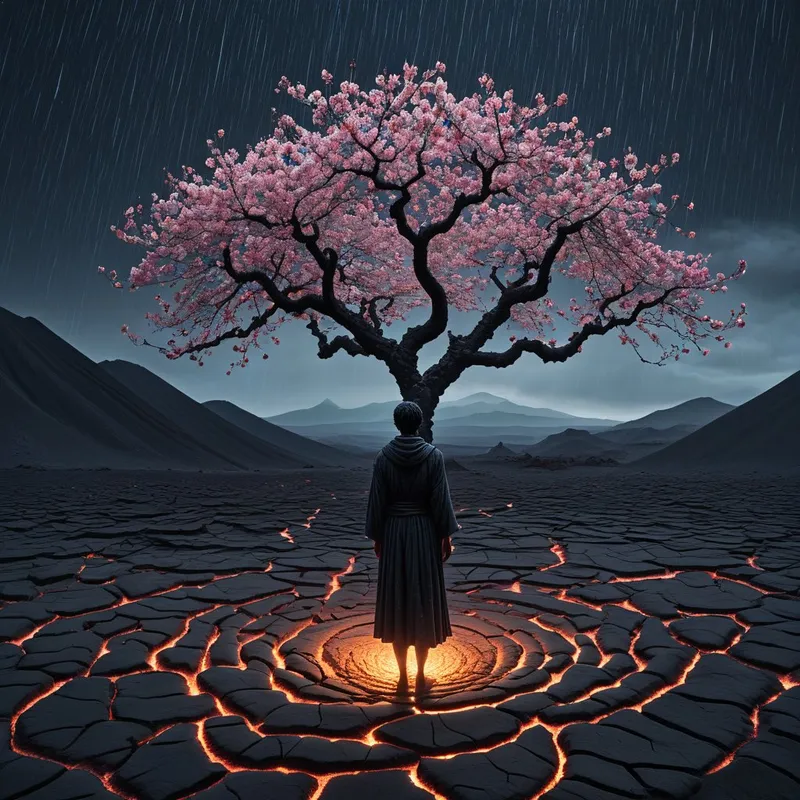
Alternatively, or subsequently, the dream may introduce the reconciling element: finding a single, beautiful flower growing in the lava field, or being given a branch of cherry blossoms by a serene figure. The psychological process here is [the ego](/myths/the-ego “Myth from Jungian culture.”/)‘s confrontation with a surge of material from the unconscious that feels destructive—a buried rage, a volcanic grief, a passionate desire that threatens to upend one’s life. The dream is not merely signaling danger; it is initiating the process of relation. The appearance of the blossom-principle suggests the nascent capacity of the conscious mind to engage this raw power, not to be destroyed by it, but to be transformed through it. The dreamer is in the prelude to integration, where the terrifying energy begins to reveal its potential as a source of immense life-force.
Alchemical Translation
For the individual, the Fuji Sengen myth maps the journey from being possessed by an inner complex to becoming the steward of its energy. The “fiery mountain” phase is when we are identified with our anger, our obsessions, or our untamed creative drives. They control us, spewing ash over our relationships and shaking our foundations.
The alchemical work begins with the “ascent”—the conscious decision to turn toward, not away from, this inner turmoil. This is Konohanasakuya-hime’s climb. It requires courage to face the heat and the shaking ground of our own depths. The offering we bring is not suppression, but the fragile, truthful acknowledgment of our own being: our vulnerability, our beauty, our desire for life.
Individuation is the process by which the volcano of the Self and the blossom of the ego recognize their essential marriage. The fire does not go out; it becomes the hearth at the center of the mountain-home of the personality.
The resolution is not the elimination of passion, but its sacralization. The eruptive power becomes disciplined creativity. The chaotic emotion becomes a grounded sense of purpose. The individual no longer fears their own depth because they have built a stable structure—the symmetrical “mountain” of their character—around it. They become like Fuji itself: a calm, majestic presence in the landscape of their life, a source of nourishment (water from the snowmelt) for themselves and others, with a direct connection to the transcendent ([the summit](/myths/the-summit “Myth from Taoist culture.”/)), accessible through disciplined pilgrimage. The myth teaches that our most terrifying inner forces, when related to with reverence and courage, are the very materials from which our sacred wholeness is forged.
Associated Symbols
Explore related symbols from the CaleaDream lexicon: