Fudo-Myoo Myth Meaning & Symbolism
A wrathful deity of immovable wisdom, embodying the fierce compassion that burns away delusion to reveal the adamantine core of the true self.
The Tale of Fudo-Myoo
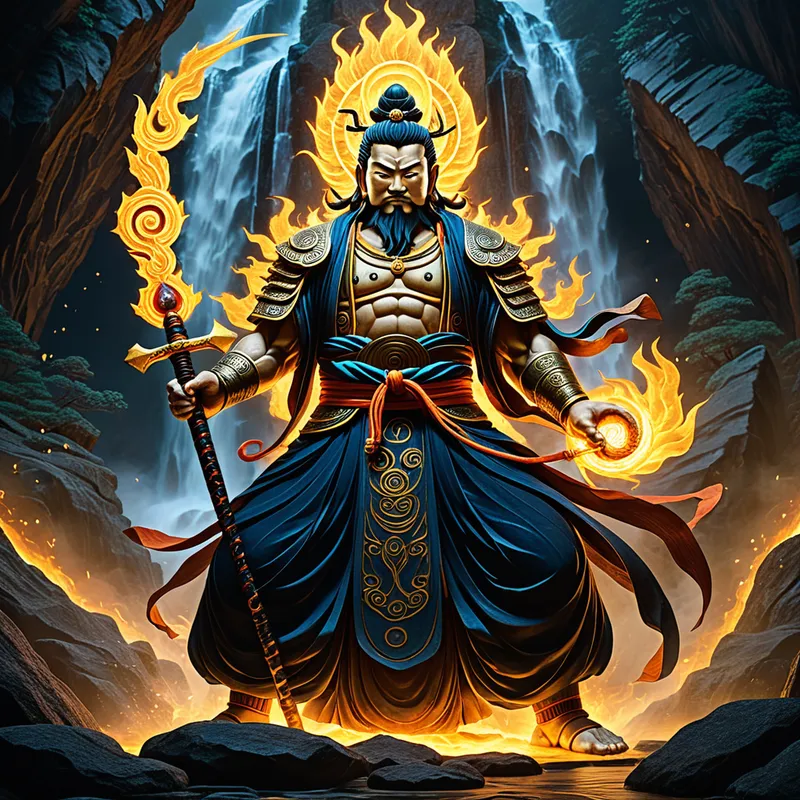
In the deep places of the world, where the roar of waterfalls drowns all mortal thought and the rock holds the memory of the first dawn, there sits a presence that does not move. The air there does not stir with common wind, but with the heat of a sacred fury. This is the domain of Fudo-Myoo.
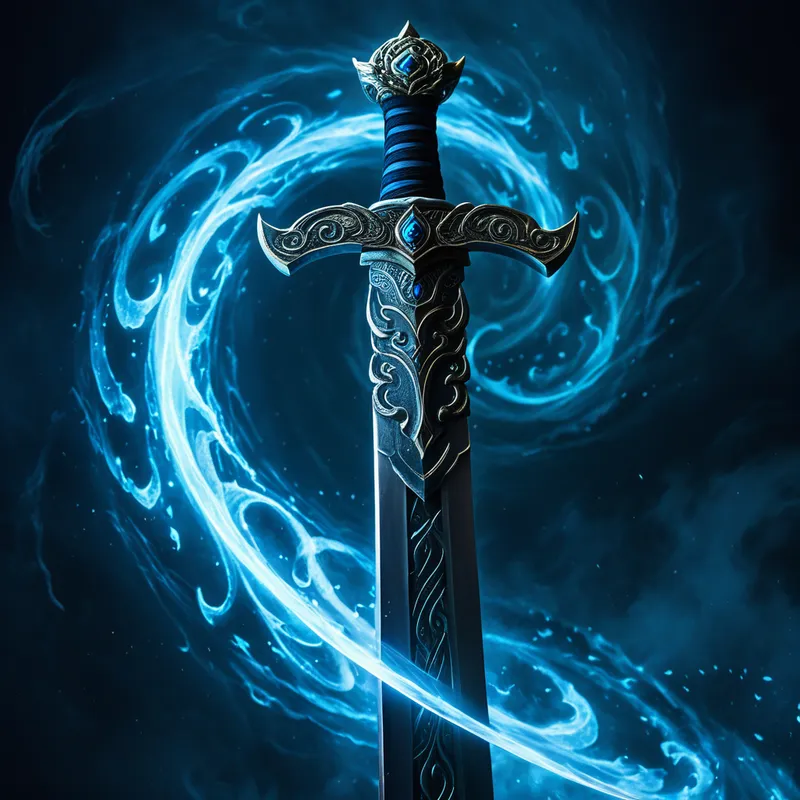
He is not found in sunlit meadows, but at the root of mountains, behind the veil of thundering water, in the heart of the impenetrable crag. His body is the blue-black of a storm cloud or of cooled lava, the hue of immense, solidified power. In his right hand, he grips Kongo-ken, the vajra sword. Its edge is not of steel, but of diamond-hard wisdom, forged to cut, not flesh, but the endless, tangled threads of human delusion—the greed that binds, the hatred that blinds, the ignorance that shrouds the soul in perpetual night.
In his left hand, he holds a coiled rope. This is no ordinary tether, but Kensaku, the lasso of compassionate capture. His face is a terrifying mask of righteous wrath, one fang bared upwards, one downwards, a silent roar against the chaos of suffering. Behind him blazes the Goma fire, a pyre of wisdom that burns eternally, its flames never consuming the rock upon which he sits, but illuminating it from within.
He does not speak. His is the silence of the mountain. His is the immovability of the bedrock. Demonic shapes, born of fear and desire, swirl from the shadows—the Mara of the human heart. They whisper, they shriek, they offer illusions of escape and pleasure. Fudo-Myoo does not flinch. The sword flashes, not in anger, but with the precise, surgical strike of truth, severing the head of deceit. The lasso flies, not with malice, but with the unerring aim of compassion, binding the flailing energy of panic and transforming it into stillness.
He is the guardian at the threshold, the unwavering pillar in the flood. He does not conquer a distant land; he holds the line within your own breast. The conflict is the swirling chaos of the unexamined life. The rising action is the gathering courage to face one's own inner specters. The resolution is not a battle won, but a presence established—an immovable seat of awareness amidst the world's, and the mind's, endless torrent. The waterfall crashes, the fire burns, and the Fudo-Myoo sits. Unshaken. Complete.
Cultural Origins & Context
While deeply associated with Shinto sacred sites, Fudo-Myoo (Acala Vidyārāja) is a central figure in Shingon and Tendai Buddhism, which syncretized profoundly with Shinto over centuries. This mythic presence lives in the liminal space where Buddhist philosophy met the animistic spirit of Japan. He is often enshrined near waterfalls, caves, and unusual rock formations—places already considered Kami-dwelling in Shinto. The myth was not told as a linear epic by bards, but transmitted through esoteric rituals, mandalic art, and the oral teachings of mountain ascetics (Yamabushi).
His societal function was multifaceted. For the state, he was a protector of the nation and the imperial law. For temples, he was the fierce guardian of the Dharma's gates. For the individual practitioner, especially in Shugendo, he represented the terrifying yet necessary process of purification and empowerment undergone in wilderness retreats. The myth was enacted, not just narrated, through the Goma fire ceremony, where offerings are burned as symbols of one's defilements, under the gaze of Fudo-Myoo. He became the archetypal model for turning one's own inner poison into the medicine of unwavering resolve.
Symbolic Architecture
Fudo-Myoo is not a god of destruction, but of radical, transformative clarity. His wrath is not emotional anger; it is the implacable, focused energy required to dismantle the psychic structures that keep us in suffering. He represents the aspect of consciousness that can say a final, thunderous "NO" to compulsion, addiction, and self-deception.
The sword is not for others; it is the surgical instrument for the self. It is the discriminating awareness that cuts through the story to the stark truth beneath.
His immovability symbolizes the unshakable center of the integrated Self, the Self that remains constant while the ego's passions rage. The lasso is the binding power of conscious attention—the ability to hold a painful complex, a shadow aspect, in the light of awareness without being identified with it or fleeing from it. The fire is the alchemical flame of introspection that burns away the dross of persona and conditioning. His rocky seat is the foundational, often rough and uncomfortable, reality of our actual condition, upon which enlightenment must be built, not as an escape, but as a deeper embodiment.
The Dreamer's Resonance
To dream of Fudo-Myoo or his symbols—a figure of fierce stillness, a sacred fire in a dark place, a sword that cuts bonds—is to dream of a critical moment of psychic consolidation. The dreamer is likely in a somatic state of high stress or moral conflict, feeling "tied up in knots" or assailed by chaotic impulses or external pressures.
The dream presents not a gentle guide, but an inner warrior-mentor. It signals the psyche's mobilization of immense resolve. The body may be processing a felt need to "stand one's ground" or to finally confront a pattern that has long been tolerated. The psychological process is one of gathering scattered energies, of moving from a state of passive suffering or confusion to one of active, determined facing. The wrath in the dream is the dreamer's own latent power, often repressed as "unacceptable" anger, now being reclaimed as a force for inner truth and boundary-setting. It is the Self insisting on integrity.
Alchemical Translation
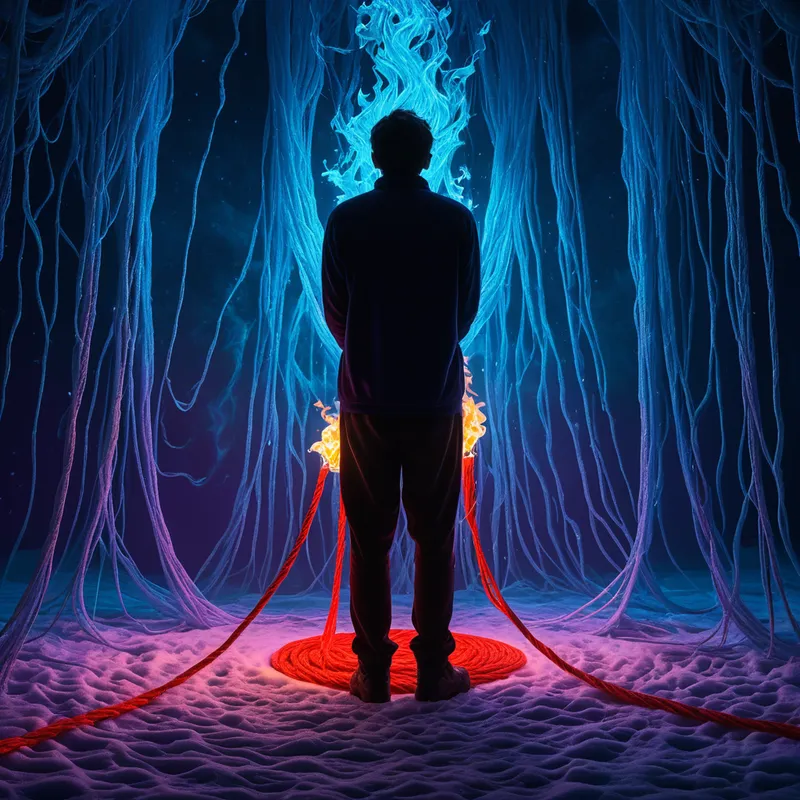
The myth of Fudo-Myoo is a precise manual for the alchemical stage of Nigredo—the confrontation with the shadow and the burning away of impurities. For the modern individual, the "waterfall" is the relentless cascade of information, opinion, and demand. The "demonic shapes" are the internalized critics, the addictive pulls, the anxieties that fragment attention.
The alchemical work is to find, or rather to forge, the immovable seat within that chaos. It is to take up the sword of discernment: "Is this thought true? Does this action align with my core?" It is to use the lasso of mindfulness to catch the runaway emotion and hold it until its chaotic energy settles into usable insight.
Individuation is not about becoming placid, but about becoming grounded enough to contain your own necessary fire.
The triumph is not the annihilation of the personal shadow, but its transformation. The raging fear, once bound by the lasso of compassionate observation, becomes steadfast courage. The tangled greed, cut by the sword of honesty, becomes focused intention. The Goma fire is the transformative heat of sustained inner work, which does not destroy the individual, but incinerates what is false, leaving the diamond-like Vajra nature of the authentic self, seated, at last, immovably in its own authority.
Associated Symbols
Explore related symbols from the CaleaDream lexicon:
- Fire — The sacred Goma flame, representing the transformative power of enlightened wisdom that burns away ignorance, passion, and obstacle without being consumed itself.
- Sword — The Kongo-ken or vajra sword, symbolizing the sharp, discriminating insight of prajna wisdom that cuts through illusion and severs the roots of suffering.
- Mountain — The immovable foundation and sacred abode of the deity, representing unwavering stability, spiritual endurance, and the lofty, challenging path of ascent.
- Waterfall — The dynamic, roaring, purifying context in which Fudo-Myoo is often depicted, symbolizing the constant flow of samsara and the cleansing power of facing truth directly.
- Rock — The deity's seat and essence, symbolizing absolute immovability, the solid ground of reality, and the indestructible core of the true self (Self).
- Rope — The Kensaku lasso, representing the binding power of compassionate means, the ability to restrain destructive impulses and lead wandering attention back to the center.
- Shadow — The demonic forms (Mara) that Fudo-Myoo subdues, directly representing the personal and collective unconscious shadow that must be faced and integrated.
- Warrior — The essential archetype embodied by Fudo-Myoo, representing the fierce, disciplined, and compassionate resolve needed for the inner battle of spiritual and psychological development.
- Order — The deity's ultimate function: to establish and protect the cosmic and psychic order (Dharma) against the forces of chaos and delusion.
- Cave — The deep, interior, often hidden space of practice and confrontation, where the alchemical work of facing one's own depths occurs.
- Lightning — The instantaneous, illuminating flash of the vajra sword's strike, symbolizing sudden insight, awakening, and the electrifying power of truth that shatters darkness.