Four-leaf clover Myth Meaning & Symbolism
A story of the Druid who captured the four winds of the Otherworld in a single clover, creating a rare talisman of perfect harmony and fortune.
The Tale of the Four-leaf Clover
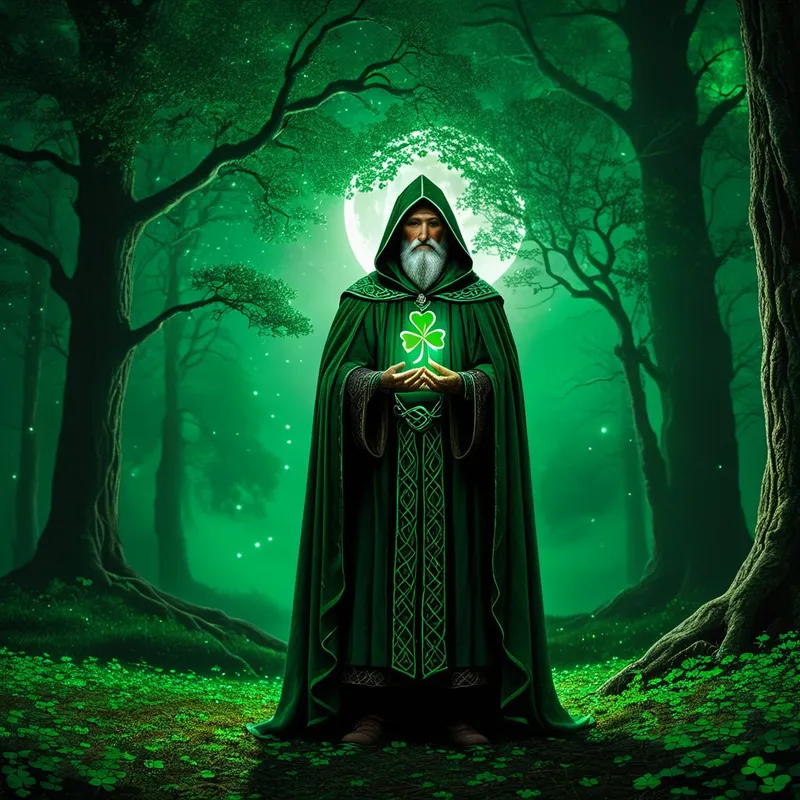
Listen now, by the fire’s glow, to a tale not of great battles or stolen treasures, but of a quiet, profound magic hidden in the green mantle of the earth. In the time when the veil between our world and the Otherworld was thin as morning mist, there lived a druid named Dairgné. He was a keeper of balances, a listener to the whispers of stone and stream.
But the world was out of joint. The four great winds of the directions—the gentle zephyr from the south, the fierce gale from the north, the damp breath from the west, and the dry gust from the east—quarreled like petulant children. Their conflict churned the skies into constant turmoil. Crops were flattened by northern fury, seeds were stolen by eastern theft, rains fell too hard from the west, and the south’s warmth grew listless and weak. The people suffered, and the land groaned beneath the discord.
Dairgné sought the counsel of the genii locorum, the spirits of the oak grove. They spoke in rustling leaves: “Harmony is not commanded; it is woven. You must find a vessel simple enough to hold complexity, humble enough to escape notice, yet strong enough to bind the wild.”
For seven days and seven nights, Dairgné fasted and walked the meadows, his bare feet feeling the heartbeat of the earth. He saw the common clover, the seamróg, beloved of the land, each leaf a testament to the sacred triple realms of Land, Sea, and Sky. But it was not enough. On the eighth morning, as the first light touched the dew, he saw it. A single clover, shining with a dewdrop like a captured star, and upon its stem, not three, but four perfect leaves.
In that moment of pure perception, he understood. He knelt, not to pluck, but to invite. He sang a song of binding, a chant that spoke of the north’s cleansing strength, the south’s nurturing growth, the west’s emotional depth, and the east’s intellectual clarity. He did not command the winds; he acknowledged them. One by one, feeling seen and valued, the quarreling winds stilled. They descended from their chaotic dance, each weaving a thread of its essence—a spark of frost, a hint of bloom, a tear of rain, a wisp of dawn—into that fourth, miraculous leaf.
The clover glowed with a soft, internal light, a miniature cosmos of perfect equilibrium. The winds, their purpose fulfilled in this new unity, resumed their journeys, but now in respectful turn, bringing balance to the seasons. Dairgné left the clover rooted, living. But its pattern was now seeded into the world—a rare and sacred blueprint. To find one, he knew, was to stumble upon a place where the world, for just a moment, is perfectly in tune.

Cultural Origins & Context
The myth of the four-leaf clover is a folk narrative that grew from the deep soil of pre-Christian Celtic animism and Druidic natural philosophy. Unlike the formalized myth cycles of the Tuatha Dé Danann, this is a seanchas tale—a story of place and phenomenon, passed down not by royal bards but by grandmothers, farmers, and hedge-doctors. Its primary function was explanatory and moral: it explained a rare natural occurrence (the genetic mutation of a white clover) and embedded within it a core Celtic value of fír flathemon—the "ruler’s truth," or the harmony between the sovereign and the land, here translated to the individual’s relationship with cosmic forces.
The three-leaf clover, or shamrock, was already profoundly sacred, used by Druids as a symbol of the triadic worldview and reportedly to symbolize the Holy Trinity by later figures like St. Patrick. The four-leaf variant, therefore, was not a replacement but a miraculous exception. Its myth served as a folk reminder that the divine or the harmonious is not only in the prescribed sacred forms but can manifest unexpectedly in the mundane, offering a personal, unmediated touch of grace and balance to the finder.
Symbolic Architecture
At its heart, this myth is a symbolic map of integration. The common three-leaf clover represents the established, stable order—the known world, the conscious mind, the cultural triad. The fourth leaf is the integrating element, the "fourth function" in Jungian terms, or the piece that makes the whole greater than the sum of its parts.
The fourth leaf is not an addition, but a completion. It transforms a symbol of the cosmos into a vessel for the soul.
The four winds represent the disparate, often conflicting, aspects of the psyche and of life itself: emotion (West), intellect (East), the unconscious/instinct (North), and the conscious/ego (South). Their quarrel is the internal and external chaos we experience when these forces are at war. The druid Dairgné represents the observing, mediating consciousness—the ego that seeks not to dominate these forces, but to listen, honor, and invite them into relationship. The act of finding the four-leaf clover in the myth is not one of searching, but of recognizing—a moment of grace where inner alignment allows one to perceive the hidden harmony in the outer world.

The Dreamer's Resonance
When the four-leaf clover appears in a modern dream, it rarely manifests as a simple plant. It may appear as a four-petaled flower in a field of three-petaled ones, a four-paneled window revealing perfect scenes, or a four-sided object that brings a deep sense of calm. This is the psyche signaling a moment of nascent synthesis.
Somatically, the dreamer may report a feeling of relief, a release of tension, or a centered calm upon seeing the symbol. Psychologically, this indicates a resolution phase. The dreamer has likely been struggling with a conflict between major life domains (work vs. family, heart vs. head, tradition vs. innovation) or feeling fragmented. The clover is the dream’s affirmation that a unifying perspective is available—not through forceful control, but through receptive acknowledgment. It is an invitation to stop striving and to allow the disparate parts to find their own natural balance. The dream says the "fourth wind" has finally agreed to join the others.
Alchemical Translation
The myth models the alchemical individuation process perfectly. The initial state is nigredo—the blackening, the chaos of the quarreling winds, representing the fragmented psyche in crisis. Dairgné’s fast and walk is the meditatio, the conscious work of introspection and engagement with the unconscious (the genii locorum).
The discovery of the four-leaf clover is the albedo—the whitening, the moment of illuminating insight. It is not he who creates the symbol; he discovers it already formed by nature, representing the archetypal pattern of wholeness that pre-exists in the collective unconscious. His chant is the crucial conjunctio—the sacred marriage. He does not force the union; he sings the invitation, performing the psychic act of valuing and giving a place to each inner "wind."
The luck of the finder is the grace that follows the inner work of reconciliation. It is the outer world mirroring an inner state of accord.
Finally, leaving the clover rooted is the rubedo—the reddening, the return to the world with the integrated state made permanent and living. The talisman’s power persists not as a physical object he carries, but as a transformed pattern within his own being and, by extension, seeded into the shared reality. For the modern individual, the myth teaches that true "luck" or fortune is not random. It is the external bounty that flows from achieving a rare internal state where all aspects of the self are acknowledged, honored, and woven into a quiet, resilient harmony. You don’t find the four-leaf clover by frantic searching. You cultivate the inner stillness of the druid, and in a moment of grace, you open your eyes to see that the harmony you seek is already here, waiting to be recognized.
Associated Symbols
Explore related symbols from the CaleaDream lexicon: