Fomorians Myth Meaning & Symbolism
The story of the monstrous Fomorians, primordial forces of chaos and the sea, whose defeat by the Tuatha Dé Danann symbolizes the ordering of the world and the self.
The Tale of Fomorians
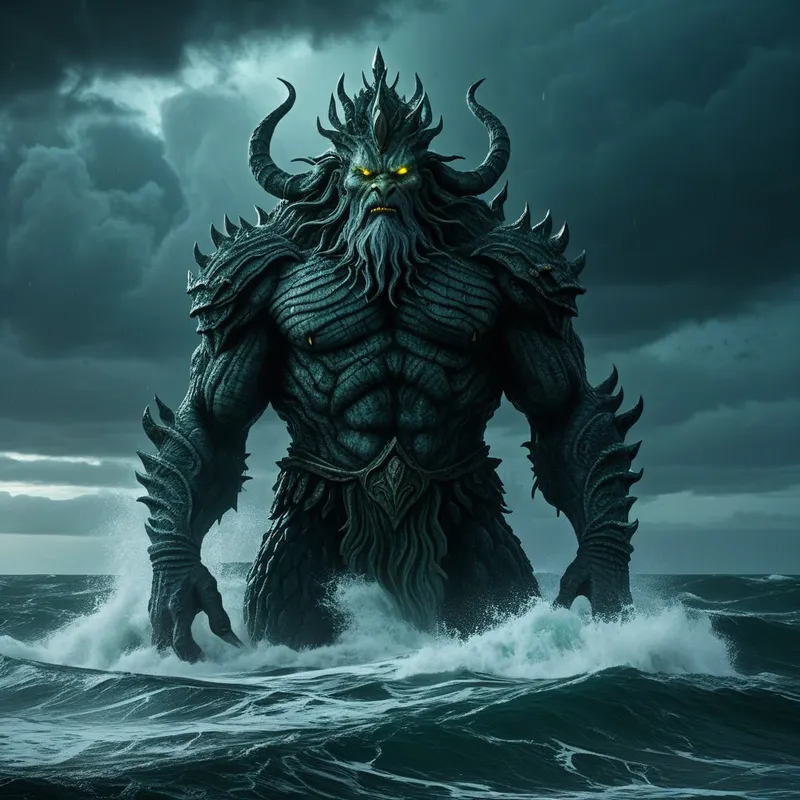
Listen now, and let the fire’s glow become the sun on a world not yet born. In the time before time, when the land was a raw, wet dream, the first beings were not of the green earth, but of the cold, churning abyss. They were the Fomorians. They rose from the depths, a host of misshapen forms: kings with one eye, one arm, one leg, their bodies a congress of man and sea-beast, their voices the groan of tidal caves. They were the storm, the famine, the crushing weight of the deep. They were not evil, for such a word is too small. They were the principle of untamed, consuming chaos, and they laid claim to the newborn shores of Ériu.
For ages, they were the law. They demanded tribute from the early peoples—not in gold, but in the very milk of the land and the strength of its children. Their rule was a cold, heavy thing, a perpetual winter of the spirit. Then came a new wind, bearing a people of skill and light: the Tuatha Dé Danann. They arrived in a mist that blotted out the sun for three days, masters of druidry, craft, and the arts of civilization. They were order, beauty, and conscious skill. And the land, groaning under the Fomorian yoke, sighed at their coming.
The Fomorian king, Balor of the Baleful Eye, saw this light as a threat. That eye, lid sealed by seven heavy locks, held a power that could wither an army where it stood. War was inevitable. It was a war not just for land, but for the very nature of reality. Would the world be one of wild, arbitrary power, or of cultivated skill and sovereign order?
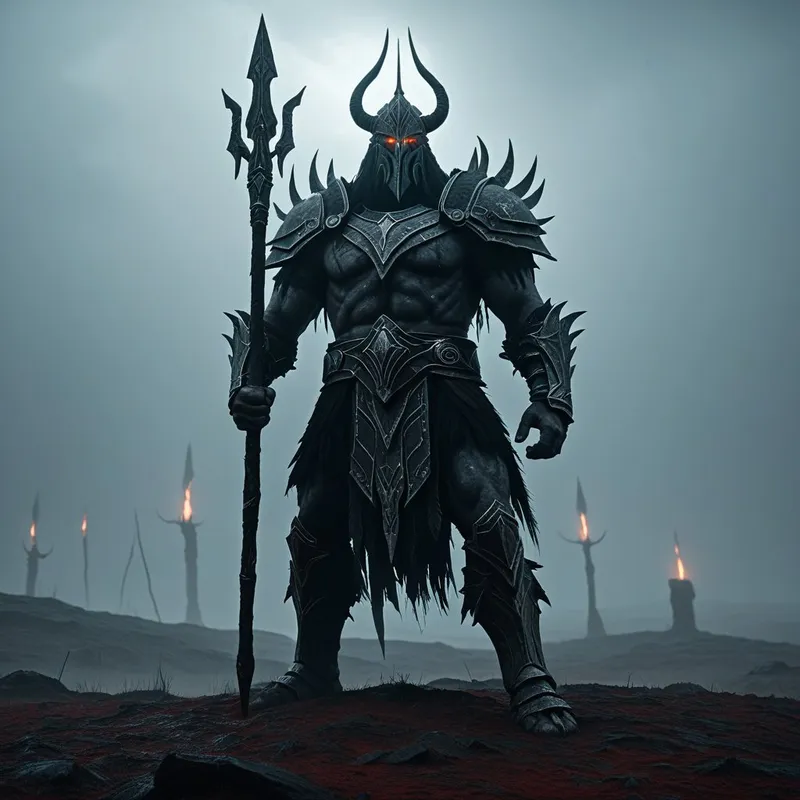
The two hosts met on the fateful plain of Mag Tuired. The air was thick with the stench of salt and blood, the cacophony of monstrous roars against the chanted spells of the Dé Danann. The battle raged, a tide of chaos against a wall of will. Heroes fell on both sides. The Fomorian champion, the immense and terrible Balor, strode forth, his lid-locks beginning to strain. But the Tuatha Dé had a champion of their own: Lugh of the Long Arm, the Ildánach, the master of every craft.
As Balor’s deadly eye creaked open, a beam of pure destruction beginning to lance forth, Lugh did not flee. With a sling-stone, honed by skill and destiny, he struck. The stone did not hit the eye, but drove it backward through Balor’s own skull, so that the baleful gaze swept over the ranks of the Fomorians themselves, turning their own king’s power against them. The chaotic host broke. The sea, their mother, took them back, not as rulers, but as a receding tide, a memory of the deep. The Tuatha Dé Danann stood victorious on the field. The land breathed free. Order, for a time, was established. The world was made fit for song, for law, for hearth-fire. But the sea, and what dwells within it, never forgets.
Cultural Origins & Context
This myth is not a simple bedtime story. It is a foundational narrative, preserved by the filid, the poet-historians of early medieval Ireland, who committed the native lore to writing even as Christianity took root. Texts like the Lebor Gabála Érenn (The Book of Invasions) and Cath Maige Tuired (The Battle of Mag Tuired) are its primary vessels. These compilations are themselves alchemical, blending pre-Christian myth with a scholarly desire to create a "history" for the Irish people that could stand beside Biblical and Classical traditions.
The societal function was profound. It explained the origins of sovereignty and the rightful order of the world. The Tuatha Dé Danann, who later faded into the aos sí or fairy folk of folklore, were presented as the divine ancestors who established the proper relationship between the people, the land, and the powers that govern it. The Fomorians represented every existential threat to that order: foreign invasion, blight, bad kingship, and the ever-present chaos of nature. The myth served as a sacred charter, justifying the current social order by rooting it in a primordial victory of cosmic significance.
Symbolic Architecture
Psychologically, the Fomorians are the ultimate representation of the Shadow in its most archaic, collective form. They are not personal failings, but the impersonal, chthonic forces of the unconscious that precede and oppose the birth of consciousness.
The Fomorian is the unformed potential that resists form, the chaos that must be encountered so that order may have meaning.
They symbolize the part of the psyche that is alien, monstrous, and seemingly hostile to the light of the ego (the Tuatha Dé Danann). Their physical deformities—one eye, one arm, one leg—speak to a consciousness that is not whole, but singular and obsessive. Balor’s eye is a perfect symbol of a destructive complex: a concentrated, unconscious power that, when unleashed autonomously, annihilates everything in its path. It cannot see relation or nuance; it only destroys.
The victory of Lugh, the master of all arts, is crucial. He does not defeat chaos with brute force alone, but with a synthesis of every skill—martial, magical, artistic. This suggests that consciousness (the ego) only triumphs over the archaic shadow by becoming integrated itself, by developing a multifaceted awareness. The stone cast backward signifies a psychological truth: we often overcome a destructive complex not by facing it head-on, but by redirecting its energy, by understanding its source so thoroughly that its power is turned upon its own origins.
The Dreamer's Resonance
When this myth stirs in the modern dreamer, it often manifests as an encounter with a vast, impersonal, and terrifying force. It is not a dream of being chased by a neighbor, but by a tidal wave, a tectonic shift, or a figure of immense, oceanic darkness. The somatic feeling is one of primal dread, weight, and cold.
This signals that the dreamer is confronting not a personal shadow element, but touching what Jung called the objective psyche—the collective, impersonal layer of the unconscious. The process is one of ego-alienation and potential reorganization. The dream-ego feels small, ill-equipped, facing something ancient and systemic. This could correlate with life periods where foundational structures are threatened: a collapse of a career identity, a profound crisis of faith, or the eruption of a long-repressed family or cultural trauma. The Fomorian in the dream is the psychic representation of that de-structuring force. The dream is the first stage of the Second Battle of Mag Tuired within the individual soul.
Alchemical Translation
The alchemical process mirrored here is the nigredo, the blackening, the necessary dissolution of the old, rigid state so that a new, more conscious one can be born. The Fomorians are the nigredo. They are the chaotic, prima materia that the alchemist must work with, not simply reject.
Individuation does not proceed by banishing the shadow to the depths, but by forging a conscious relationship with it, transforming its raw, chaotic power into a source of strength and depth.
For the modern individual, the "Fomorian struggle" begins when life itself becomes the plain of Mag Tuired. A chaotic force—a depression, a sudden loss, a crushing failure—rises from our personal depths and threatens to wipe out our hard-won sense of order and identity (the Tuatha Dé Danann of the personality). The instinct is to fight it directly, to deny it, to proclaim our "light" louder. But the myth instructs otherwise.
The work is to become Lugh, the skilled one. It is to bring all our resources—therapy, art, community, introspection—to bear not to destroy the chaos, but to understand its origin and nature. The "sling-stone" is the precise, conscious insight aimed not at the destructive symptom (Balor’s open eye), but at the underlying structure holding it in place. When we can see how our own unconscious patterns feed the monster, its energy is redirected. The depression, integrated, becomes a profound capacity for empathy and a reassessment of values. The failure, understood, becomes the cornerstone of resilience.
The Fomorians are never truly gone. They recede into the sea of the unconscious, becoming the necessary tension that keeps the land of consciousness fertile. To have made peace with them is to know that our sovereignty, our conscious self, is not a default state, but a heroic achievement, constantly renewed through engagement with the deep. We do not kill our monsters. We learn their language, and in doing so, we find they were a disowned part of our own kingdom all along.
Associated Symbols
Explore related symbols from the CaleaDream lexicon: