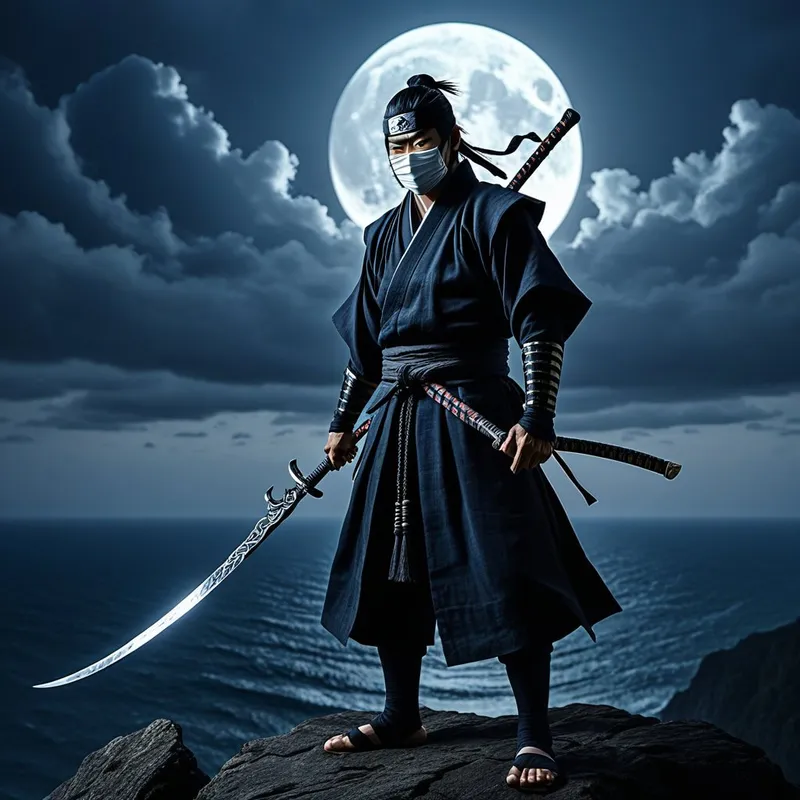
Fūma Kotarō Myth Meaning & Symbolism
The tale of a legendary ninja clan leader, a phantom of loyalty and vengeance caught between the rigid order of the samurai and the fluid chaos of the shadow.
The Tale of Fūma Kotarō
Listen, and hear the whisper from the age of warring states, when the land was painted in blood and ambition. This is not a tale of sunlit castles and honorable duels, but one born in the twilight, in the spaces between the rigid posts of society. It is the story of Fūma Kotarō, a name that was less a name and more a title passed down through generations of shadows.
He was the fifth, the most famous, a phantom given flesh. His domain was not a province, but the chaos itself—the mist of Sagami Bay, the dense forests of the Kantō plain, the alleys of towns where light feared to tread. He led not an army, but a clan: the Fūma-ryū, a brotherhood of spies, saboteurs, and silent killers who moved like the wind and struck like demons. Their loyalty was pledged to the mighty Hōjō clan of Odawara, a bond forged in the dark necessities of war.
The world was a chessboard of samurai, but Kotarō was a piece that moved in its own way, unseen. He was the master of the ambush at night, the poison in the well, the rumor that sowed discord in an enemy camp. His greatest foe was not a rival daimyo, but another legend: Hattori Hanzō, the loyal "Demon" of the Tokugawa. Their rivalry was the clash of two worlds—Hanzō, the shadow who served the emerging sun of a new shogunate; Kotarō, the shadow who served a fading star.
The climax came with the siege of Odawara. The vast forces of Toyotomi Hideyoshi surrounded the castle, a tidal wave against a stone. In the chaos, Kotarō’s arts were at their peak—raids on supply lines, false flags in the night, terror in the besiegers' hearts. Yet, even a phantom could not hold back the dawn. Odawara fell. The Hōjō were broken.
And what of the shadow when the light it served is extinguished? Some say Kotarō turned to piracy, a king of the waves, his Fūma becoming a true terror of the coast. Others whisper he was finally captured, outmaneuvered not on a battlefield, but in the court of the victorious Tokugawa by his eternal rival, Hanzō. His end is as fluid as his life—beheaded, or escaped into eternal legend. He vanished, not with a bang, but with the sigh of the wind through the pines, leaving behind only stories of a loyalty that outlasted its lords, and a power that belonged solely to the night.
Cultural Origins & Context
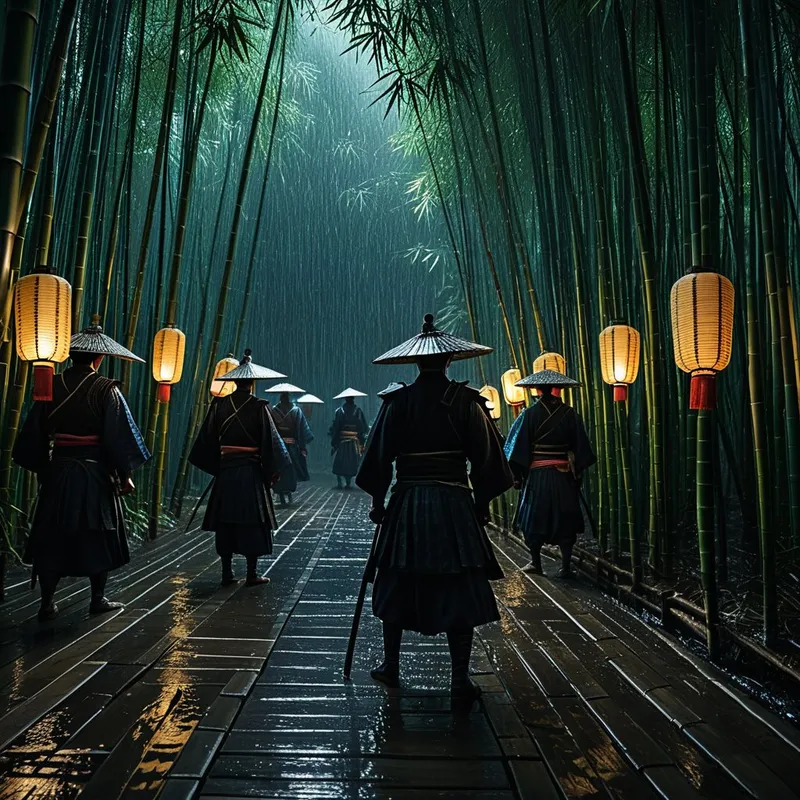
The figure of Fūma Kotarō exists in the fertile borderland between history and folklore. He is rooted in the Sengoku Jidai, a century of social upheaval where the old orders crumbled. In this chaos, the shinobi emerged as crucial, if deniable, assets. The Fūma clan were likely a historical bushidan operating in the Kantō region, expert in maritime guerrilla warfare and intelligence.
His myth was not carved in official chronicles, which were written by and for the samurai elite. Instead, it was forged in gunki monogatari, later popularized in Edo-period kōdan and kabuki plays. Here, the historical mercenary captain was transfigured into a superhuman ninja, a folk anti-hero. He represented the cunning, resourcefulness, and visceral power of the commoner, the outsider who mastered the arts the samurai publicly despised but privately needed. His stories functioned as a cultural shadow-complex—a thrilling, subversive acknowledgment of the dirty, necessary work that underpinned the pristine world of bushido.
Symbolic Architecture
Fūma Kotarō is the archetypal embodiment of the Shadow in its collective, cultural form. He is everything the samurai code of bushido seeks to repress: deception over directness, pragmatism over honor, collective subterfuge over individual glory. He is not evil, but amoral—a force of nature applied to human conflict.
The shadow warrior does not break the rules; he exists in the unspoken space where the rules do not apply.
His loyalty to the Hōjō is his tether to the world of structure. It is the contract that gives his amorphous power a direction. When that tether is severed with their fall, he becomes pure, untethered potential—hence his transformation into a pirate, a symbol of chaotic, self-directed agency. His rivalry with Hattori Hanzō is profoundly symbolic: two shadows, one who integrates into the new order (Hanzō serving the Tokugawa shogunate), and one who refuses, becoming an eternal rebel. It is the psyche's conflict between assimilating its shadow aspects and letting them rule in autonomous, potentially destructive, rebellion.
The Dreamer's Resonance
To dream of Fūma Kotarō is to encounter one's own inner guerrilla, the part of the psyche that operates outside the ego's laws. This is not a dream of brute force, but of cunning, adaptability, and profound resourcefulness born of feeling like an outsider in one's own life.
Somatically, one might feel a coiled tension, a readiness in the limbs, a hyper-awareness of environment—the body preparing for a different kind of fight. Psychologically, the dreamer is likely navigating a situation where conventional, "honorable" approaches have failed. The Kotarō energy arises as the instinct to use unorthodox methods: a strategic silence instead of a confrontation, gathering intelligence before acting, leveraging unseen advantages, or dissolving a rigid position to move with fluidity. It can also signal a deep conflict around loyalty—to a cause, a leader, or a system that may be failing, forcing the dreamer to question whether to go down with the ship or become a masterless rōnin of their own spirit.

Alchemical Translation
The myth of Fūma Kotarō models a critical, perilous stage in the alchemy of individuation: the conscious engagement with and direction of the shadow's power. The initial state is identification with a system (the Hōjō clan). The catalyst is the collapse of that system (the fall of Odawara). The climax is the shadow's release from servitude.
The immature psyche either represses its Kotarō (denies its cunning, its anger, its pragmatic amorality) or is possessed by it (becomes deceitful, chaotic, self-serving). The alchemical work is to do what Hattori Hanzō, in the myth, symbolically represents: to capture this potent force. Not to destroy it, but to bring it into some form of service to the emerging, more complex Self.
Individuation requires making a pact with your inner ninja—not to let it run the castle, but to listen to its intelligence from the walls.
This means acknowledging the parts of oneself capable of strategic deception, of fierce independence that rejects unjust authority, of survival at all costs. The triumph is not in Kotarō's victories or his romanticized piracy, but in the potential his story represents. He is the raw, undifferentiated power of the unconscious that, once recognized, can be integrated. The modern individual's "Odawara" may be a crumbling career, a dying relationship, or an outdated self-image. The "Fūma Kotarō" within is the ruthless, adaptive intelligence that emerges to ensure the psyche's survival, demanding we become not just servants of an old order, but the sovereigns of a new, more authentic, and complete inner realm.
Associated Symbols
Explore related symbols from the CaleaDream lexicon: