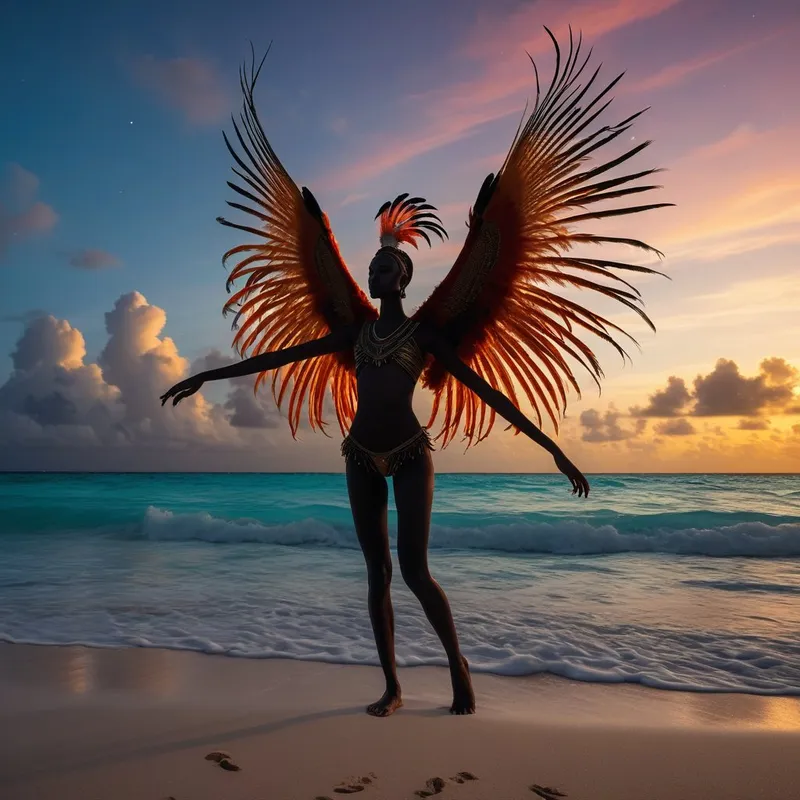
Flamingo Dancers Myth Meaning & Symbolism
A myth of celestial dancers who descend to the mortal shore, their sacrifice of flight birthing the flamingo and the enduring rhythm of life.
The Tale of Flamingo Dancers
Listen. Before the sun learned its path and the moon its pull, when the sky was a canvas still wet with first light, there were the Dancers of the Upper Air. They were not gods, but children of the space between breaths, beings woven from the music of the spheres. Their home was the Veil of Dawn, a realm of perpetual twilight and weightless grace. There, they danced the world into being—the slow pirouette that spun the clouds, the staccato tap that coaxed rain from the air, the languid sway that taught the waves their rhythm.
But from below, a silence rose. A profound, aching stillness from the newborn shores of the great sea. It was the silence of the land not yet knowing its own song. The Dancers, in their celestial rounds, felt this silence like a cold stone in their chests. They peered through the Veil and saw the world below: beautiful, yes, with sands of pearl and waters of sapphire, but mute. Its creatures moved without cadence; its winds blew without melody. The silence was a hunger, and it called to them.
The eldest among them, she whose movements painted the first colors of sunrise, spoke. “We are the keepers of rhythm. A world without a beat is a world half-born. We must go down.” The others trembled, for to pass through the Veil was to take on weight, to trade ether for earth. It was a one-way journey. Yet, the call of the silent shore was a chord they could not leave unresolved.
And so they descended. Not with the fury of a fall, but with the deliberate grace of a final, offering step. As they passed through the Veil, their luminous forms grew dense. The air of the world clung to them like wet silk. Their feet, which had never known purchase, touched the cool, damp sand. With the touch, a shock ran through them. Their celestial lightness began to seep into the ground. Their bodies, once pure energy, began to solidify.
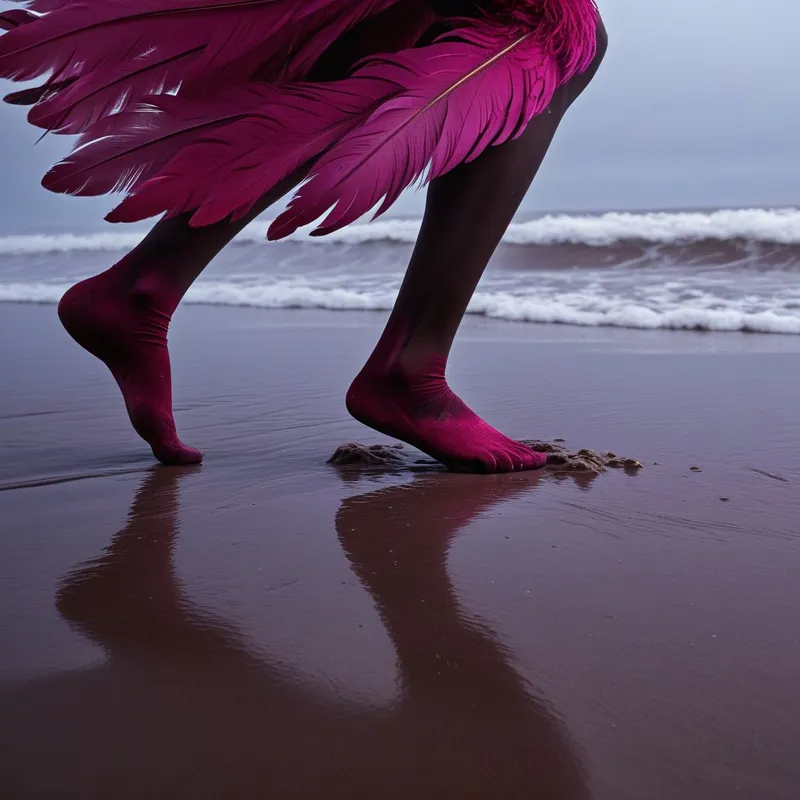
Undeterred, they began to dance. There, on the empty beach, as the true sun breached the horizon for the first time, they danced the First Dance. It was a dance of greeting and of gift. They stamped the rhythm of the tides into the sand. They swept their arms to carve the path for the trade winds. They bowed their heads to teach the palms how to sway. But with every movement, they grew heavier. The brilliant hues of their forms—the rose of dawn, the scarlet of sunset, the gold of high sun—began to run, staining their feet and legs a permanent, vibrant pink from the salt and the earth.
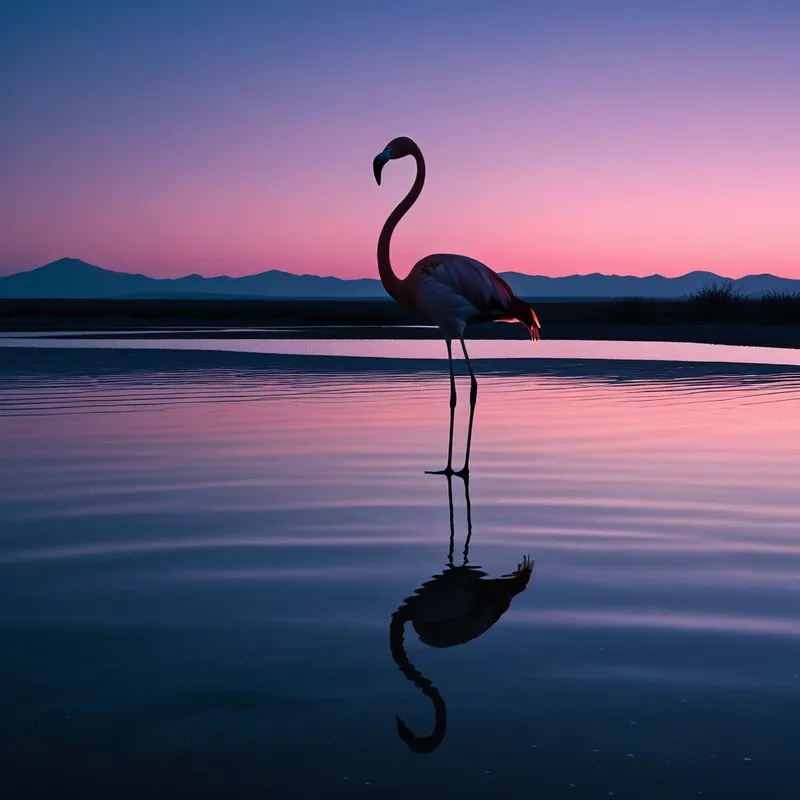
Their great wings, needed no more in this heavy world, grew stiff. The feathers, one by one, molted in a shower of fading light, dissolving into the sea foam. Their final act was not a step, but a surrender. As the dance reached its crescendo, they gave the last of their upward yearning to the land itself. Their long necks stretched not toward their lost home, but in a graceful arc to tend to the waters. Their legs, now forever stained, became slender pillars. Their dance did not end; it changed. It became the slow, deliberate wade through the lagoon, the delicate sifting of the brine for sustenance. They had traded the music of the spheres for the rhythm of the shallows. They were dancers still, but of earth and water. They had become the first flamingos, and the silent world had found its enduring, beating heart.
Cultural Origins & Context
This myth finds its roots in the oral traditions of various Amerindian cultures of the Caribbean, later woven into the fabric of syncretic storytelling post-contact. It was not a tale for grand temples, but for the intimate space of the firelight, told by elders as the day’s heat faded into the cool of evening. The storyteller was often a behique or a gifted conteur, whose role was less to record history and more to explain the soul of the landscape.
Its societal function was multifaceted. Primarily, it was an etiological myth, answering the child’s question: “Why are the flamingos pink and why do they stand in the water?” But on a deeper level, it served as a foundational narrative about responsibility, community, and the cost of beauty. In a region defined by the meeting of elements—African, European, Indigenous—and the brutal history of displacement, the story of beings who choose a difficult, transformative descent for the sake of bringing rhythm to a silent world carried profound resonance. It modeled a form of sacred adaptation, where loss is not merely endured but alchemized into a new, sustaining form of existence.
Symbolic Architecture
At its core, the myth of the Flamingo Dancers is a profound map of voluntary descent and creative sacrifice. The Dancers represent the unmanifest potential, the pure archetypal pattern of order and beauty that exists prior to incarnation. The silent shore is the material world, awaiting the imprint of soul, of meaning. The journey through the Veil is the archetypal moment of incarnation itself—the shocking, often traumatic acquisition of a body, of limits, of weight.
The sacrifice is not of the self, but of a mode of being. The gift is not of things, but of pattern—the imprint of soul upon substance.
The staining of the legs is the central symbol. It signifies the indelible mark of earthly experience. The vibrant pink is not a stain of corruption, but a badge of embodiment, a literal embodiment of the celestial colors (dawn, sunset) ground into the earth. It speaks to how our highest ideals and most beautiful potentials must, to become real, get muddy. They must engage with the grit and salt of reality. The loss of flight—the stiffening of the wings—symbolizes the acceptance of limitation, the trading of infinite potential for grounded, specific action. The flamingo’s eventual form—graceful, balanced, filtering sustenance from the brine—shows that the new mode of being is not a diminishment, but a translation. The dance continues, but its stage and its purpose have transformed.

The Dreamer's Resonance
When this myth stirs in the modern unconscious, it often manifests in dreams of weight, grace, and silent calling. A dreamer may find themselves in a vast, beautiful, but eerily quiet landscape—a deserted beach, a still lagoon. There is a deep, somatic feeling of responsibility, a need to move, to break the silence, even if they do not know how.
Dreams of trying to dance with heavy legs, or of brightly colored garments becoming stained and heavy with water or earth, are somatic echoes of the Dancers’ descent. The dream ego is grappling with the process of incarnation in a new life phase: taking on a weighty responsibility (a caregiving role, a creative project, a commitment), feeling the loss of a previous, freer identity (the “flight”), and discovering that their unique “color” or spirit is becoming permanently, visibly part of this new, grounded reality. The anxiety in the dream is the fear of being stuck, of losing oneself. The resolution, if it comes, is the dream-image of finding a new, slower, more deliberate rhythm—of wading, not flying; of filtering nourishment from a complex environment, not receiving it from the ether.
Alchemical Translation
For the individual psyche, the Flamingo Dancers myth charts the path of the individuation process, specifically the phase where the conscious ego must make a sacred descent into the neglected, silent realms of the soul or the demands of outer life. It is the alchemy of the nigredo—the blackening, the staining—as a necessary prelude to transformation.
The modern individual often experiences this as a calling to bring order or beauty to a chaotic personal or professional situation. It is the artist who must leave the ivory tower of pure ideas to engage with the messy materials of their craft. It is the caregiver who sacrifices personal freedom to tend to another. It is anyone who feels a noble impulse to “heal” or “bring rhythm” to a stagnant environment.
The alchemical fire is not in the sky, but in the friction between the soul’s grace and the world’s gravity. The pearl is formed from the grit in the shell.
The myth instructs that this process is not a failure or a contamination. The “pink stain” is the proof of the work. The psychic transmutation occurs precisely when we stop lamenting the loss of our celestial wings and learn the elegant, balanced stance of the flamingo—one leg grounded in practical reality, the other subtly active in the fluid unconscious. We learn to feed ourselves by filtering meaning (the brine) from the very environment that seemed to silence us. Our dance becomes quieter, more sustained, and ultimately more foundational. We become the stable, graceful presence that gives the silent world around us its beat, having discovered that our true home was never the escape from weight, but the sacred balance found within it.
Associated Symbols
Explore related symbols from the CaleaDream lexicon: