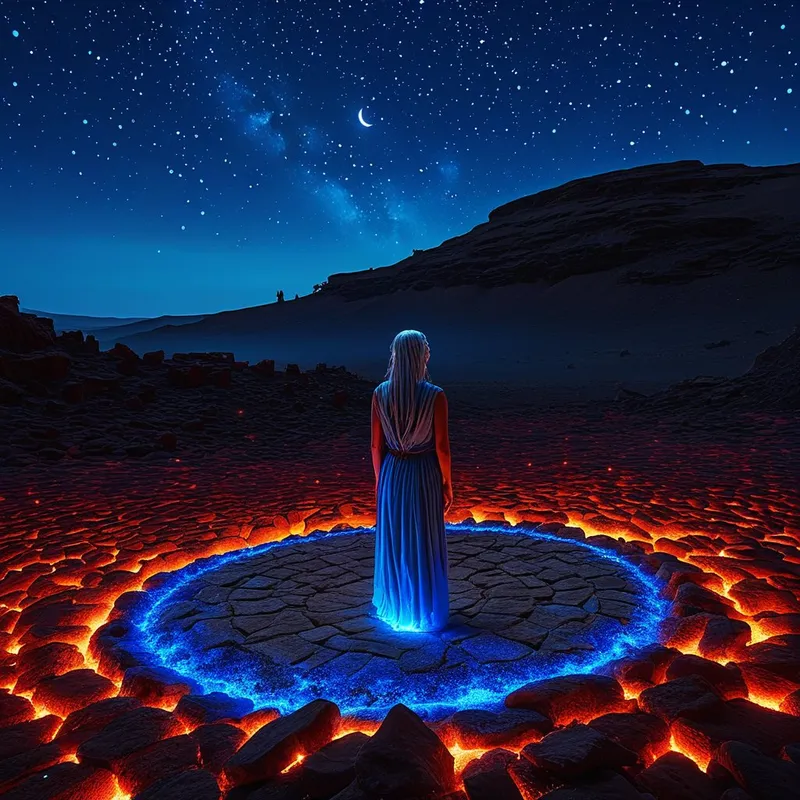
Fire Walkers Myth Meaning & Symbolism
An ancient myth of those who walked through the world's first fire, emerging not burned but transformed, carrying the sacred spark of consciousness.
The Tale of Fire Walkers
In the time before time, when the world was a cloak of cold stone and whispering shadow, the People huddled in the dark. They knew the sun, but it was a distant, untouchable god. They knew the stars, but they were cold, silent eyes. The belly of the earth held a secret warmth, but it was locked away, a dream in deep stone. The People were creatures of chill and twilight, their songs thin, their spirits brittle as winter branches.
Then came the Great Rending. The Sky Father, in a rage of thunder, struck the tallest peak with a spear of white light. The mountain wept fire. Molten stone, like the blood of the earth itself, poured forth. It devoured forests, boiled rivers into steam, and painted the night in a terrifying, beautiful orange glow. The People fled to the high places, watching the world burn below. They named it The Devouring Tongue, a beast that consumed all it touched.
Among them was a woman named Kala. While others saw only destruction, Kala heard a voice within the roar. It was not a scream of pain, but a deep, rhythmic song—the heartbeat of the world, finally exposed. She watched the flowing fire cool at its edges into a bed of pulsating, crimson coals. The voice called to her. It was a call not to flee, but to meet.
Her people begged her to stay. "It is death!" they cried. But Kala, her eyes reflecting the dancing flames, felt a truth colder than the old dark: to remain forever in the chill was a slower death. One night, as the coals gleamed like a field of fallen stars, she stepped to the edge. She removed her hides, feeling the terrible heat on her skin. She did not think. She listened. To the song. To the pulse.
She placed her foot upon the Ember Road.
The heat was an entity, a wall of pure sensation. It demanded everything. Kala did not fight it. She breathed into it, her breath becoming part of its rhythm. She walked. Not quickly, in panic, but with the deliberate, measured pace of a ritual. Each step was a conversation. The fire asked a question of her spirit; her spirit gave an answer in surrender. She felt not the searing of flesh, but a fantastic alchemy: the cold fear in her bones, the grief of the old world, the brittle stories of limitation—all were offered up as fuel. They burned away in the invisible flame of her passage.
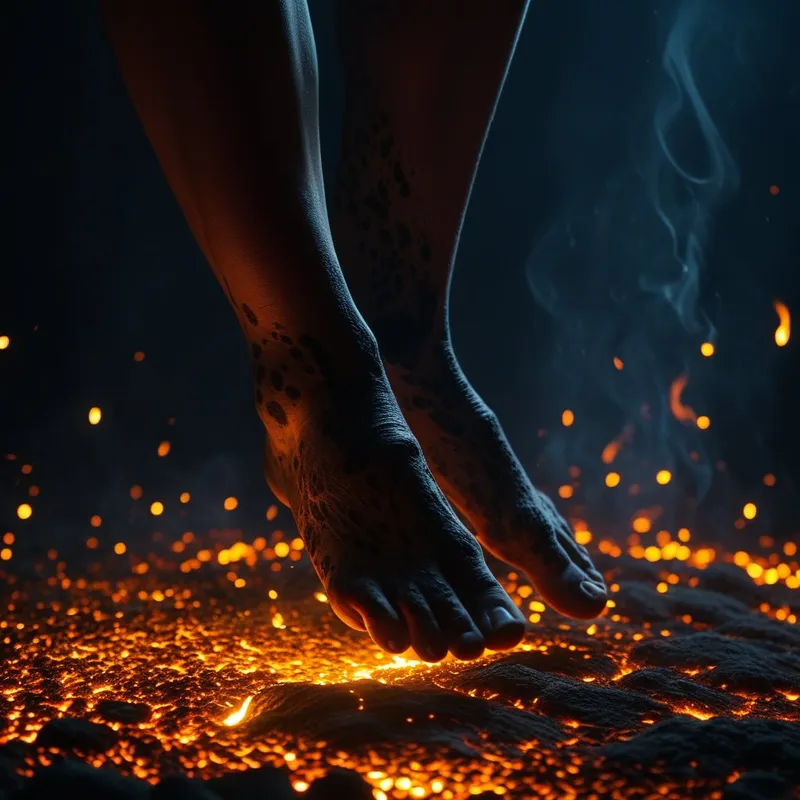
When she reached the other side, she turned. Her feet were black with sacred ash, but unburned. And in her chest, where her heart beat, a new warmth glowed—not the destructive heat of the Devouring Tongue, but a contained, steady spark. She had not crossed over fire. She had walked with it, and had carried a piece of its essence back into the world of the living. She was the first Fire Walker. And the spark she carried was the birth of the first hearth, the first community, the first conscious light held safe against the dark.
Cultural Origins & Context
The myth of the Fire Walkers is not a singular story from one tribe, but a profound archetypal narrative found across circumpolar and Siberian shamanic traditions. It belongs to the oral tapestry of peoples for whom fire was not merely a tool, but a living spirit, the very embodiment of the sun's captured power on earth. This tale was the sacred property of the angalkuq or shaman, recounted during long winter nights or at the heart of initiation rites.
Its function was multifaceted. On a practical level, it encoded the dangerous knowledge of fire's dual nature—destructive and life-giving. On a societal level, it established the shaman's authority; they were the descendants of Kala, the ones who could navigate impossible thresholds and return with power for the people. The story was a map for facing collective crises—plague, famine, spiritual malaise. It taught that the solution to a consuming threat was not always flight, but sometimes a sacred, conscious passage directly through its heart.
Symbolic Architecture
At its core, the myth is a master symbol of initiation. The fire represents the unbearable truth, the psychic pain, the core trauma, or the overwhelming life force that seems poised to annihilate the ego. The old, "cold" existence is one of defended separation. The fire is the ultimate integrator.
The fire does not discriminate; it consumes all that is offered. To walk through it is to offer everything you are, so that you may become what you are meant to be.
The Ember Road is the liminal space, the "betwixt and between" where transformation occurs. Kala’s measured pace symbolizes the necessity of presence and regulation when facing trauma; one must not rush through dissociation nor freeze in terror, but feel each step fully. Her unburned feet signify the emergence of a new psychological substance—a "diamond body" or resilient Self that can contain immense energy without being destroyed by it. The spark she retrieves is the liberated libido, the conscious creative power that was previously locked away in unconscious conflict or fear.

The Dreamer's Resonance
When this myth activates in the modern psyche, it often manifests in dreams of trial by element. You may dream of your house on fire, but instead of escaping, you find yourself walking calmly through the flames to retrieve a specific, vital object. You may dream of wading through lava, or of a crucial path that is nothing but hot coals.
Somnatically, this signals a profound process of individuation underway. The psyche is presenting you with your own "Devouring Tongue"—perhaps a long-avoided grief, a rising rage, a tidal wave of creative energy you fear will consume your stable life. The dream is not a warning to run, but an instruction to walk. It indicates that the ego has gathered enough strength to engage directly with this core material. The anxiety upon waking—the remembered heat—is the body keeping score of this profound inner work.

Alchemical Translation
For the modern individual, the Fire Walker’s path models the alchemical stage of nigredo and its transcendence. Our "fire" is the shadow, the depression, the breakdown, the addiction, the shattered relationship—any experience that feels annihilating.
The first step is Kala’s listening. This is moving from resistance to curiosity toward our pain. What is the song within the roar? What truth is this fire trying to expose? The second step is the deliberate walk: the conscious, therapeutic, or creative engagement with the material. We must "offer our feet"—our grounded reality, our felt sense—to the heat of full feeling.
The goal is not to exit the fire unchanged, but to be cooked by it. The spark retrieved is the lapis philosophorum, the philosopher's stone of your unique consciousness—the integrated insight, the healed complex, the authentic voice that can only be forged in such a furnace.
You become a Fire Walker when you stop asking "How do I put out this fire in my life?" and instead ask, "What must die in me so that I can walk through this and carry the spark forward?" The myth concludes not with the end of fire, but with its domestication into a hearth. So too, our greatest trials, once walked through with conscious courage, become the central, warming fire around which a more authentic life is built.
Associated Symbols
Explore related symbols from the CaleaDream lexicon: