Feng Huang Myth Meaning & Symbolism
A celestial bird of perfect virtue whose appearance heralds harmony, renewal, and the union of cosmic opposites, embodying the soul's capacity for rebirth.
The Tale of Feng Huang
Before the world knew its name, in the time when the sky was still soft and the earth was learning its shape, a silence fell over the Hundun. It was not an empty silence, but a listening one. The breath of the cosmos held itself, waiting at the peak of the Kunlun.
Then, from the womb of the eastern dawn, a sound was born. It was not a cry, but a note—clear, perfect, and resonant, vibrating through the very bones of the mountains. It was the sound of celestial strings being plucked. And with that sound came the light. Not the harsh light of the sun, but a gentle, iridescent luminescence that seemed to be woven from rainbows and stardust.
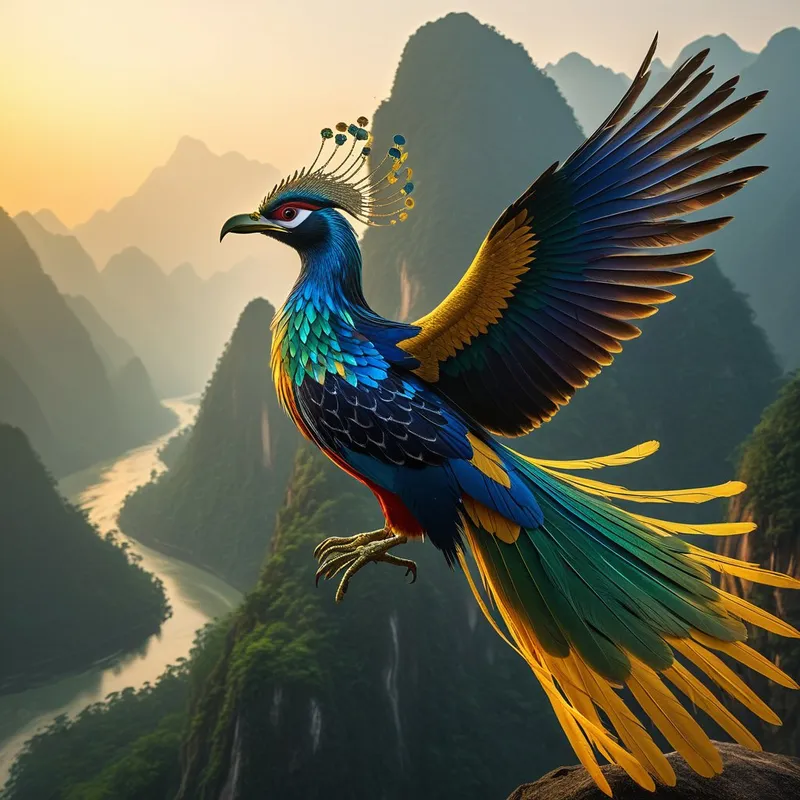
From within this radiance, it emerged. First, the head of a golden pheasant, crowned with grace. Then, the breast of a goose, broad and noble. The back of a tortoise, solid and enduring. The throat of a swallow, delicate and true. And the tail… oh, the tail was of a fish, but not as you know it. It flowed like liquid silk, a cascade of twelve or sometimes thirteen feathers, each one a different hue of the cosmos: the black of the profound north, the red of the passionate south, the azure of the growing east, the white of the reflective west, and the yellow of the sovereign center.
This was the Feng Huang. It did not fly so much as unfold across the heavens. With each beat of its wings, which bore the characters for virtue, righteousness, propriety, benevolence, and fidelity, a wave of harmony pulsed outward. Where its shadow fell, crooked trees grew straight. Bitter waters turned sweet. Animals ceased their predation and sat together in peace. Its song was a five-note scale that tuned the heart of the world.
It descended not to a nest, but to the Wutong tree, whose leaves parted like respectful hands to receive it. It ate only the seeds of the bamboo, drank only from the purest springs of dawn. It appeared not in times of war or clamor, but only when the empire was ruled with wisdom and the people lived in accordance with the Dao. Its coming was not an invasion, but a recognition—a mirror held up to a world momentarily in balance.
And when its time of manifestation was complete, it would not die. It would gather itself into a pyre of its own divine essence, a silent, cool fire of all its colors merging into a blinding white. From that concentrated point of perfect harmony, from that seed of cosmic order, it would simply… begin again. A new note from the dawn. A new unfolding from the light. An eternal promise written in feathers and flame.
Cultural Origins & Context
The Feng Huang is not a myth with a single, linear narrative like those of the Greco-Roman tradition. Its origins are diffuse, emerging from the deep, collective psyche of ancient Chinese civilization, likely from Neolithic totemic beliefs that revered the potent symbolism of birds. It coalesced during the Shang and Zhou dynasties, appearing on ritual bronzes and jade carvings as a powerful, often paired, avian deity.
It was systematized by the Confucian scholars, who codified its symbolism into an emblem of virtuous rule and social harmony. The Feng Huang became the herald of a sage-king, its appearance the ultimate celestial endorsement of a ruler’s moral authority. Simultaneously, Daoist philosophy embraced it as a symbol of the transcendent soul and the harmonious union of yin and yang—the Feng (male phoenix) and the Huang (female phoenix). It was passed down not just by bards, but by historians, poets, artists, and philosophers, each layer adding to its profound resonance as both a political ideal and a spiritual archetype.
Symbolic Architecture
The Feng Huang is perhaps the ultimate symbol of synthesis. It is not a single entity, but a harmonious assembly. Its composite anatomy—borrowed from the most esteemed creatures—tells us that perfection is not found in purity, but in integration. It is a living mandala of cosmic order.
The phoenix does not possess virtue; it is the embodiment of virtue in graceful, feathered form. Its flight is the movement of the Dao itself.
Its five colors correspond to the five directions, the five phases (Wuxing), and by extension, the entire structured universe. Its song is the perfect pitch to which a harmonious life and society can be tuned. Crucially, its cyclical renewal is not a resurrection from death, but a transmutation from a state of mature, manifested harmony back into potential, and out again. It represents the psyche’s capacity to integrate all aspects of the self—the noble and the humble, the strong and the graceful—into a cohesive, virtuous, and radiant whole. It is the anthropos, the complete human, realized not through battle, but through balanced becoming.
The Dreamer’s Resonance
When the Feng Huang appears in a modern dream, it rarely comes with fanfare. It may be glimpsed as a flash of impossible color in a grey cityscape, or heard as a distant, hauntingly beautiful melody that cuts through anxiety. To dream of it is to encounter the Self’s assurance of one’s inherent wholeness.
The somatic experience is often one of profound relief and awe—a loosening in the chest, a sense of weight being lifted. Psychologically, this dream marks a pivotal point in what Jung called the transcendent function: the resolution of painful opposites within the psyche. The dreamer may be trapped in inner conflict—duty versus desire, logic versus intuition, activity versus rest. The phoenix does not choose a side; it marries them. Its appearance signals that the struggle is not about victory, but about synthesis. The dream is an invitation from the deepest unconscious to stop fighting oneself and to begin the alchemical work of combining warring elements into a new, more graceful form of being.
Alchemical Translation
The individuation journey modeled by the Feng Huang is not the hero’s slaying of dragons, but the artist’s creation of a masterpiece from disparate materials. The modern soul’s “Kunlun Mountain” is the center of one’s own being, the place of inner stillness amidst the chaos of life. The “five virtues” inscribed on its wings are the often-contradictory values we must hold in tension: our responsibility and our freedom, our compassion and our boundaries, our tradition and our innovation.
The alchemical fire of the phoenix is not destruction, but the intense, focused heat required to fuse separate metals into a sacred alloy.
The process begins with recognition—seeing the scattered, beautiful, yet unintegrated parts of oneself (the pheasant’s head, the tortoise’s back). It proceeds to assembly—the courageous and patient work of bringing these parts together without rejecting any. This is followed by harmonization—finding the inner “song” or rhythm that allows this new composite self to function gracefully. Finally, there is renewal. This is the most critical phase. It is the willingness, after a period of stability and manifestation, to consciously return to the crucible. To let a completed identity, even a virtuous one, dissolve back into essence so that an ever-more authentic self can unfold. It is the cycle of death and rebirth reinterpreted not as catastrophe, but as the necessary rhythm of a soul committed to endless, harmonious becoming. The Feng Huang teaches that our highest purpose is not to remain forever in one perfect form, but to master the graceful art of cyclical integration, forever tuning our lives to the resonant note of the coming dawn.
Associated Symbols
Explore related symbols from the CaleaDream lexicon: