Fafnir Myth Meaning & Symbolism
A cursed dwarf, transformed by greed into a venomous dragon, hoards a treasure that brings only ruin, until a hero must face the monster within and without.
The Tale of Fafnir
Listen, and hear the tale of gold that gleamed with a curse, of a heart that hardened into scale, and of the doom that rides on treasure. It begins not with a dragon, but with brothers.
There were three: Otr, who in otter-shape fished in a waterfall; Regin, cunning of mind and hand; and Fafnir, strongest of them all. Their father was Hreidmar, a lord of great wealth and greater greed.
The gods Odin, Hönir, and Loki journeyed the worlds. By the waterfall, Loki saw an otter with a salmon, sleek and fine. With a single stone, he slew it, thinking only of the pelt. A fatal error. For at Hreidmar’s hall, the pelt was displayed, and the dwarf king roared in grief and rage: “You have slain my son!”
To pay the weregild, the blood-price, Loki was sent to fetch gold. He captured the dwarf Andvari in his waterfall form and stripped him of all his treasure, including a single, beautiful ring. Andvari, in his despair, laid a curse upon it: “This gold, and the ring that commands it, shall be the death of all who own it.” Loki cared not; a price was a price.
They stuffed the otter-skin with the cursed gold and covered it with the ring. But a single whisker remained exposed. Hreidmar demanded it be covered. Loki, with a grim smile, placed the ring upon it. The debt was paid, but the doom was sealed.
Fafnir looked upon the hoard, and a sickness entered his heart. The gold whispered to him of power, of a kingdom of his own. Greed, cold and sharp, coiled in his breast. He took up his sword and slew his own father in his sleep, claiming the treasure. No hall could hold such malice. He gathered the gold, and driven by paranoia and the ring’s whispering venom, he fled to the desolate heath of Gnitaheidr.
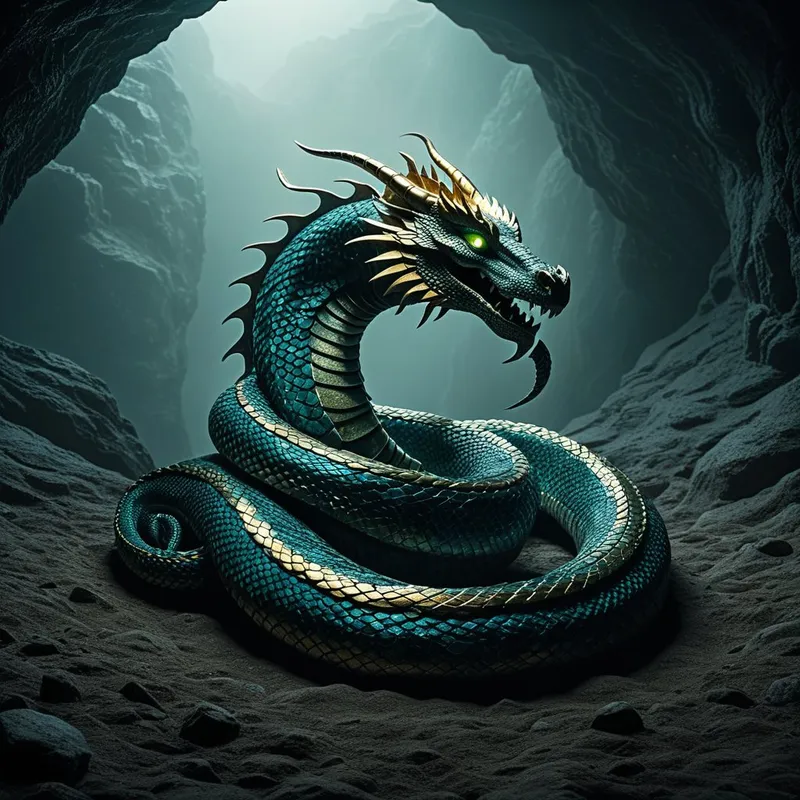
There, in a cave damp with mist and malice, the curse worked its full will. Fafnir’s form began to warp. His skin thickened, hardening into plates of iron-like scale. His limbs twisted, his spine elongated into a sinuous, coiling horror. His breath, once mere air, became a poisonous miasma. The strong dwarf was no more. In his place lay Fafnir the dragon, a monstrous worm coiled atop his glittering, accursed hoard, his eye ever-watchful, his heart a furnace of solitary avarice.
And Regin, the surviving brother, nursed his own greed and a thirst for vengeance. He found a youth of pure heart and mighty destiny: Sigurd, son of Sigmund. Regin became his foster-father and smith, forging for him a sword of surpassing sharpness, Gram. He fed Sigurd tales of Fafnir’s evil, of rightful treasure stolen, and stoked the fires of heroic ambition.
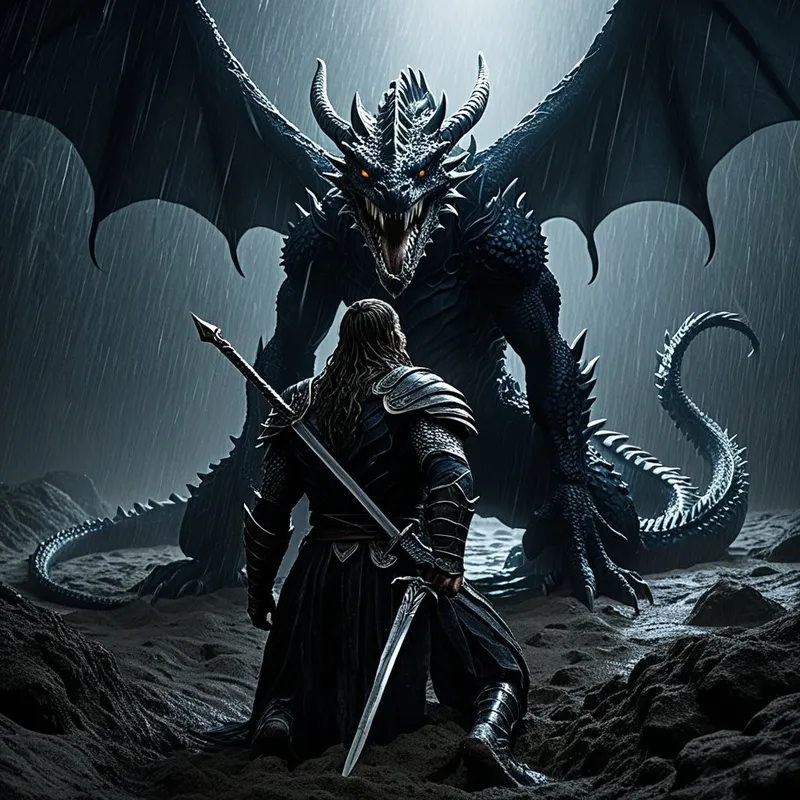
Guided by Regin’s counsel, Sigurd journeyed to Gnitaheidr. He did not charge the beast head-on. Wisdom, not just strength, was needed. He dug a pit in the dragon’s path to the water and hid within it. As the earth shook with the dragon’s passing, as the reek of poison filled the air, Sigurd thrust his sword upward into the soft underbelly of the beast. A roar shattered the heath’s silence, a sound of agony and ancient rage. Fafnir, dying, spoke prophecies of betrayal and doom, his words as venomous as his blood. The hero had slain the dragon, but the curse lived on, waiting in the gold, and in the heart of the smith who sent him.
Cultural Origins & Context
The myth of Fafnir is preserved primarily in the Poetic Edda, specifically in the Reginsmál and Fáfnismál, and is recounted in prose in the later Prose Edda. These texts are our windows into a world where myth was not mere story, but a vital framework for understanding fate, morality, and the precarious nature of fortune.
This tale was not told in grand temples, but in the fire-lit halls of chieftains and around hearths in longhouses. The skalds, the poet-historians, were its custodians. They wove it into the larger tapestry of the Völsunga Saga, a sprawling epic of heroism, betrayal, and tragic fate that resonated deeply with the Norse ethos. Its function was multifaceted: it was entertainment, a reinforcement of societal values regarding kinship and oath-breaking (and their terrible costs), and a profound meditation on the nature of ørlög—the inescapable web of fate. The gold’s curse is a narrative embodiment of this principle; once set in motion, its tragic trajectory cannot be halted, only endured.
Symbolic Architecture
At its core, the myth of Fafnir is a masterful depiction of psychic possession. The cursed gold is not merely wealth; it is the object of absolute, all-consuming desire. It represents any ideal or possession that, when pursued without limit or conscience, turns inwards and devours the pursuer.
The dragon is not born; it is made. It is the final, monstrous shape of a fixation left to grow in the dark.
Fafnir’s transformation is the ultimate symbol of this inner process. His physical metamorphosis from dwarf to dragon is a perfect externalization of an internal reality: greed hardens the heart, paranoia armors the soul, and isolation distorts the self until one becomes a monster, guarding one’s obsession in a self-made prison. He does not have a hoard; he is the hoard. Sigurd, the hero, represents the conscious ego that must confront this embodied shadow. Yet, crucially, he is guided by Regin—the cunning intellect, the manipulative advisor who represents the very greed he claims to oppose. This reveals a terrifying truth: the impulse to slay the dragon is often born from the same psychic complex that created it.
The Dreamer's Resonance
When this myth stirs in the modern unconscious, it rarely appears as a literal dragon. Its pattern manifests in dreams of suffocating enclosures: vaults that cannot be opened, rooms that shrink, being trapped in a car filling with water or sand. The somatic feeling is one of constriction, of being coiled around by one’s own life.
Psychologically, this is the dreamer encountering a “Fafnir complex.” It may appear as a career ambition that has consumed all joy, a relationship dynamic that feels like a guarded fortress, or a material possession whose maintenance drains the spirit. The dreamer is both Fafnir (the trapped hoarder) and Sigurd (the one who seeks liberation). The process underway is a confrontation with a part of the psyche that has become rigid, defensive, and toxic due to an over-identification with a single value or goal. The dream is a signal from the Self that the “treasure” is now a poison, and a heroic, perhaps painful, integration is required.
Alchemical Translation
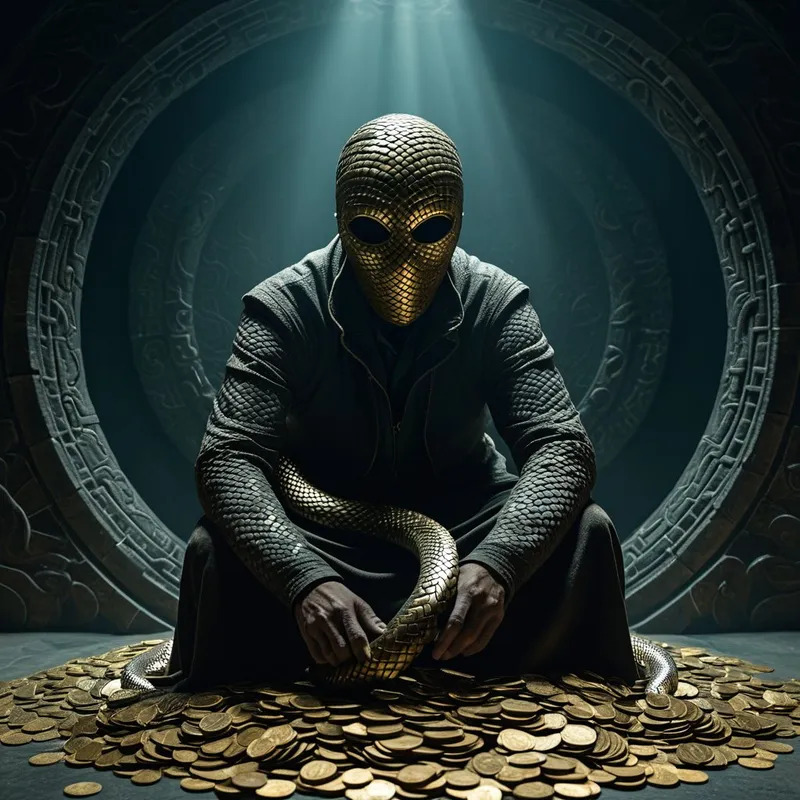
The alchemical journey mirrored in Fafnir’s tale is the nigredo—the blackening, the putrefaction. Fafnir’s transformation is the ultimate nigredo: the complete inversion of a human spirit into its darkest, most base form through the fire of unchecked desire. The gold itself is the prima materia, the base substance that contains both supreme value and deadly poison.
The work is not to acquire the gold, but to survive its possession. The true treasure is not the hoard, but the integrated consciousness that can bear its weight without transformation.
For the modern individual, the alchemical process begins with recognizing one’s own “Fafnir-tendency.” What have I hoarded? What ideal has armored my heart? The “slaying” is not destruction, but a disciplined, conscious piercing of that armored complex. Sigurd, hiding in the trench, acts from a place of strategic humility, not brute force. This is the insight needed: one must get underneath the defensive structure of the complex. The venomous blood that burns Sigurd’s skin is the painful, corrosive affect released when a long-held complex is punctured.
The final, and most treacherous, stage is dealing with the “Regin” within—the voice of cunning that urges you to claim the treasure for yourself, to use the power of the conquered complex for personal gain. This leads only to the next cycle of curse. The true alchemical rubedo (reddening) or culmination comes only when the gold—the liberated psychic energy—can be put to service beyond the ego’s vault, understanding its cursed nature and handling it with a reverence akin to fear. It is the wisdom that some treasures are best left in the flow of life, not piled in the darkness of a solitary heart.
Associated Symbols
Explore related symbols from the CaleaDream lexicon: