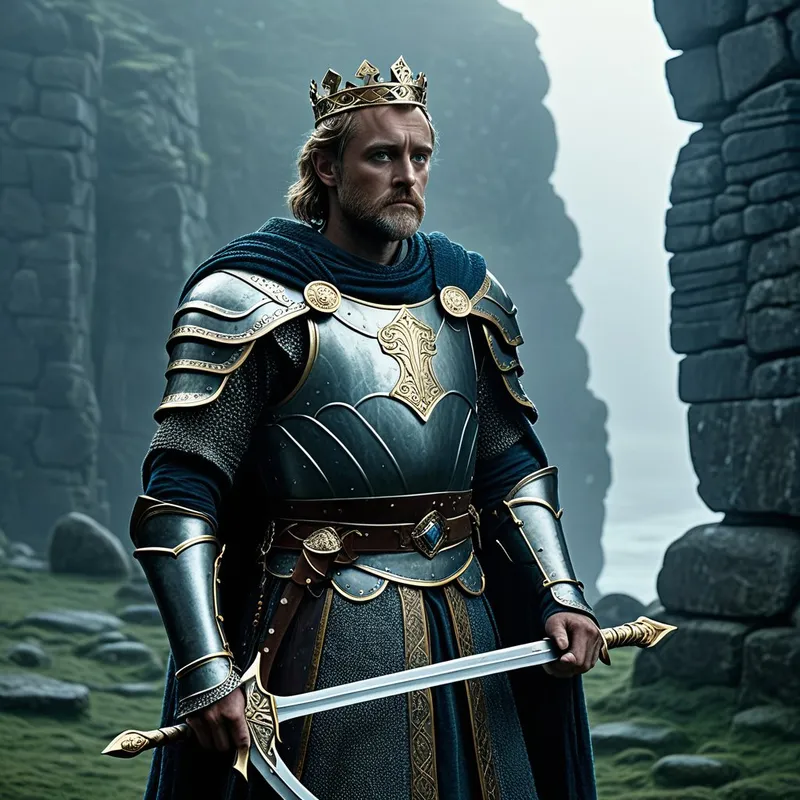
Excalibur's Scabbard Myth Meaning & Symbolism
The myth of the scabbard that protects the king from mortal wounds, a symbol of sovereign integrity lost through betrayal and human frailty.
The Tale of Excalibur's Scabbard
Listen, and hear the tale not of the blade, but of its keeper. The mists of Avalon were thick that day, a silver veil over the mere. From those waters, a hand emerged—not to offer a sword, but to withhold it. The Lady of the Lake held Excalibur aloft, its edge catching the weak sun like a shard of ice. But her eyes, ancient and deep as the lakebed, were fixed upon the young king, Arthur.
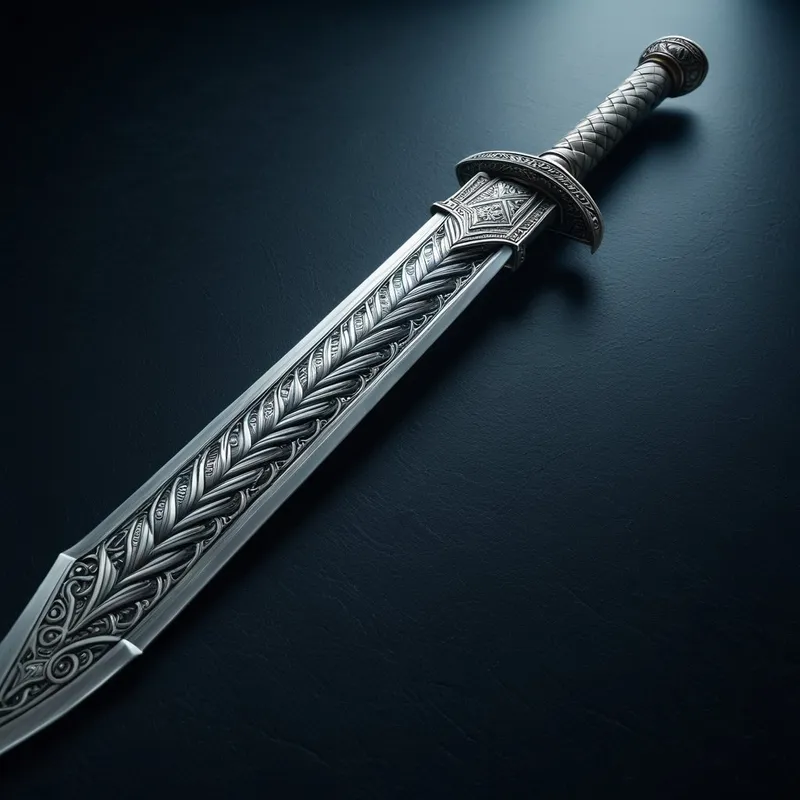
“The blade is peerless,” she said, her voice the sound of water over stone. “It will cleave armor and bone, and men will sing of its cuts for a thousand years. But this…” From the folds of her mantle, she drew forth the scabbard. It was unassuming at first glance, leather and silver. Yet as it moved, the very air around it seemed to still, to thicken with a palpable quiet. “This is the greater treasure. While you wear this sheath, you shall lose no blood, suffer no mortal wound. The sword is for the kingdom’s enemies. The scabbard is for the kingdom’s heart. Lose the blade, and you may fight on. Lose this, and you are but a man, fragile and fleeting.”
Arthur took them both, feeling the sword’s eager weight and the scabbard’s profound stillness. For years, the truth of her words held. In the chaos of battle, amid the din and the blood-spray, Arthur stood as an island of unbroken flesh. Blows that should have felled him glanced away; spear-points found no purchase. His knights whispered of a king touched by divine grace. The scabbard was his silent covenant, the hidden root of his sovereignty.
But roots can be poisoned. In the shadowed heart of Camelot, where ambition curdled into spite, his half-sister, Morgan le Fay, watched. She saw not a sacred trust, but a vulnerability. To wound the myth, one must steal the magic. Not through force of arms, but through guile and the intimate betrayal of blood. In Arthur’s moment of unguarded trust, perhaps in a chamber heavy with familial pretense, the scabbard passed from his belt to her hands.
She did not melt it down or break it. She performed a subtler, more profound act of unmaking. In a hidden grotto, by a black pool that reflected no light, she invoked older, darker pacts. She spoke words that unwove the Lady’s enchantment, not by shattering it, but by draining it, pouring its essence into the void. The scabbard did not crack; it simply became inert. Leather, metal, and empty promise.
When Arthur belted it on again, he felt only its weight. The stillness was gone. The covenant was broken. He was, from that moment, reducible. The myth of the inviolate king was over. The final battle at Camlann was not lost because Excalibur failed, but because the scabbard was absent. A petty, mortal wound found its mark, and the golden age bled out into the waiting earth.

Cultural Origins & Context
The tale of the scabbard is woven into the later strands of the Arthurian tapestry, most prominently in Sir Thomas Malory’s 15th-century compilation, Le Morte d'Arthur. It represents a sophisticated development in the mythos, moving beyond the simple acquisition of a magical weapon to a more nuanced meditation on the nature of kingship and its vulnerabilities. In the Celtic and Welsh traditions that feed the Arthurian cycle, sovereignty is often personified as a goddess or linked to a tangible talisman; the scabbard serves as this talisman for Arthur’s personal, bodily sovereignty.
The story was told in halls and scriptoria, a cautionary layer added to the heroic epic. Its function was societal: it transformed Arthur from an invincible demigod into a tragic monarch. His flaw was not in battle, but in trust—a failure of discernment within his own court. This reflected very real medieval anxieties about betrayal, the fragility of royal authority, and the idea that a kingdom’s health was intrinsically tied to the literal, physical wholeness of its king. The loss of the scabbard is the moment the legend becomes human, and therefore heartbreaking.
Symbolic Architecture
The scabbard is the unsung counterpart to the sword, and in its silence lies its profound meaning. Excalibur represents active, directed power—the power to cut, to decide, to separate and to rule. It is logos, will, and outward action. The scabbard, however, represents receptive, containing power. It is the vessel that holds the blade’s ferocity without being cut by it. It symbolizes the container of the Self.
To wield great power without the capacity to contain it is to be self-wounding. The scabbard is that capacity—the integrity that allows force to be applied without the wielder disintegrating.
Psychologically, the scabbard represents the ego’s healthy boundary and the psychic immune system. It is the function that allows us to engage with the world—to fight our battles, make our incisions into reality—without being annihilated by the feedback, the trauma, or the sheer expenditure of energy. Arthur with the scabbard is the integrated Self, capable of action without catastrophic depletion. Arthur without it is the ego exposed, vulnerable to every psychic arrow.
Morgan le Fay’s theft is the archetypal act of betrayal from the shadow of the family or the inner circle. She does not represent an external enemy, but the unconscious complex—perhaps of resentment, envy, or neglected aspects of the feminine—that operates from within the fortress of the psyche. She knows precisely which treasure to take to enact a spiritual death. Her act translates the enchantment, turning sacred containment into profane object, mirroring how psychological wounds (often from early relationships) can dismantle our innate protective structures.
The Dreamer's Resonance
When this mythic pattern stirs in the modern unconscious, it rarely appears as a literal scabbard. The dreamer may experience a profound sense of being unshielded. Somatic sensations are key: feeling exposed in a crowd, dreaming of skin that is transparent or missing, or of being in a battle where every blow lands and sticks. There is a visceral, felt sense of permeability.
One might dream of a cherished locket that opens to reveal it is empty, a phone whose protective case has vanished, or a house whose locks no longer work. The core affective state is one of fundamental vulnerability. The psychological process at work is often one of boundary erosion—where the dreamer’s capacity to say “no,” to filter stimuli, or to protect their core energy has been compromised, often by a betrayal of trust or a prolonged relational demand that has gone unrecognized. The dream is a signal from the Self: the container is breached; integrity must be restored.

Alchemical Translation
The alchemical journey modeled here is not the forging of the sword (the development of one’s will or talents), but the creation and maintenance of the vessel. The opus is in the crafting of the scabbard. For the modern individual, this translates to the often-overlooked work of building psychic and somatic resilience—the “vessel” that can hold the transformations of life without cracking.
The first stage is receiving the vessel (the gift from the Lady). This is the recognition that our wholeness depends not just on what we do, but on how we contain ourselves. It is the practice of grounding, setting boundaries, self-care, and cultivating an inner stillness that cannot be easily disturbed. It is the discipline of the container.
The theft by Morgan represents the inevitable nigredo, the blackening. This is the life-event or the inner complex that attacks our containment. A burnout, a betrayal, a trauma that makes us feel “skinless.” The alchemical secret here is that the theft is necessary. The perfect, gifted protection is a kind of innocence. Its loss forces the individuation process: we must now, consciously, reclaim or reconstitute our protective capacity. We must become the smith of our own scabbard.
The final, reconstituted scabbard is not the same as the first. It is not a gift from the Other, but an achievement of the Self. It is a resilience earned through the conscious integration of the wound and the betrayal.
Thus, the myth’s alchemical translation is a movement from bestowed integrity to earned sovereignty. The goal is not to return to a state of naive, magical invulnerability, but to forge a conscious, flexible strength that knows its own fragility and guards it wisely. We are to become not just the bearer of the sword, but the eternal guardian of the sheath. For in the end, it is not the sharpness of our blade that determines our fate, but the integrity of what holds it.
Associated Symbols
Explore related symbols from the CaleaDream lexicon: