
Eshu in the New World
The Yoruba trickster deity Eshu's journey across the Atlantic, evolving into a complex symbol of cultural resilience, communication, and subversion in the African diaspora.
The Tale of Eshu in the New World
The story begins not with a beginning, but with a rupture. It begins in the hold of a ship, in the space between worlds, where the old names were swallowed by salt and sorrow. Here, in the liminal dark, the first seeds of the New World Eshu were sown. He did not arrive as a conquering god on a gilded throne, but as a whisper in the chain, a flicker of recognition in a shared glance, a coded rhythm tapped against wood. He was the memory of the crossroads that persisted when all visible roads led only to the overseer’s whip.
In the brutal geometry of the plantation, where every path was prescribed and every movement surveilled, Eshu became the architect of the unseen path. He was the one who could turn a simple message about a gathering into a children’s song, its true meaning hidden in the turn of a phrase known only to the initiated. He was the spirit in the work slowdown, the “accidental” breaking of a tool, the moment of misunderstood instruction that caused chaos in the field and bought a precious hour of rest. He wore no crown but the cap of a trickster, no robes but the tattered clothes of the enslaved, yet he wielded the profound power of the Opon Ifá—the ability to open ways where none seemed to exist.
His altars were not of carved wood in clearings, but of a carefully placed stone by a specific tree, a bottle filled with rum and hot peppers hidden in the corner of a cabin, a pattern drawn in the dust. To speak his name openly was dangerous, so he was called by many: Elegua in Cuba, Exu in Brazil, Legba in Haiti. In each place, he absorbed the local color—a syncretic saint, a devil at the crossroads, a mischievous boy. Yet, beneath these masks, his core function remained: master of the threshold, guardian of communication, the necessary chaos that prevents any system from becoming absolute. He was the divine argument that ensured the conversation between the human and the spirit world—and between the oppressed and their oppressors—never fully ceased.
Cultural Origins & Context
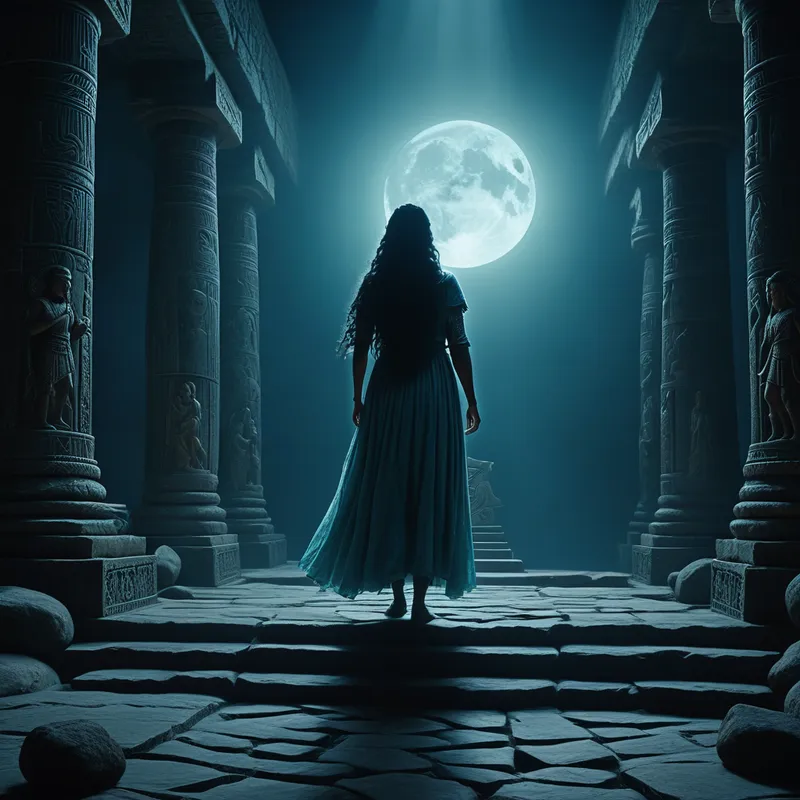
Eshu’s roots plunge deep into the soil of Yorubaland, in what is now Nigeria and Benin. There, he is Orisha of the crossroads, the messenger between humanity and the other Orisha, and the dynamic principle of unpredictability and change. He is the first and last to be acknowledged in ritual, for he opens and closes the door to the divine. Without Eshu, no prayer is delivered, no sacrifice received.
The Middle Passage and the institution of slavery did not erase this theology; they subjected it to a terrible alchemy. Stripped of their temples, priests, and sacred groves, the enslaved Africans carried the essence of their gods within their souls and practices. In the New World, under the hostile gaze of colonial Christianity which demonized their pantheon, the Orisha went underground. They merged with Catholic saints in a strategy of spiritual survival known as syncretism. Eshu, with his ambiguous, boundary-crossing nature, was particularly vulnerable to being labeled as purely malevolent, a “devil.” Yet, this very misidentification by the oppressor became a layer of his protective camouflage. What the master feared as devilry was often the sacred technology of cultural continuity and resistance.
Thus, Eshu’s evolution in the diaspora is a direct map of the trauma and genius of survival. He embodies the double-consciousness described by W.E.B. Du Bois—the necessity of holding two worlds, two meanings, in one mind. He is the deity of the diaspora condition itself: forever at the crossroads of memory and adaptation, Africa and the Americas, the sacred and the profane, submission and subversion.
Symbolic Architecture
Eshu in the New World is not a single symbol, but a living system of symbolic logic. He represents the psychological and spiritual infrastructure built to navigate a world designed for your annihilation.
He is the deconstruction of absolute power. By introducing chance, misunderstanding, and accident, Eshu proves that no system of control is seamless. He is the flaw in the blueprint, the grain of sand in the machine of tyranny, forcing it to stutter and reveal its weaknesses.
His primary symbol is the crossroads, but in the diaspora, this is no simple intersection. It is the crossroads of history, where the path from the past meets the uncertain road to the future. It is the crossroads of identity, where one must choose which face to wear. It is the psychic crossroads where despair meets resilience.
He is the divine linguist of the oppressed. Eshu masters the language of the master only to subvert it, while preserving the mother tongue in secret rituals and songs. He sanctifies all forms of communication that evade surveillance: sign, song, silence, and dance.
He holds the key, but it is a key that unlocks multiple doors—some leading to opportunity, others to danger, all leading away from stagnation. He is the necessary chaos that prevents the psyche from hardening into the rigid posture of the slave, forever reminding the spirit that choice, however constrained, still exists at the level of meaning and interpretation.
The Dreamer's Resonance
To encounter Eshu in a dream or in the depths of the psyche is to confront the archetype of the threshold guardian in one’s personal life. He appears when we are at a literal or metaphorical crossroads, paralyzed by a binary choice imposed upon us by external forces—be they societal expectations, familial pressures, or oppressive systems.
Psychologically, Eshu represents the vital function of the trickster within the individual, as described by Carl Jung. This is not the trickster as mere prankster, but as the agent of psychic disruption who prevents the conscious ego from becoming too rigid, too identified with a single role or “master’s narrative.” He is the inner voice that questions unquestioned rules, that finds the loophole in our own self-limiting beliefs, that forces a re-evaluation of the paths we thought were closed.
For the diasporic dreamer or any individual living under conditions of psychological or social constraint, Eshu resonates as the capacity for creative agency. He is the part of the self that can code-switch, that can wear a mask for survival while keeping the true self alive in an inner sanctum. He embodies the resilience that comes not from frontal assault, but from strategic indirection, from knowing that sometimes the most powerful act is to redirect the flow of a dominant energy rather than to block it head-on. He calls the dreamer to master the arts of communication with all parts of the self and to recognize the sacred power inherent in every moment of choice, however small.

Alchemical Translation
The journey of Eshu across the Atlantic is itself an alchemical process of the nigredo—the blackening, the dissolution in the dark waters of trauma. The old, stable forms of worship were shattered. What emerged from this crucible was not a diluted ghost, but a potent, concentrated essence. The gold produced was not purity, but adaptability; not fixed dogma, but fluid practice.
The alchemy of Eshu is the transformation of oppression into orature, of silence into polyrhythm, of the master’s tool into a sacred instrument. He is the philosophical proof that meaning cannot be wholly owned or dictated; it can always be hijacked, twisted, and reborn in the hearth of the subjugated.
In the personal alchemy of the soul, Eshu presides over the dissolution of false personas—the “good slave,” the acceptable mask—to make way for a more authentic, complex, and self-determined identity. He is the catalyst that turns the leaden weight of fate into the mercury of possibility. His rituals often involve spicy foods, rum, and tokens—all symbols of heat, fermentation, and transformative energy. He teaches that the path to the gods, or to one’s highest self, is not always straight and reverent; it may wind through confusion, laughter, and strategic rebellion. He translates the raw material of suffering into the refined art of survival, and survival into a culture of profound spiritual depth.
Associated Symbols
Explore related symbols from the CaleaDream lexicon:
- Crossroads — The quintessential domain of Eshu, representing choice, potential, and the convergence of destinies and worlds.
- Mask — The embodiment of the necessary personas worn for survival, communication, and ritual transformation within oppressive contexts.
- Key — Eshu’s tool for opening doors between realms, unlocking opportunities, and accessing hidden knowledge or freedom.
- Trickster — The archetypal force of disruption, subversion, and creative chaos that challenges rigid order and reveals hidden truths.
- Bridge — Symbolizing Eshu’s role as the essential connector and messenger between humanity and the divine, the past and the present.
- Dance — A coded language of resilience and memory, where sacred meanings and histories are preserved and communicated through the body’s movement.
- Root — The deep, enduring connection to African origins and ancestral wisdom that persists and nourishes beneath the surface of New World realities.
- Chaos — The fertile, unpredictable force that Eshu governs, which breaks stagnation and creates the opening for new possibilities and orders to emerge.
- Resistance — The active principle of cultural and spiritual defiance, often enacted through subtlety, wit, and coded practices rather than direct confrontation.
- Threshold — The sacred space of transition and possibility that Eshu guards, marking the moment between one state of being and another.