Erisichthon Myth Meaning & Symbolism
A king's sacrilege against a sacred tree unleashes a curse of insatiable hunger, leading to his ultimate self-destruction.
The Tale of Erisichthon
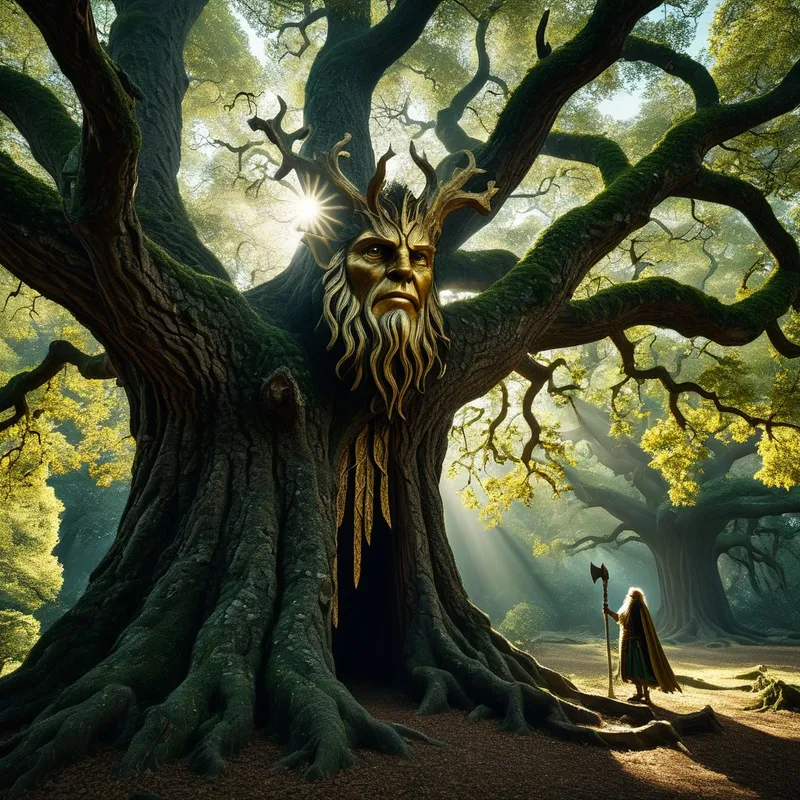
Hear now a tale not of glorious heroes, but of a hollowing. In the land of Thessaly, there was a king named Erisichthon. He was a man of vast appetite, not for wisdom or justice, but for dominion. His will was a plough that sought to turn over all that lay fallow and sacred. In his realm stood a grove sacred to Demeter, a place of such profound peace that the very air hummed with it. At its heart grew an immense, ancient oak, its branches a canopy for a thousand songs of birds, its trunk the home of a dryad.
Driven by a need to build a feasting hall for his own vanity, Erisichthon marched upon the grove. His men hesitated at the boundary, feeling the chill of the sacred. But the king, laughing at their fear, seized a double-bladed axe himself. The first bite of iron into the living wood was a sound that silenced the grove. From the wound, blood flowed—not red, but golden sap. A voice, groaning and immense as the earth itself, issued from the trunk: a warning from the dryad within. "I who am beloved of Demeter, cease your blow, impious man, lest you invoke a goddess's wrath!"
Erisichthon, his eyes bright with the madness of possession, sneered. "Then this shall be the roof of my goddess—the goddess of my feasts!" He struck again. The dryad’s life faded with the tree’s fall, and her dying curse was whispered on the wind to Demeter.
The goddess heard. She did not bring thunder or earthquake, but a punishment tailored to the sinner’s soul. She summoned Limos, a creature more shadow than substance, from the icy depths of Scythia. "Enter the belly of that arrogant man," Demeter commanded. "Let him feel a void that all the world cannot fill."
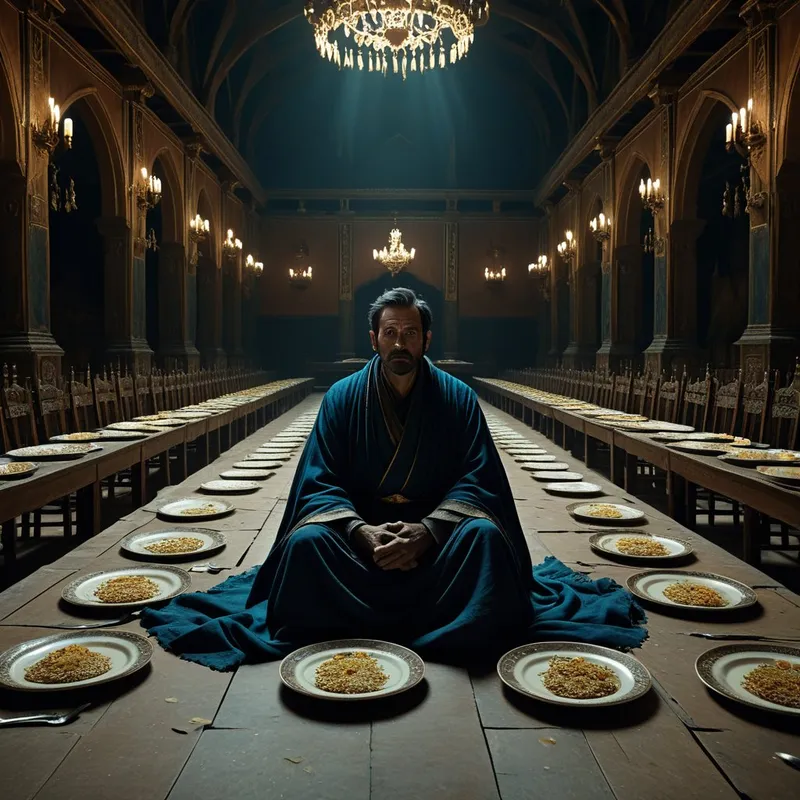
Limos, cold and insubstantial as famine, slipped into the king’s palace on a sigh. She found Erisichthon at his victory feast, roasted meats piled high. As he ate, she coiled in his gut. He finished one plate, then another, and felt not satisfaction, but a yawning abyss. The feast ended, but his hunger began. It grew, a fire in his belly that consumed all logic. He ate through his storerooms, his flocks, his herds. He sold his treasures for food, then the very clothes from his back. Finally, only one commodity remained: his own daughter, Mestra.
Blessed by Poseidon with the power to change her shape, Mestra was sold again and again, transforming to escape and return to her father, only to be sold once more to feed his bottomless maw. The cycle became his world. In the end, with nothing and no one left to sell, with even the memory of satiety a forgotten myth, Erisichthon turned his hunger upon himself. In a filthy alley, unseen by gods or men, the king who tore the earth began to devour his own flesh, gnawing at his limbs until nothing remained but the hunger itself.
Cultural Origins & Context
This stark myth comes to us primarily from the Hellenistic poet Callimachus, in his Hymn to Demeter. It is a tale deeply embedded in the Greek understanding of natural law and sacred boundaries. The grove (alsos) was not merely pretty woodland; it was a temenos, a precinct cut off from ordinary use, belonging wholly to the deity. To violate it was hubris—not just pride, but a violent overstepping of fundamental limits that maintained cosmic and social order.
The myth functioned as a powerful etiological and cautionary narrative. It explained the very real, terrifying phenomenon of famine (personified as Limos) as a divine punishment for sacrilege against the goddess of grain. For an agricultural society, Erisichthon’s story was a potent religious sanction protecting sacred groves, which often served as crucial watersheds and wildlife preserves. It was a tale told to reinforce eusebeia (piety, proper respect) and the concept that human prosperity is a gift from the natural world, contingent upon our reverence for it. The king’s consumption of his own kingdom and family mirrored how a leader’s impiety could consume the entire state.
Symbolic Architecture
At its core, the myth of Erisichthon is a map of a soul cannibalizing itself. The sacred oak is more than a tree; it is the symbol of the axis mundi, the living connection between the human realm and the divine, between the conscious ego and the nourishing, unconscious depths. Erisichthon’s axe is the instrument of a tyrannical consciousness that seeks to cut itself off from this source, to use the sacred solely for its own aggrandizement.
The hunger that follows sacrilege is not for food, but for the meaning and connection that was violently severed.
The curse is poetic justice of the highest order. Demeter does not strike him dead; she turns his own ruling principle—insatiable appetite for possession and control—into his prison and executioner. His daughter Mestra, with her shape-shifting, represents the last vestiges of the soul’s adaptability and resourcefulness, now horrifically perverted into a tool for enabling the very addiction that destroys them both. She is the psyche’s creativity forced into the service of its own annihilation. The final act of autocannibalism is the ultimate, logical endpoint of a life lived in consumption without reverence, where the self, having devoured its entire world, has only itself left to consume.

The Dreamer's Resonance
When this myth stirs in the modern unconscious, it rarely appears as a literal king and a tree. Instead, the dreamer may experience a profound, existential hunger. They may dream of endless, unsatisfying meals, of shopping for food that turns to dust, or of a black hole opening in their stomach. Somatic sensations of a gnawing emptiness or a "bottomless pit" feeling upon waking are common.
Psychologically, this signals a state where an aspect of the psyche has committed a "sacrilege"—perhaps against one’s own inner life. This could be the relentless "axing" of creativity for productivity, the violation of personal boundaries for external validation, or the clear-cutting of one’s values for material gain. The figure of Limos has taken up residence. The hunger is for the soul-nourishment that was disregarded: rest, authenticity, beauty, connection, or meaning. The dream is a stark alarm from the Self, indicating that the ego is consuming the very resources it needs to survive.
Alchemical Translation
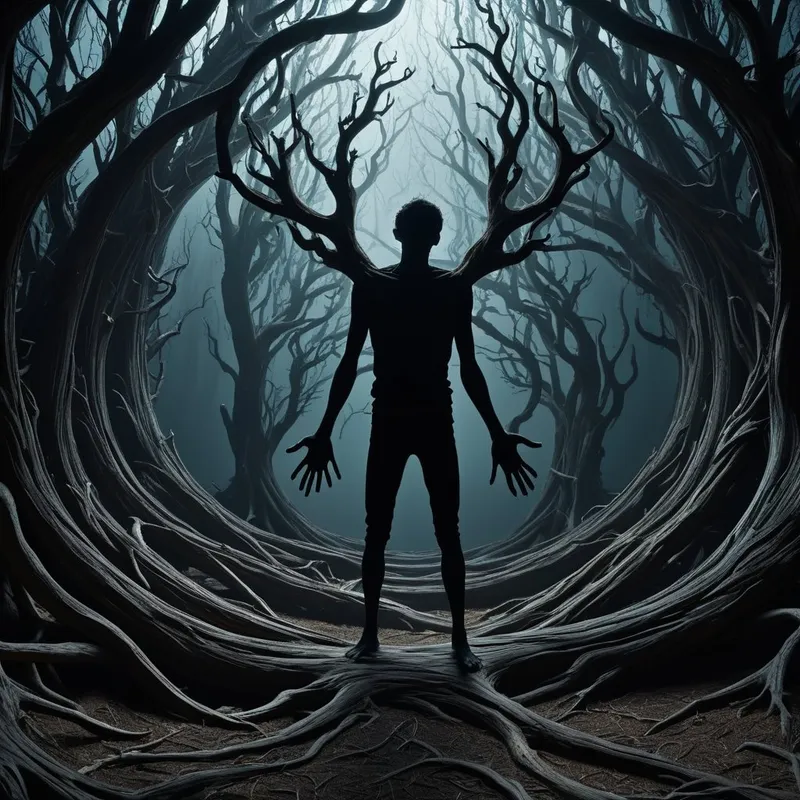
The alchemical process mirrored here is the nigredo—the blackening, the stage of mortification and despair. Erisichthon’s entire journey is a descent into this blackness. For the modern individual, the myth does not offer a redemption for its protagonist, but a terrifyingly clear map of the path to avoid, and a profound instruction on the necessity of the sacred.
The process of individuation requires a relationship with the inner "sacred grove," the deep, instinctual, and spiritual layers of the unconscious. To "hew it down" for the sake of the ego’s "feasting hall" (status, persona, material accumulation) is to invite the curse of spiritual famine. The alchemical work, then, is the opposite of Erisichthon’s act. It is the cultivation of reverence. It is to approach the inner oak not with an axe, but with an offering. It is to listen for the dryad’s voice—the intuitive, guiding wisdom of the soul—and to honor it.
The transmutation begins when we cease feeding the bottomless hunger of the ego and instead turn to nourish the neglected, sacred center.
The myth’s brutal end shows the consequence of failing this work: complete identification with the insatiable complex, leading to psychic self-destruction. Our salvation lies in recognizing the hunger for what it truly is—a desperate signal from a starved soul—and having the courage to replant the grove we have, in our own ways, all too often violated.
Associated Symbols
Explore related symbols from the CaleaDream lexicon: