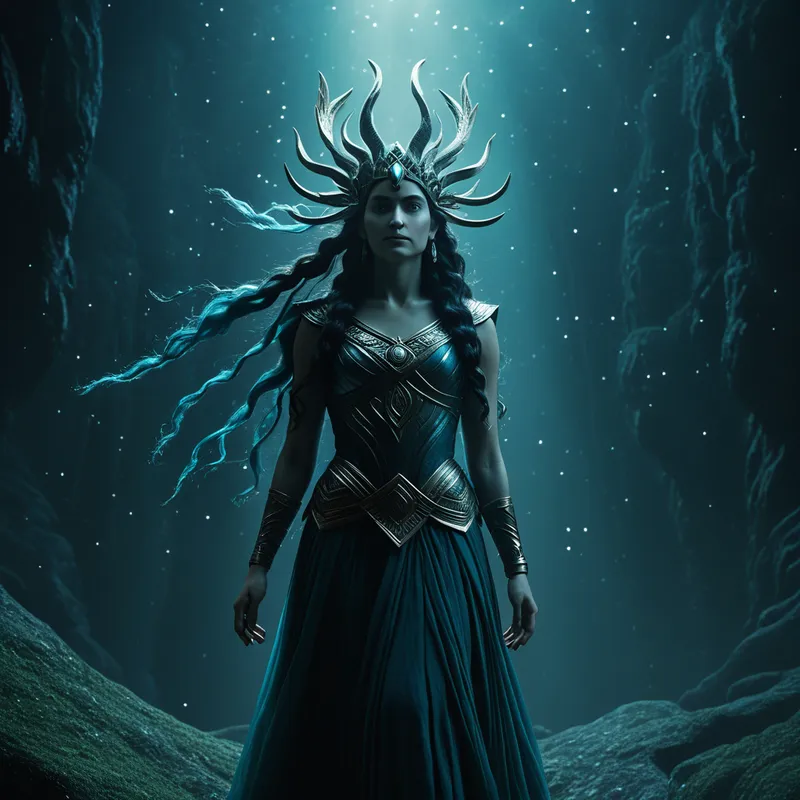
Enki and the World Order
The Sumerian god Enki establishes civilization by assigning domains to deities, revealing both divine wisdom and the fragile balance of cosmic authority.
The Tale of Enki and the World Order
In the beginning, when the heavens were distant and [the earth](/myths/the-earth “Myth from Hindu culture.”/) was unyielding, the great gods labored under a heavy burden. [The world](/myths/the-world “Myth from Tarot culture.”/) was raw, untamed, and without function. The divine assembly, weary from their toil, cried out for relief. It was then that Enki, the clever and profound god of the sweet waters, of wisdom and craft, awoke from his slumber in the Apsu.
He rose from his watery abode and surveyed the [chaos](/myths/chaos “Myth from Greek culture.”/) of creation. He saw not a void, but a field of potential, a great unspoken word waiting to be articulated. With the calm certainty of deep intelligence, Enki convened the council of the gods. He did not seize power through force, but through a act of profound distribution, a divine administration of essence.
One by one, he called the deities forth and assigned to them their me, the fundamental decrees that establish all aspects of civilization and natural order. To Utu, he gave the domain of the sun and [justice](/myths/justice “Myth from Tarot culture.”/), to light the world and judge its paths. To Nanna, he entrusted [the moon](/myths/the-moon “Myth from Tarot culture.”/) and the measure of time. To [Inanna](/myths/inanna “Myth from Sumerian culture.”/), though her fiery spirit was vast, he granted the arts of love and war, of storehouse and festival. He appointed [Enlil](/myths/enlil “Myth from Sumerian culture.”/), the king of the gods, to the overarching authority of [the wind](/myths/the-wind “Myth from Various culture.”/) and command, but it was Enki who defined the boundaries of that command. He assigned the plow to the farmer god, the brick mold to [the architect](/myths/the-architect “Myth from Various culture.”/) god, the reed stylus to the scribe god. He decreed the me for kingship, for priesthood, for truth, for music, for carpentry, and for the crafts of the metalworker.
He did not hoard; he irrigated the world with function, allowing each divine power to flow into its proper channel. He fixed the destiny of [the Tigris and Euphrates](/myths/the-tigris-and-euphrates “Myth from Mesopotamian culture.”/) rivers, filling them with his own life-giving waters, and appointed the god of the canals to tend them. He filled the marshes with fish and birds, appointed a guardian for them, and established the laws of the fisherman and the fowler. He created the hoe, the brick, the sheepfold—the very tools of civilization sprang from his decrees.
Yet, within this grand design lay a hidden tension. In his wisdom, Enki held the totality of the me within himself. He was the source, the administrator, the cunning custodian of the cosmic blueprint. While Enlil held the scepter of executive authority, Enki held the quill that had written the laws upon which that authority rested. This created a fragile, dynamic balance—a world ordered, yet perpetually poised between the king’s command and the sage’s foundational wisdom. The myth whispers that in his celebratory state, after his great work, Enki might have considered redistributing the me once more, a hint that the order he established was not a static monument, but a living, breathing system susceptible to the very cunning that had conceived it.
Cultural Origins & Context
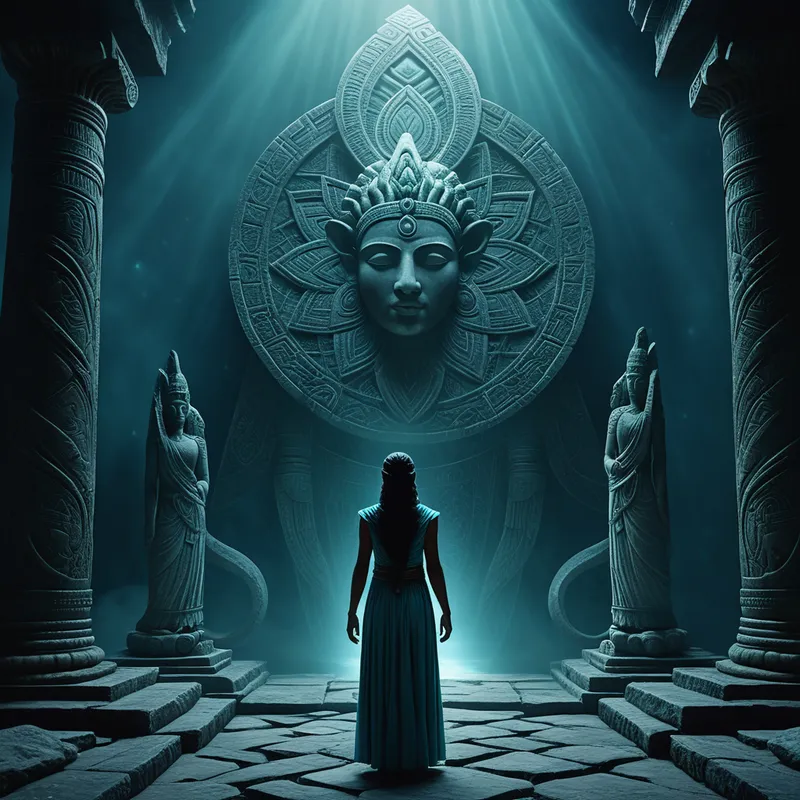
This myth, primarily known from the Sumerian composition “Enki and the World Order,” emerges from the alluvial plains of Mesopotamia in the late 3rd millennium BCE. It is a foundational state myth, reflecting the worldview of the world’s first urban, bureaucratic civilization. The Sumerians lived in a precarious environment, dependent on the meticulous management of unpredictable rivers for survival. Enki’s act of assigning domains mirrors the essential Sumerian solution to chaos: organized, specialized labor and hierarchical administration.
The concept of the me is central. These were not abstract ideas but concrete, potent divine forces that inhabited and animated all aspects of a functional society. To possess the me for kingship was to be kingship. Enki’s distribution, therefore, is not a metaphor but a literal act of installing the operating system for reality. The myth legitimizes the social order—the division of labor, the hierarchy of temple and palace, the very crafts that built ziggurats—by rooting it in primordial, divine action. It answers the question “why is the world structured this way?” with “because the god of wisdom willed it so.”
Furthermore, the tension between Enki and Enlil reflects a deep cultural understanding of power. Enlil represents the sometimes terrifying, unstoppable force of authority (the storm wind), necessary for decisive action. Enki represents the intelligent, strategic, and fluid principle that designs the systems within which authority operates. A civilization requires both the decree from the mountain (Enlil) and the nourishing waters from the deep (Enki).
Symbolic Architecture
At its core, this myth is an articulation of the [psyche](/myths/psyche “Myth from Greek culture.”/)’s [journey](/symbols/journey “Symbol: A journey in dreams typically signifies adventure, growth, or a significant life transition.”/) from undifferentiated potential to structured [consciousness](/symbols/consciousness “Symbol: Consciousness represents the state of awareness and perception, encompassing thoughts, feelings, and experiences.”/). Enki’s Apsu represents the unconscious, a [realm](/symbols/realm “Symbol: The symbol of ‘Realm’ often signifies the boundaries of one’s consciousness, experiences, or emotional states, suggesting aspects of reality that are either explored or ignored.”/) of limitless possibility but no form. His rising is the [emergence](/symbols/emergence “Symbol: A process of coming into being, rising from obscurity, or breaking through a barrier, often representing birth, transformation, or revelation.”/) of the ordering principle of the mind—[the ego](/myths/the-ego “Myth from Jungian culture.”/), or the conscious self, tasked with bringing coherence.
The distribution of the me is the psyche’s act of creating internal archetypal complexes: assigning the “warrior” its domain of assertiveness, the “caretaker” its domain of nurturance, the “ruler” its domain of self-control. Enki’s retention of all me within himself signifies that the Self, the total psyche, contains all potentials, even as it delegates their operation.
The myth’s hidden [tension](/symbols/tension “Symbol: A state of mental or emotional strain, often manifesting physically as tightness, pressure, or unease, signaling unresolved conflict or anticipation.”/) is the eternal psychological [drama](/symbols/drama “Symbol: Drama signifies narratives, emotional expression, and the exploration of human experiences.”/) between the established order of the conscious [personality](/symbols/personality “Symbol: Personality in dreams often symbolizes the traits and characteristics of the dreamer, reflecting how they perceive themselves and how they believe they are perceived by others.”/) (the administered world) and the subversive, creative, and potentially chaotic wisdom of the unconscious (Enki’s lingering, playful control). True psychological [health](/symbols/health “Symbol: Health embodies well-being, vitality, and the balance between physical, mental, and spiritual states.”/), the myth suggests, is not [the tyranny](/symbols/the-tyranny “Symbol: A symbol of oppressive control, unjust authority, and systemic domination that suppresses individual freedom and collective well-being.”/) of one over the other, but the fragile, dynamic balance between them—[the authority](/symbols/the-authority “Symbol: A figure representing power, control, and societal structure, often embodying rules, leadership, or external judgment.”/) of the [king](/symbols/king “Symbol: A symbol of ultimate authority, leadership, and societal order, often representing the dreamer’s inner power or external control figures.”/) tempered by the deep cunning of the waters.
The Dreamer’s Resonance
When this myth echoes in the modern soul, it speaks to our own acts of world-building. It appears in the profound relief and pride of establishing a home, a routine, a career—creating a personal “civilization” out of life’s raw materials. It resonates in the moment we find our “domain,” our calling, that piece of the universal me that feels uniquely ours to steward.
Conversely, it also illuminates our crises of order. The feeling of being burdened by a chaotic, unmanageable life is the pre-Enki state, where the gods labor without purpose. Burnout can be a sign that our internal “Enki” has fallen asleep, that we have stopped consciously assigning our energies and are being ruled by undifferentiated demands. The myth also warns of [the shadow](/myths/the-shadow “Myth from Jungian culture.”/) of order: the rigidity that comes when we identify solely with the administrator, forgetting the fluid, cunning, and creative source from which all order springs. A life too perfectly ordered becomes brittle, devoid of the nourishing, disruptive wisdom from the deep.

Alchemical Translation
In the alchemical vessel, Enki is the [Mercurius](/myths/mercurius “Myth from Alchemical culture.”/) figure—the cunning, fluid intelligence that facilitates [the great work](/myths/the-great-work “Myth from Alchemical culture.”/). The Apsu is the [prima materia](/myths/prima-materia “Myth from Alchemical culture.”/), the chaotic first matter. The act of distributing the me is the [separatio](/myths/separatio “Myth from Alchemical culture.”/) and ordinatio, the separation of elements and their arrangement into a harmonious hierarchy, leading to the opus of a coherent, functioning self.
The alchemical goal is not to destroy chaos, but to marry it with order, to bring the deep, watery wisdom into conscious collaboration with the fiery will. Enki’s work is never finished; it is a perpetual process of re-ordering, a reminder that the Self must continually re-negotiate the distribution of its own powers to remain vibrant and whole.
The myth teaches that creation is an act of intelligent delegation, not hoarding. The gold of the philosopher’s stone is not a single, seized treasure, but the establishment of a functioning, self-sustaining kingdom within the soul, where every aspect of one’s nature is honored with a sacred duty.
Associated Symbols
Explore related symbols from the CaleaDream lexicon:
- [Water](/myths/water “Myth from Chinese culture.”/) — The primordial, fluid medium of potential and unconscious wisdom from which all ordered forms emerge, embodied by Enki’s domain, the Apsu.
- Order — The divine principle of assigning specific functions and boundaries, transforming chaos into a living, structured cosmos.
- The Authority — The invested power to command and execute, represented by Enlil, which depends upon a deeper, foundational wisdom to be legitimate and effective.
- Scepter of Authority — The visible emblem of executive power and kingship, which is granted its meaning and scope by the prior, less visible act of cosmic administration.
- Quill of Creation — The instrument of foundational decree, writing the immutable laws and potentials that precede and enable all manifest action.
- Trickster — The aspect of wisdom that is fluid, cunning, and subversive, capable of creating order and also playfully questioning its permanence.
- Border — The essential boundaries established between domains, defining the roles of deities, natural forces, and aspects of [the self](/myths/the-self “Myth from Jungian culture.”/).
- River — The life-giving, directed flow of creative power through the landscape of existence, shaped and managed according to divine decree.
- Temple — The structured, sacred space that results from the establishment of order, a microcosm of the cosmos as administered by the gods.
- Root — The hidden, foundational source of power and nourishment that sustains the visible structures of civilization and the self.
- Seed — The concentrated potential containing the complete blueprint for growth and manifestation, analogous to the me held within Enki before distribution.
- Circle — The wholeness and totality of all powers contained within the source, even as they are delegated to manifest in the linear world of time and function.