Endymion Myth Meaning & Symbolism
A shepherd loved by the moon goddess is granted eternal, ageless sleep, visited nightly by his celestial lover in a state of perpetual dreaming.
The Tale of Endymion
Hear now a tale not of thunderous war, but of silent, silver longing. It begins on the wild, pine-scented slopes of Mount Latmus, where the air is cool and the nights are profound. Here dwelt Endymion, a shepherd king, but no ordinary man. His beauty was not of the polished marble of the court, but of the earth itself—a beauty so still and deep it seemed to drink the light of the stars. He was a creature of the threshold, most alive when the sun fled and the world held its breath.
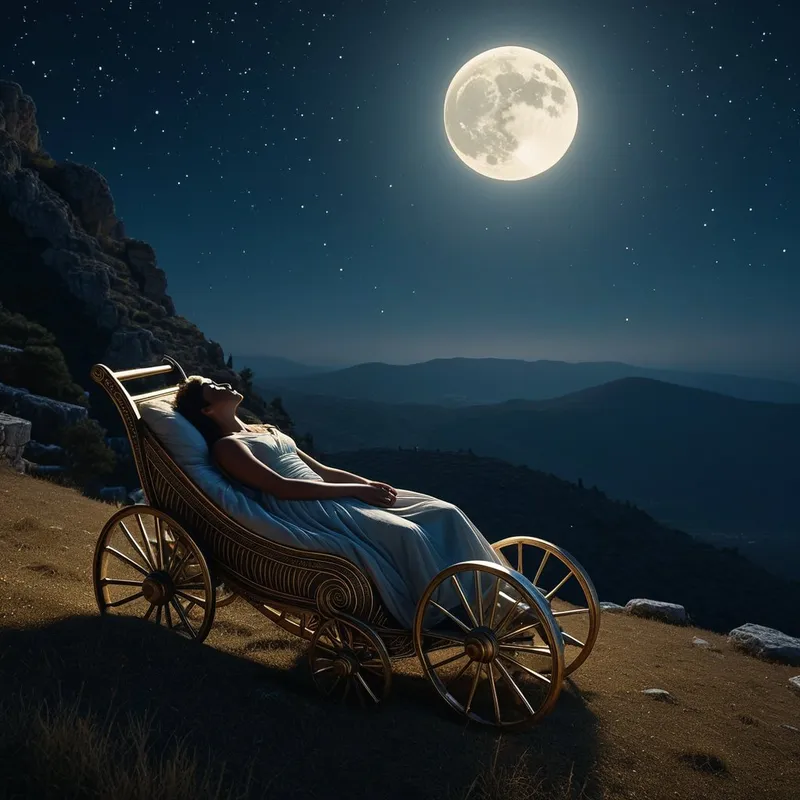
His true life began at dusk. While other men sought their beds, Endymion would climb to a high meadow, a bowl of grass cradled by ancient rock, and lie down to watch the vault of heaven. He did not sleep, but witnessed. He knew the slow dance of the constellations, the secret paths of the planets. And he waited, though he knew not for what, his heart a silent cup waiting to be filled.
One night, the heavens parted. The usual procession of stars seemed to bow, and a new, softer light washed the mountain in a luminous grey. It was Selene, driving her chariot across the black velvet sky. Her oxen were pale as mist, her path one of quiet command. But as she passed over Latmus, her gaze fell upon the solitary figure below. She saw Endymion, not as a man, but as a stillness within her own ceaseless motion. In his upturned face, she saw a reflection of her own lonely journey. A longing, sharp and sweet as a night-blooming flower, pierced her immortal heart.
She descended. Leaving her chariot to drift among the clouds, she stepped onto the dewy grass. Endymion, entranced, did not rise but watched her approach—a woman woven from moonlight itself, her presence cooling the air, her eyes holding the patience of a thousand nights. She knelt beside him. No words were spoken that mortal tongues could understand; their communion was one of presence, a merging of celestial journey with earthly repose. Night after night, she returned, forsaking her ordained route across the sky for this hidden meadow. Their love was a secret pact between the moving and the still, the eternal and the ephemeral.
But a shadow grew in Selene’s heart. She was timeless; he was not. Each dawn was a theft, pulling her back to her duty and him toward the decay of days. She could not bear the thought of watching his beauty wither, of his eyes clouding with age while she remained unchanged. Love demanded a solution, but immortality was a gift only the great Zeus could grant.
Selene approached the throne of Olympus, not with a demand, but with a desperate plea. She laid bare her divine anguish. Zeus, moved by her tears or perhaps by the poetic symmetry of the request, offered a choice—but not the one she hoped for. Endymion could not join her in eternity. Instead, he could be spared death’s corruption through an endless, ageless sleep. He would dream forever, untouched by time, and in that dream-state, Selene could visit him each night for all eternity.
The choice was a torment. It was union, but a union with a phantom, a love preserved in amber. Yet, to refuse was to accept utter loss. Selene, her heart breaking, accepted. Zeus’s decree fell upon Endymion on his mountain. A profound lethargy, sweeter than any wine, overcame him. His eyes closed not in death, but in an enchanted slumber. His body did not age; it remained the perfect vessel of the moment Selene first loved him.
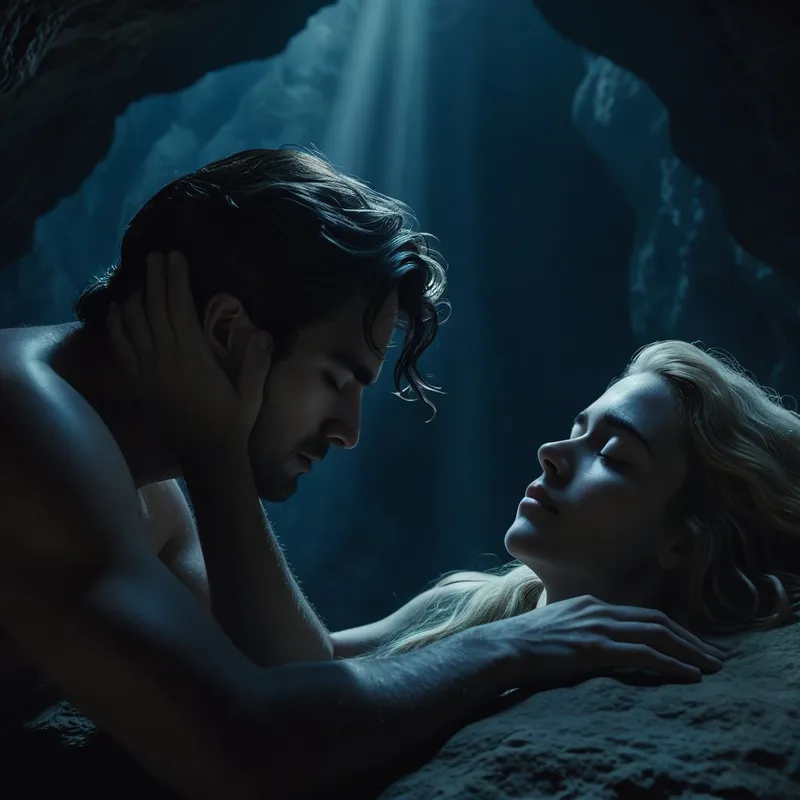
And so, the pact was sealed. Endymion sleeps in a hidden cave on Latmus, his dreams deep and unknowable. And every night, without fail, the Moon slows her course, bends her light into that sacred grotto, and kisses her sleeping lover. Their romance is perpetual, but its price is perpetual dreaming. He is hers, but only in the silent, silver world of sleep.
Cultural Origins & Context
The myth of Endymion is a soft but persistent thread in the rich tapestry of Greek storytelling. It finds its most famous telling in the Bibliotheca of Pseudo-Apollodorus, but echoes appear in the poetry of Sappho and the later, more elaborate Roman versions by poets like Ovid. Unlike the grand, civic myths of Athens or Thebes, this is a tale often carried by poets and lovers, a private story for starlit nights. Its primary function was not to explain natural phenomena in a literal sense—though it poetically accounts for the moon’s gentle, lingering gaze—but to explore an existential and emotional dilemma.
In the Greek imagination, the moon (Selene) was a powerful, ambivalent force. She governed the rhythms of women, the tides, and the hidden, fertile dark. Endymion, often associated with the very old, pre-Olympian figure of a king or hero of Elis, represents a rooted, earthly sovereignty. Their union is a sacred marriage (hieros gamos) of sky and earth, but one tragically skewed by the fundamental imbalance between mortal and immortal. The myth served as a poignant meditation on the human condition: our deepest longings often brush against the divine or the eternal, yet our nature binds us to time, sleep, and decay. It gave a face to the quiet ache felt under a beautiful, indifferent moon.
Symbolic Architecture
At its core, the myth of Endymion is a profound map of the psyche’s relationship with the numinous—that which is utterly other and captivating. Endymion is the aspect of consciousness that is receptive, contemplative, and oriented toward the sublime. He is not a hero of action, but of perception. His "shepherding" is not of sheep, but of his own inner world under the night sky.
Endymion’s sleep is not an escape from life, but a descent into a deeper, more essential state of being where the soul’s true marriage can occur.
Selene represents the anima, the soul-image, in its most luminous, transcendent form. She is the pull toward beauty, meaning, and eternal values. Their love is the longing of the ego (Endymion) for connection with this deeper, guiding principle. However, the resolution—eternal sleep—reveals the central paradox. To fully unite with the numinous, ordinary waking consciousness must be surrendered. The ego cannot possess the anima; it can only be visited by her in altered states—in dreams, in creative trance, in moments of awe.
The cave on Mount Latmus is the temenos, the sacred enclosure of the inner self. The choice offered by Zeus is the cruel wisdom of the psyche itself: you can have timeless connection to the soul, but not on the terms of the waking, time-bound ego. The price of perfect, unchanging beauty is the cessation of conscious, striving life.
The Dreamer's Resonance
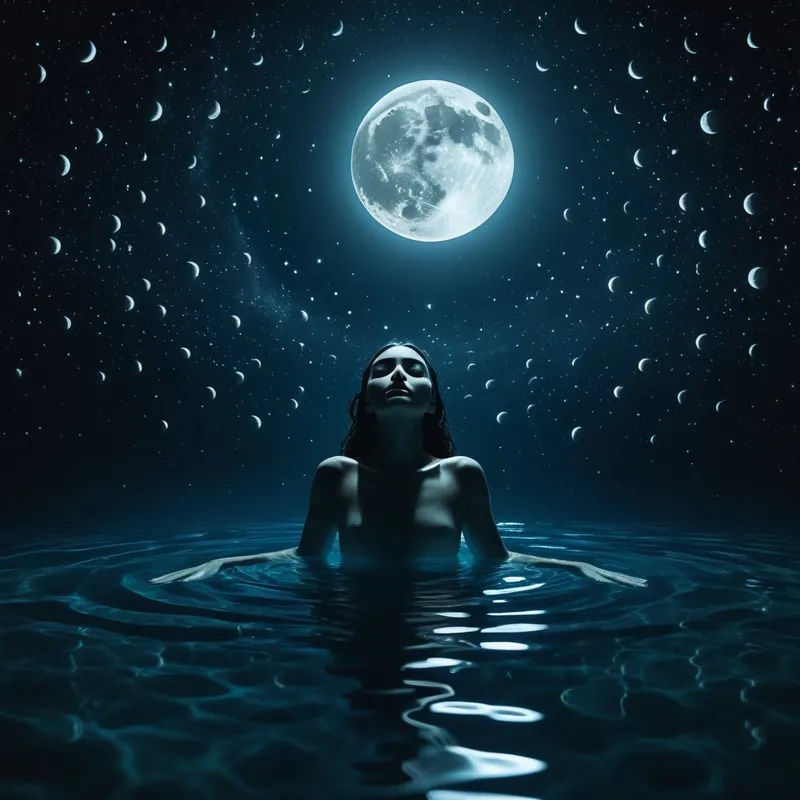
When this mythic pattern stirs in the modern dreamer, it often manifests as dreams of profound, enchanting sleep, of being visited by a luminous or celestial figure, or of feeling suspended in a beautiful, timeless space. One might dream of floating in a warm, dark sea under a full moon, or of a loved one who is present yet forever just out of reach in a twilight landscape.
Somatically, this can correlate with feelings of deep fatigue that are not entirely unpleasant—a longing to retreat, to hibernate. Psychologically, it signals a process of introversion so deep it approaches a kind of psychic death-and-rebirth. The ego is being called to let go of its diurnal ambitions and agendas. The dreamer is in an Endymion phase, where the most vital work is not doing, but being receptive to the nourishing, healing, and inspiring visits from the unconscious (Selene). It is a time for incubation, for allowing insights to form in the dark, away from the harsh light of day-logic. The danger, as the myth warns, is getting stuck in the enchantment, preferring the beautiful dream to the complex reality of a life lived in time.
Alchemical Translation
The alchemical process mirrored in Endymion’s tale is solificatio—the whitening, the illumination by the moon, following the initial blackening (nigredo) of descent into sleep or unconsciousness. This is not the gold of solar consciousness, but the silver of lunar integration.
The individuation journey requires a voluntary descent into the cave of Latmus—a conscious agreement to be put to sleep by one’s own deepest longings.
The modern individual engaged in this work must first cultivate the "Endymion capacity": the ability to be still, to watch, to listen inwardly. The conflict arises when the soul (Selene) makes her claim, revealing a longing for a beauty or a truth that ordinary life cannot sustain. The "Zeus" within—the executive, ruling function of the psyche—must then mediate. It cannot grant immortality (permanent inflation with the unconscious), but it can sanction a sacred space and time for temenos.
The eternal sleep is the alchemical coniunctio (sacred marriage) achieved in the unus mundus, the unitary world of the unconscious. For us, this translates to dedicated, regular practice—dream work, active imagination, artistic creation—where we consciously enter the "cave" to be visited by the anima/animus. We return to waking life refreshed and inspired, carrying the moon’s silver imprint. The goal is not to sleep forever, but to learn the rhythm of descent and return, allowing the timeless love affair with the soul to inform and deepen our time-bound existence. In this way, we honor both Selene’s love and Endymion’s humanity, achieving not a static eternity, but a life rhythmically married to the eternal.
Associated Symbols
Explore related symbols from the CaleaDream lexicon: