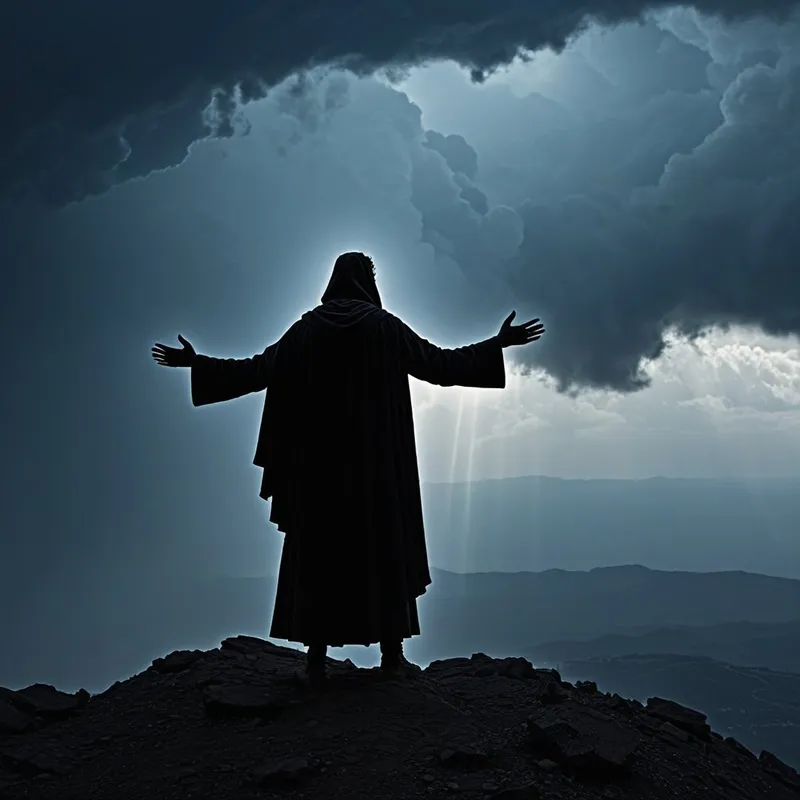
Elijah's Drought Myth Meaning & Symbolism
A prophet declares a drought to challenge a kingdom's idolatry, culminating in a fiery confrontation that shatters illusions and restores the life-giving rain.
The Tale of Elijah's Drought
Hear now the tale of the drought, a story of a land choked by silence and a sky turned to brass. In the days when Ahab ruled in Samaria, he did more evil than all the kings before him. He took Jezebel as his queen, and together they raised altars to the storm god, Baal, across the hills of Israel. The scent of incense meant for other gods filled the high places, and the voice of YHWH grew faint in the land, a whisper beneath the clamor of idols.
Then, like a sudden thunderclap from a clear sky, a man appeared before the king. He was Elijah, a figure from the wild places, clothed in animal skins, his eyes burning with a fire not of this earth. He stood, unbowed, and his voice was dry as the bones in the valley. “As YHWH, the God of Israel lives, before whom I stand,” he declared, “there shall be neither dew nor rain these years, except by my word.”
The word was a seal upon the heavens. The rains ceased. The dew, the gentle mercy of the morning, vanished. The wadis, once singing with runoff, became gaunt, stony scars. The earth cracked open with thirst. The granaries emptied. The breath of the ox grew labored, and the faces of the children grew pinched. For three long years, the sky was a relentless, polished bowl of heat, and the kingdom of Ahab became a kingdom of dust and desperate prayers to silent idols.
Elijah vanished into the wilderness, sustained by a brook that soon dried and by ravens that brought him bread. He was a ghost in the land’s dying, a living embodiment of the judgment he had proclaimed. The conflict festered, a spiritual rot mirroring the physical decay. Finally, the word of YHWH came to him: “Go, present yourself to Ahab, and I will send rain upon the earth.”
The confrontation was set upon Mount Carmel. Elijah stood before all the people and the four hundred and fifty prophets of Baal. “How long will you limp between two different opinions?” he cried. “If YHWH is God, follow him; but if Baal, then follow him.” The test was simple, terrible, and absolute: two altars, two sacrifices, no fire. The god who answered with fire, he would be God.
The prophets of Baal danced and shouted from morning until noon, cutting themselves with swords and lances, their blood mingling with the dust. Their cries rose to a silent heaven. “O Baal, answer us!” But there was no voice, no answer, no sign. Only the mocking stillness of the heat.
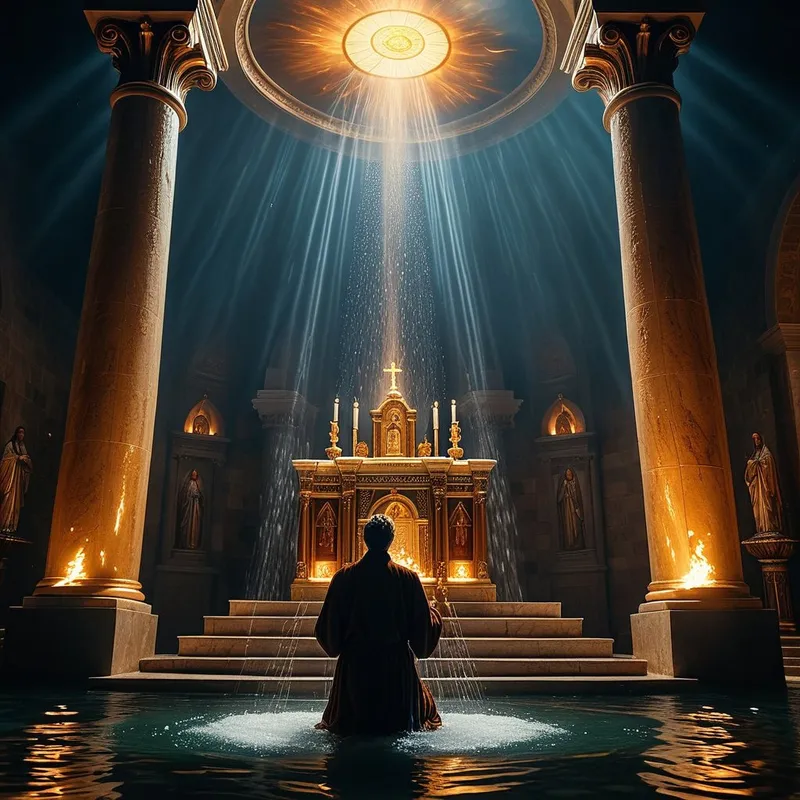
Then Elijah rebuilt the altar of YHWH with twelve stones. He dug a trench around it, laid the wood and the bull, and then, in an act of supreme, defiant faith, commanded that twelve jars of precious water be poured over it all, once, twice, three times, until the trench itself was filled. The sacrifice was drowned, a symbol of the very rain he was asking to end the drought.
At the time of the evening offering, Elijah stepped forward. His prayer was not a scream, but a clear invocation of covenant and identity. “O YHWH, God of Abraham, Isaac, and Israel, let it be known this day that you are God in Israel, and that I am your servant, and that I have done all these things at your word. Answer me, O YHWH, answer me, that this people may know that you, O YHWH, are God.”
Then the fire of YHWH fell. It consumed the burnt offering, the wood, the stones, the dust, and licked up the water in the trench. The people fell on their faces. “YHWH, he is God! YHWH, he is God!”
Elijah turned to Ahab. “Go up, eat and drink, for there is a sound of the rushing of rain.” He climbed to the top of Carmel, bowed himself to the earth, and sent his servant to look toward the sea. Six times the servant saw nothing. The seventh time, he reported, “Behold, a little cloud like a man's hand is rising from the sea.” The sky grew black with clouds and wind, and a great rain began to fall, breaking the years-long drought. The word of the prophet had sealed the heavens, and now, it opened them.
Cultural Origins & Context
This narrative is preserved in the First Book of Kings (chapters 17-18), a text that forms part of the Deuteronomistic History—a grand theological interpretation of Israel’s monarchy compiled during the Babylonian exile. The story of Elijah is not mere chronicle; it is prophetic legend, a foundational myth of the prophetic office itself, told and retold to define the very soul of the nation against the threat of assimilation.
The historical setting is the 9th century BCE, a period of intense cultural and religious pressure. The northern kingdom of Israel, under the Omride dynasty (Ahab’s house), was engaged in political and economic alliances with Phoenician city-states like Tyre and Sidon. Queen Jezebel was not merely a foreign consort but a missionary for her native cult of Baal-Melqart. The conflict, therefore, was existential: would Israel remain a people defined by the covenant with YHWH, or would it dissolve into the broader Canaanite religious landscape, where divine power was linked to natural cycles and royal patronage?
The storytellers were the keepers of the prophetic tradition. They functioned as the nation’s critical conscience. The Elijah cycle served to affirm that true power—over rain, fertility, and life itself—resided not in the popular, syncretic cults of the land, but in the transcendent will of the covenant God. It validated the often-lonely and persecuted prophetic voice as the true conduit of that power. The drought was not a random natural disaster but a direct, theological consequence, a withdrawal of divine blessing that forced a crisis of identity and allegiance.
Symbolic Architecture
At its core, the myth is a profound drama of reality-testing. The drought symbolizes a state of spiritual and psychic aridity, a life cut off from its authentic source. It is the consequence of a collective shadow—the worship of "Baal", representing any compelling, yet ultimately illusory, system of meaning that promises fertility (success, security, identity) but cannot deliver when the soul is truly parched.
The drought is the necessary desert where all false wells run dry, so that the soul may remember the taste of true water.
Elijah embodies the archetypal individuated consciousness. He is the one who stands before YHWH, a posture of radical alignment with the transcendent Self, even against the collective consensus. His declaration of drought is not cruelty, but the enactment of a painful, therapeutic truth: when you feed the false, the true withers. The confrontation on Carmel is the psyche’s ultimate tribunal. The frenzied, self-lacerating prophets of Baal represent the ego’s desperate efforts to prop up its chosen idols through sheer effort, performance, and willpower—a drama that yields only exhaustion and silence.
The fire that consumes the water-drenched altar is the central symbol of transformative revelation. It is not destructive fire, but discerning fire. It does not burn instead of the water, but through it, revealing a power that transcends and includes the natural order. It is the sudden, undeniable ignition of knowing—the moment when a buried truth becomes self-evident, burning away ambiguity and compromise.
The Dreamer's Resonance
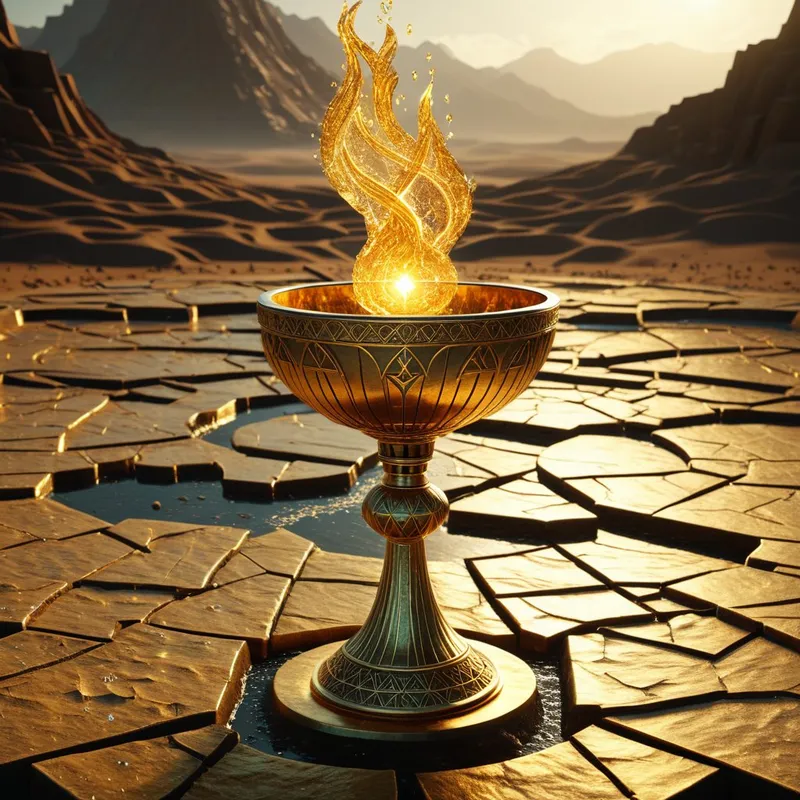
When this myth stirs in the modern dreamscape, it often signals a profound interior drought. The dreamer may find themselves in endless, cracked landscapes, searching for a spring that has vanished. They may be in a house where all the taps run dry, or witness a beloved garden turning to dust. This is the somatic expression of a soul in crisis, feeling cut off from vitality, creativity, or meaning—a deep, existential thirst.
The figure of Elijah might appear as a stern guide, a homeless sage, or simply as a compelling, undeniable voice or command within the dream. The dreamer may be cast in the role of Ahab, paralyzed and resentful in a decaying kingdom of their own making, or as one of the confused people, “limping between two opinions.” The climactic dream image may not be a literal altar, but a situation of impossible choice or a test where the dreamer must wait, saturated in doubt (the water), for an authentic response to emerge (the fire).
Such dreams mark a critical juncture in shadow-work. The drought has done its work; the false supports have been exposed. The dream is the psyche’s Mount Carmel, creating a container for the confrontation between the ego’s attachments and the Self’s demand for integrity. The emotional tone is one of tense anticipation, moving through despair (the failed efforts of the Baal-prophets) toward a potential moment of awe and release.
Alchemical Translation
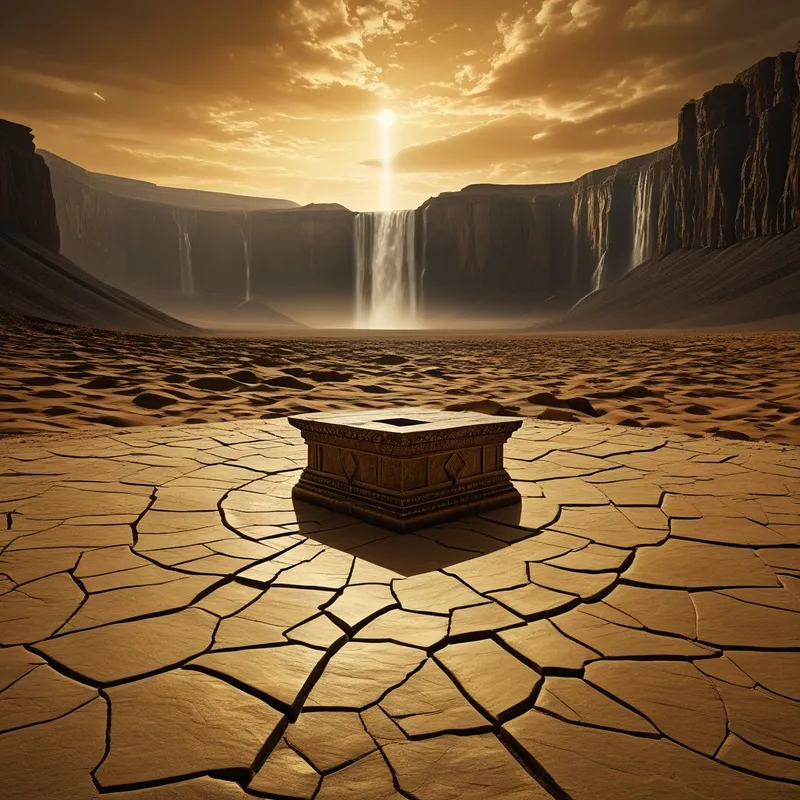
The myth of Elijah’s drought is a perfect map for the alchemical process of nigredo and albedo in the human soul. The declaration of drought initiates the nigredo: the deliberate, painful withdrawal of projection and libido from the outer world of collective values and idols. The ego’s kingdom—built on compromise, people-pleasing, or borrowed identities—is subjected to a scorching truth and begins to disintegrate. This is the long, barren period in the wilderness, where one is sustained only by the barest of means from an unseen source.
The gathering at Carmel is the conjunctio, the bringing together of all opposites: the people, the prophets, the two altars, water and fire. The ego (the people) must witness the failure of its old, frantic methods (the prophets of Baal). Then, in a supreme act of surrender, the psyche must drench its own most sacred offering—its longing, its hope, its very life—in the waters of doubt and vulnerability.
The alchemical fire descends only upon the sacrifice that has been utterly surrendered, drowned in the very element that seems to negate it.
The answering fire is the albedo, the illuminating revelation. It is the moment of psychic integration where a higher-order truth emerges, not as an idea, but as an experienced reality that reorganizes the entire personality. The false dichotomy (Baal vs. YHWH) is resolved. The rain that follows is the rubedo, the return of life and feeling, but now flowing from an authentic, centered source. The individuated self, having passed through the fire of discernment, no longer “limps between two opinions” but becomes a vessel through which life-giving waters can flow into the world. The drought was not a punishment, but the arduous, necessary precondition for a more profound and resilient fertility of soul.
Associated Symbols
Explore related symbols from the CaleaDream lexicon: