The Somatic Echo
It begins not as a thought, but as a posture. A subtle, persistent ache in the neck and shoulders, as if you’ve been holding your head in a fixed, reverent tilt for a lifetime. A hollowness behind the sternum, a cavity where your own authority should reside, now echoing with the borrowed rhythms of another’s will. There is a specific fatigue here—not of the body’s exhaustion, but of the spirit’s servitude. It is the weight of kneeling at an altar you did not build, offering your vitality to keep a foreign flame alive. Before the dream-images form, the body knows: you are in a temple of your own making, worshipping at a shrine that consumes you.
The Dreamer's Log
The dreamer finds themselves in a vast, silent data-center, its endless racks humming with a cold, blue light. In the center of the sterile maze, on a plinth of black marble, rests a single, ornate golden key. They are compelled to guard it, to polish it, to ensure its light never dims, though the task drains them to a husk. They know, with a sinking dread, that this key opens nothing—it is merely an object to be worshipped.
The alchemy here is the recognition that the sacred object you protect with your life is, in truth, a lock disguised as a key.

The False Lead
This is not about ambition or admiration. To dream of idolatry is not to dream of simple desire for a promotion, a partner, or a possession. Those are wants. Idolatry is the silent, structural surrender of your inner throne. It is the confusion of a useful tool for the master craftsman, a helpful map for the territory itself. The terror of this dream is not in losing the idol, but in realizing you have traded your sovereignty for the hollow comfort of its service. It is a profound architectural flaw in the psyche’s foundation, mistaken for a decorative feature.
Psychological Architecture
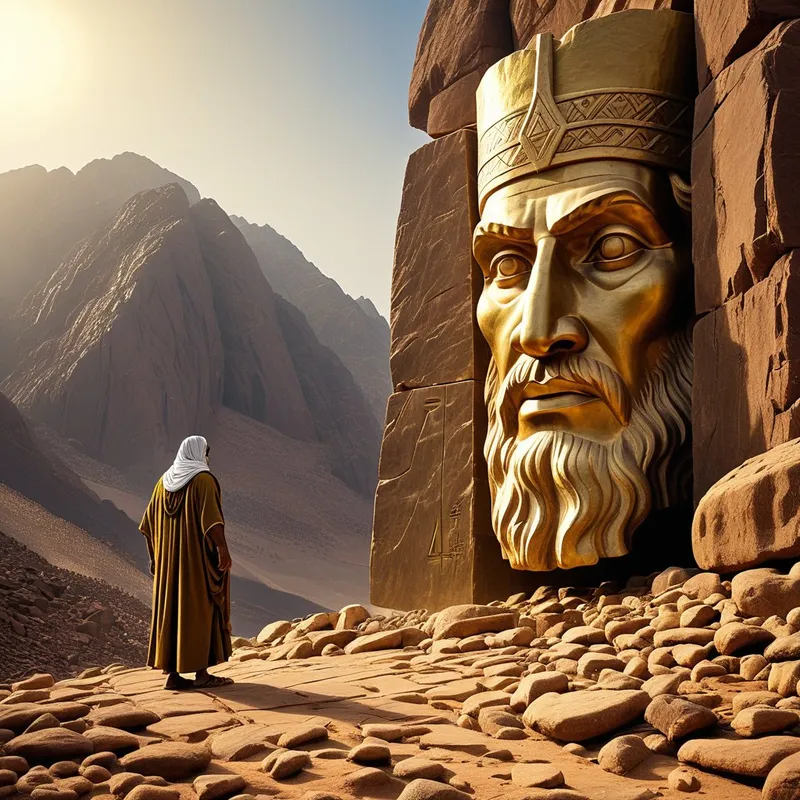
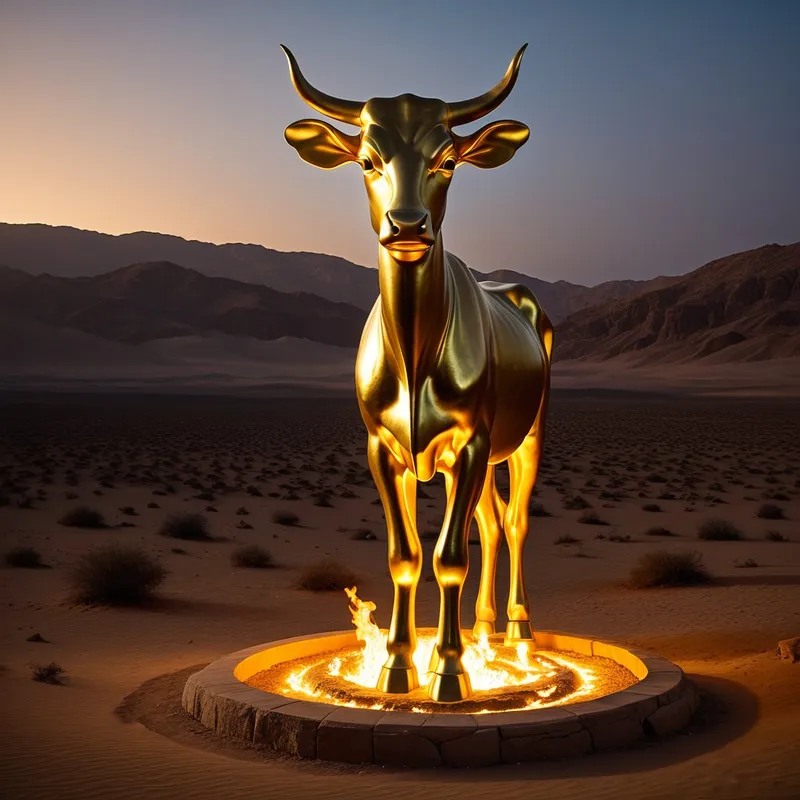
The work of idolatry is shadow work of the most intimate kind. It asks you to turn from the gleaming, gilded statue in the center of your inner temple and to look instead at the empty space where you, the worshipper, stand. Who built this altar? What ancient promise of safety, worth, or love was so desperately needed that you externalized it, crystallized it into this form, and then forgot you were the sculptor? This is the core of individuation—withdrawing projections. It is the agonizing, glorious process of re-absorbing the divine attributes you have lent to concepts, people, systems, or past versions of yourself. The idol must be seen for what it is: not a god, but a fossilized prayer. To dismantle the shrine is not an act of destruction, but of reclamation. You are not breaking a sacred object; you are melting down the gold to mint your own currency.
Mythic Resonance
Consider the tale of Pygmalion, the sculptor who fell in love with his own creation, Galatea. He prayed so fervently to Aphrodite to bring her to life that the goddess granted his wish. But the myth’s deeper current asks: what part of Pygmalion had to become stone in order to create this perfect, silent beloved? His idolatry was not of the statue, but of an ideal of love that required no messy humanity, no reciprocal voice. He worshipped a reflection of his own longing, frozen in ivory. The dream of idolatry often shows us our own Galatea—the perfect career, the salvific relationship, the unassailable identity—and asks us to feel the cold, dead weight of our own hands that carved it, and the living heart we silenced to do so.
Symbolic Nodes
- Gilded or Untouchable Objects: Keys that open no doors, crowns that fit no head, glowing orbs, sealed scrolls.
- Empty Thrones & Altars: Elaborate seats facing empty space, pristine altars with no central icon, or ones where the icon is a blank screen or mirror.
- The Compelled Ritual: Endless polishing, guarding, circling, or chanting to maintain something that gives nothing back.
- Temples of the Self: Prisons disguised as cathedrals; server farms, sterile laboratories, or personal museums you cannot leave.
- The Hollow Icon: A statue with a vacant space in its chest, a painting where the face is blurred, a monument that absorbs light.
Archetypal Resonance
The Shadow Ruler is the silent architect of the idolatrous dream. This is not the absence of authority, but its profound abdication. The Shadow Ruler refuses the terrifying burden of its own sovereignty and projects it outward, appointing a substitute king—the idol—to bear the crown. The somatic echo of the bowed neck and hollow chest is the Shadow Ruler’s posture of fealty to this false sovereign. The alchemical potential lies in the moment of rebellion against the substitute, not for chaos, but to reclaim the legitimate throne. It is the arduous journey from being a loyal subject in a foreign court to becoming the exiled monarch who returns to their own, long-empty castle.
The Alchemical Process
The transmutation of idolatry requires the heat of sacrilege and the pressure of lonely truth. The alchemical vessel is the moment you choose, in the heart of your inner temple, to turn your back on the idol. This is not a casual dismissal; it is the ultimate heresy against your own psychic orthodoxy. The heat is the shame and terror of breaking a covenant you made with yourself in a time of profound need. The pressure is the crushing silence that follows, the void where the idol’s comforting presence once was. This is the nigredo, the blackening. But in that void, a new gravity forms. The energy once spent on maintenance, devotion, and protection now has nowhere to go but inward. It begins to pool, to coalesce. Slowly, from the center of that hollow chest, a warmth that is entirely your own begins to radiate. The gold leaf stolen from your spirit to gild the idol is now molten within you, being forged into a new center of gravity. The idol does not shatter; it dissolves, its substance returning to the source that imagined it.

The Integration Protocol
Question 1: What is the one rule in my inner temple that is never questioned, the one "because it is sacred" justification that ends all debate?
Question 2: If the idol I serve could speak with my own voice, what single, repetitive command would it be giving me?
Question 3: What forgotten, messy, or "unholy" part of myself did I have to exile in order to keep this altar clean?
Action 1 (The Heretic's Journal): For seven minutes, write with your non-dominant hand. Let it scrawl, complain, and blaspheme against the central "should" or "must" that your idol represents. Do not edit or judge the handwriting or the content.
Action 2 (Deconsecration of Space): Identify one physical space (a shelf, a corner of a desk, a screen saver) that subtly reinforces the idol's domain. Alter it in a small, deliberate, and slightly irreverent way. Place an absurd object there. Change the image to something mundane. Break its aesthetic spell.
Action 3 (The Sovereign's First Edict): Perform a simple, tangible act of choice that has no purpose other than to assert your preference, however minor. Prepare the tea you like, not the one you "should" drink. Take the longer, prettier route. Wear the comfortable item. Let the action be a quiet, physical declaration: "This is my will."
Final Validation
To dream of idolatry is to feel the profound grief of self-betrayal, the deep weariness of a pilgrimage to a shrine that holds no water for your thirst. This is a difficult, sacred pain. It means a part of you is finally strong enough to feel the weight of the chains, and wise enough to recognize that you hold the key—not the one on the altar, but the one you forgot you were born clutching in your own hand. The temple was always yours. The altar is just stone. You are the living flame. Now, turn and face the empty throne, and see it for what it has always been: waiting for you.