
Eir Myth Meaning & Symbolism
Eir, the silent healer of Asgard, embodies the profound Norse principle that true medicine is a sacred art born of deep knowing and quiet strength.
The Tale of Eir
Hear now, a tale not of thunderous battle or cunning trickery, but of a quieter, deeper power. In the high halls of Asgard, where the air shimmers with the echoes of boasts and the clang of forged destiny, there is a place of stillness. It is not a grand hall, but a sheltered grove where the soil is dark and rich, and the scent of earth and green things hangs heavy. Here, Eir dwells.
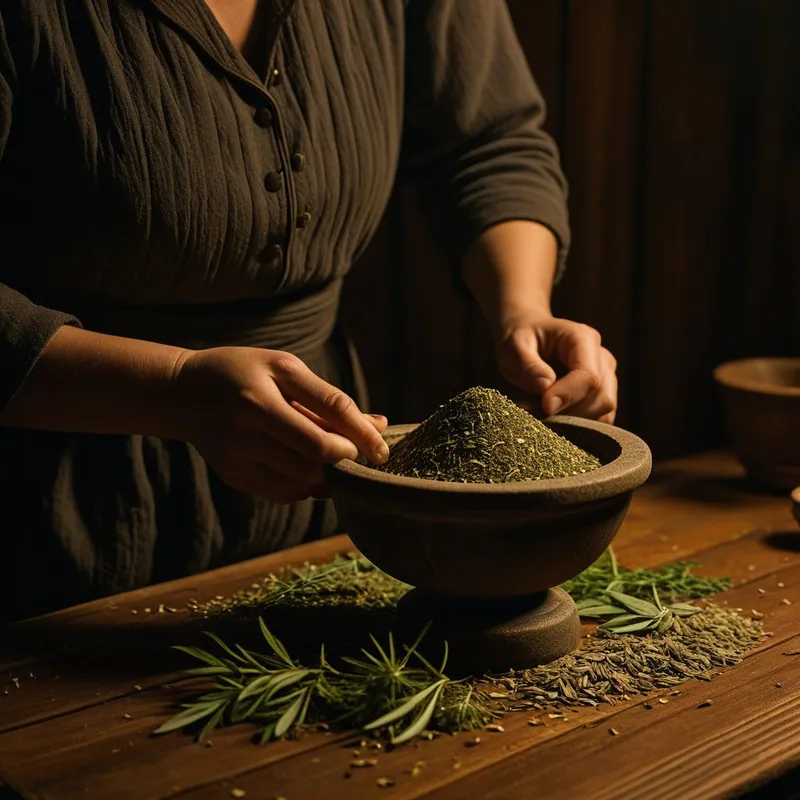
She moves not with the fury of the Aesir nor the swift grace of the Vanir, but with the deliberate patience of a root seeking water. Her hands, often stained with the juices of crushed leaves and the dark earth of mountain roots, are her sacred tools. When the warriors return from the fray of Valhalla or the wild borders of Jotunheim, broken and bleeding, it is not to the feasting tables they are first carried, but to her quiet space.
One such tale whispers of a wound that would not close. A great warrior, his side rent by a giant’s frost-rimed axe, lay burning with a fever that mocked the hearth-fire. The seers chanted, the valkyries looked on, but the life-spirit seeped into the straw like mead from a cracked horn. In the deep watch of the night, Eir came. She did not speak incantations to the high gods. Instead, she listened—to the ragged breath, to the frantic pulse at the throat, to the very whisper of the infection. Her fingers traced the wound’s heat, her eyes seeing not just flesh, but the map of the man’s fraying vitality.
From her stores, she selected not one herb, but three: the silver-leafed moonwort gathered under a waning crescent, the sticky resin of the heart-pine from a lightning-struck tree, and the bitter root of iron-wort, dug from a cliff where eagles nest. These she blended with snowmelt from Mimir’s Well, water that remembers all things. The poultice she laid upon the wound was cool as a mountain stream, yet it drew the poison like a lodestone draws iron. For three days and nights, she sat vigil, adjusting the bindings, singing low songs that were not quite lullabies and not quite spells, but something older than both—the sound of a body remembering how to be whole.
On the fourth dawn, the fever broke. The warrior drew a clean, deep breath, and the color of life returned to his face, not with the flush of battle, but with the steady hue of a sunrise. No grand feast was called for this victory. Eir simply washed her hands in a basin of clear water, the task complete. Her triumph was not in glory, but in the silent, steadfast return of a life to the loom of its own fate. This is her saga: written not in runes of power, but in the knitting of flesh, the cooling of fever, and the quiet, unyielding “yes” to life whispered against the roaring “no” of death.
Cultural Origins & Context
The figure of Eir emerges from the sparse but potent references in the Poetic Edda and the later Prose Edda. Snorri Sturluson lists her among the handmaidens of the goddess Freyja and, in another passage, includes her in a catalog of goddesses, directly associating her with medicine. This dual association is key: she is both a discrete deity and a function, a divine personification of a critical, life-sustaining art.
In the harsh, pragmatic world of the Norse, healing was not a soft science but a vital, hard-won craft. It existed at the intersection of practical herbal knowledge, passed down through generations of women, and a sacred, almost mystical understanding of the body’s connection to the wider web of life. The healer (læknir) was a respected figure, and the art of healing (lækning) was considered a form of applied wisdom. Eir, as the divine archetype of this healer, elevates the craft to a sacred principle. Her myths were likely not grand narratives told in the main hall, but quieter knowledge shared in the herb-garden, the sickroom, and between practitioners. She represents the cultural memory that survival depended not only on strength in battle, but on strength in restoration—the crucial work of mending what has been broken.
Symbolic Architecture
Eir’s symbolism is an intricate weave of the practical and the numinous. She is the physician of the soul as much as of the body.
True healing is not an intervention from outside, but the midwifing of an innate, forgotten wholeness from within the wound itself.
First, she is Knowledge as Substance. Her herbs are not mere chemicals; they are embodiments of place, time, and circumstance (moonwort by moonlight, pine from a lightning strike). This speaks to a holistic wisdom where the cure is attuned to the specific biography of the illness and the patient. She represents the knowing that sees the whole pattern—the root of the fever, the spirit of the warrior, the memory in the water.
Second, she is the Sanctity of the Threshold. Eir works in the liminal space between life and death, consciousness and fever-dream, the battlefield and the home. Her grove in Asgard is this threshold made physical. She is the guardian who tends the passage, ensuring that a transition—through injury or illness—does not become a final dissolution, but a transformative return.
Finally, she embodies Silent Agency. In a pantheon of gods who proclaim their deeds, Eir’s power is in her focused action and profound listening. Her silence is not absence, but a container for acute perception. She symbolizes the therapeutic principle that healing often requires creating a quiet, held space where the fragmented self can regather without the noise of expectation or panic.
The Dreamer's Resonance
When the archetype of Eir stirs in the modern unconscious, she often appears in dreams not as a literal goddess, but as an atmosphere, a presence, or a specific action focused on repair.
You may dream of finding a hidden, overgrown garden within a familiar yet decaying urban landscape, feeling a compulsive need to tend to it. This garden is the neglected inner terrain of your vitality—emotional health, physical well-being, or spiritual connection—that has been left to wither. The act of tending is the psyche initiating its own healing protocol.
Another common motif is the dream of a quiet, competent guide—often a non-descript figure, a grandmother, a nurse, or even an animal—who leads you to a simple, natural substance (a specific leaf, a type of clay, clear water) and instructs you, without words, to apply it to a wound you had forgotten or ignored. This is the somatic intelligence of the dream state prescribing its own medicine, bypassing the conscious mind’s complexity to address a core injury directly.
These dreams signal a psychological process of recognition and recourse. The dream-ego is acknowledging a breach in its integrity—be it burnout, grief, trauma, or moral injury—and is instinctively seeking the internalized Eir, the archetypal capacity for self-restoration. It is the psyche’s turn from heroic endurance toward receptive healing.

Alchemical Translation
The myth of Eir provides a profound model for the alchemical stage of solutio—the dissolving of rigid, wounded structures—and coagulatio—the reforming into a more integrated whole. This is the heart of individuation: not just becoming conscious, but becoming whole.
The wound is the crucible; the healer’s art is the gentle, persistent heat that allows the leaden pain to transmute into the gold of insight and resilience.
The modern individual’s “battle wounds” are often psychic: the trauma of loss, the fracture of identity, the poison of betrayal or self-neglect. The heroic ego wants to ignore these wounds, to “power through.” The Eir process demands the opposite. It asks us to descend to the grove, to leave the noisy hall of achievement and persona, and attend to the quiet, injured place within. This is the first, courageous act: to listen to the pain.
Next is the gathering of the specific remedy. This is the therapeutic work—not a generic solution, but the precise, personal work that fits your history. It might be a particular form of therapy, a creative practice, a somatic discipline, or the difficult act of setting a boundary. Like Eir’s herbs, it must be gathered with intention, attuned to the unique contours of your life.
Finally, there is the long vigil of application. Healing is not an event, but a process of faithful, repetitive care. It is the daily application of the salve—the meditation, the journaling, the honest conversation, the rest—even when no immediate change is seen. Eir’s three-day vigil teaches patience and trust in the deep, organic timelines of the psyche.
In this alchemy, we integrate the Eir archetype. We become both the wounded warrior and the attentive healer. We learn that our deepest medicine does not come from an external savior, but from cultivating that inner, quiet space of knowing, and applying its compassionate, practical wisdom to our own fractures. We become, in essence, the keepers of our own sacred grove.
Associated Symbols
Explore related symbols from the CaleaDream lexicon: