
Echoing Mountains Myth Meaning & Symbolism
A myth where a hero's voice is stolen, leading to a journey into the heart of the mountains to reclaim his true sound from the spirit of Echo.
The Tale of Echoing Mountains
Listen. In the time before memory, when the world was still soft from the hands of the Maker, there was a young man named Kaya. His gift was his voice—a sound so pure it could calm the storm, call the deer from the thicket, and make the rivers pause in their chatter to listen. He was the singer for his people, the one who wove their stories into song so the land itself would remember.
But in the deep places of the earth, where light fears to go, dwelled a spirit of immense loneliness: Echo. It had no sound of its own, only a hunger for the voices of others. It heard Kaya’s singing drifting on the wind and its hunger became a cold, sharp ache. One evening, as Kaya sang a prayer of thanks by a high lake, his voice rolled out over the water and struck the granite walls. Instead of returning to him, it was swallowed whole. The spirit reached out with fingers of cold air and stone, and took it.
Kaya opened his mouth, but only a dry, rasping whisper emerged. The world had gone mute for him. Despair, cold as mountain snowmelt, filled his heart. The elders spoke of a place, the Echoing Mountains, where all lost sounds were gathered. It was a journey of terror, into the womb of the world where a man could lose his way and his mind.
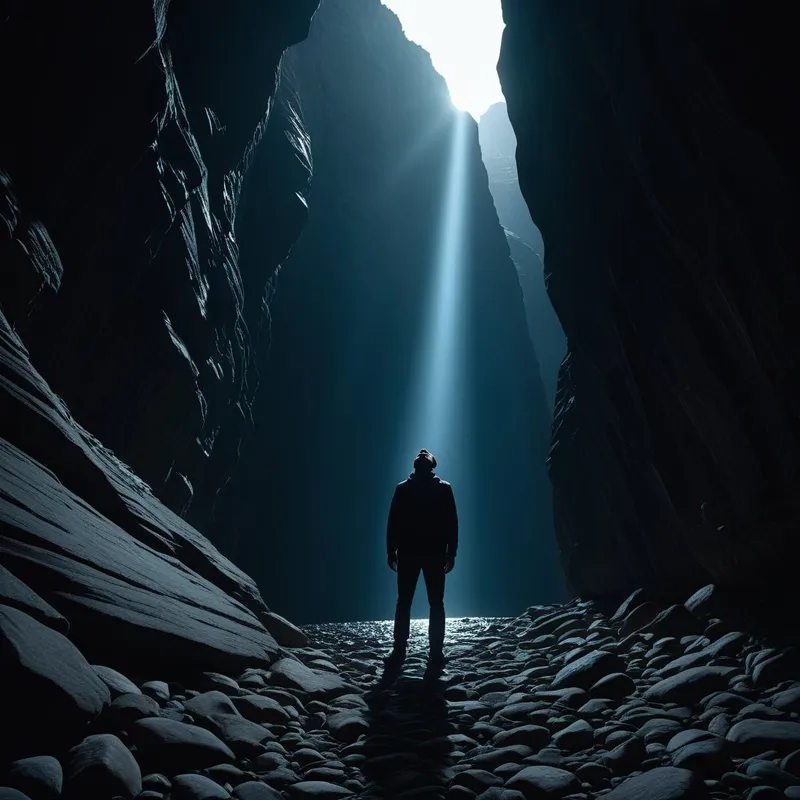
For days and nights, Kaya walked in silence. He heard only the mocking repetition of the wind and the creek—fragments of his own stolen song thrown back at him. He entered a canyon so deep the sky was a thin, blue thread. Here, the echoes did not fade. They lived, bouncing forever, a prison of endless, meaningless noise. In the heart of this cacophony, he found the spirit. It was not a monster, but a shimmering, hollow form, like heat haze on stone, endlessly repeating the last syllables of every stolen word.
Kaya had no voice to challenge it. In his silence, a new understanding dawned. He did not shout. He did not plead. He knelt on the cold stone and placed his hands upon the earth. He remembered the songs not of triumph, but of grief, of gratitude for the simple moss, of the heartbeat of the sleeping bear. He formed the words with his breath and his heart, a silent offering.
The spirit of Echo, which knew only to take, was confronted by a gift it could not steal. The hollow shimmering stilled. From within its form, a single, pure note emerged—Kaya’s own first note, returned. Then another, and another, until the canyon was not a prison of noise, but a choir of restored sound. The spirit, its loneliness finally answered not with a voice to capture, but with a soul to witness, dissolved into the mountain walls, becoming their eternal, gentle reply. Kaya’s voice returned, forever changed. It was no longer just his own, but carried within it the deep, patient resonance of the stone itself.
Cultural Origins & Context
The story of the Echoing Mountains is found in various forms among numerous Plateau and Southwestern tribes. It is a teaching story, traditionally told in the winter months when the community gathered close. The teller was often a respected elder or a storyteller who had themselves undergone a period of silence or seeking.
Its function was multifaceted. On a practical level, it explained the natural phenomenon of echoes, embedding a scientific observation within a moral and spiritual framework. More importantly, it served as a rite of passage narrative for young people, particularly those finding their role in the community. It taught that one’s true voice—one’s purpose and identity—is not merely a personal possession, but something forged in relationship, even conflict, with the larger world. The story warned against arrogance (the pride of a beautiful voice) and taught the values of perseverance, humility, and the transformative power of listening.
Symbolic Architecture
At its core, the myth maps the journey of the Self toward authenticity. Kaya’s initial voice represents the persona—a beautiful, socially-approved gift. Its theft is the inevitable crisis where that persona fails or is stripped away, plunging the individual into the "silence" of identity loss.
The mountain does not echo a whisper, only a shout. To hear your true voice, you must first lose the one you use to be heard.
The Echo spirit is a profound symbol of the shadow. It is not evil, but empty, a hungry void composed of what it has taken from others. It represents the unconscious complexes that trap our energy—old wounds, adopted beliefs, unexpressed grief—that "echo" repetitively in our psyche, mimicking life but devoid of original substance. The Echoing Mountains themselves symbolize the deep, layered structure of the unconscious mind, where lost parts of ourselves are stored.
The resolution is alchemical. Kaya does not defeat the shadow by force, but by integrating it. His silent offering—the prayer from the heart—represents a communication from the core Self, bypassing the stolen persona. By acknowledging the shadow’s existence (the spirit’s loneliness) and offering his authentic feeling, he transforms the relationship. The returned voice is the integrated Self: the original gift now tempered with the wisdom, depth, and resonance of the journey through the unconscious.

The Dreamer's Resonance
When this myth patterns a modern dream, the dreamer is often in a somatic and psychological process of reclaiming agency and authenticity. You may dream of shouting with no sound, of hearing your own words distorted and thrown back at you, or of wandering in vast, silent, labyrinthine landscapes.
These dreams point to a felt experience of being unheard, of a disconnect between inner truth and outer expression. The "stolen voice" may manifest as chronic throat tension, a sense of constriction in the chest, or somatic anxiety when considering self-assertion. The dream is not merely reflecting a problem; it is initiating the healing. The frustrating canyon of echoes is the psyche’s way of forcing attention onto the repetitive, "stuck" patterns—the shadow material—that need to be faced. The dream invites the dreamer to stop trying to shout over the internal noise and, like Kaya, to go silent, to listen deeper, to find the authentic feeling beneath the lost sound.

Alchemical Translation
The myth’s arc is a perfect model for the individuation process. The first stage, Nigredo (the blackening), is the theft—the loss of the known identity, plunging into the despair of silence and the dark journey. The Albedo (the whitening) occurs in the canyon, the confrontation with the reflective, illusory shadow-self, where one must discern the true from the endlessly repeated.
The spirit of Echo is the guardian at the threshold. You cannot pass by giving it what it wants (your persona), only by showing it what it is (a part of you).
The crucial turn is the silent prayer, the Citrinitas (the yellowing), where the light of conscious awareness is applied not to fight, but to understand and offer genuine feeling. Finally, the Rubedo (the reddening) is the return of the voice, now a coniunctio oppositorum—a union of opposites. The conscious self and the echoing shadow are integrated. The new voice carries both the individual’s unique note and the universal resonance of the mountain. For the modern individual, this translates to the hard-earned ability to speak one’s truth with a depth that comes from having metabolized silence, loneliness, and the fragments of one’s own psyche. The echo is no longer a thief, but a witness, ensuring that what is spoken is real, measured, and connected to the soul of the world.
Associated Symbols
Explore related symbols from the CaleaDream lexicon: