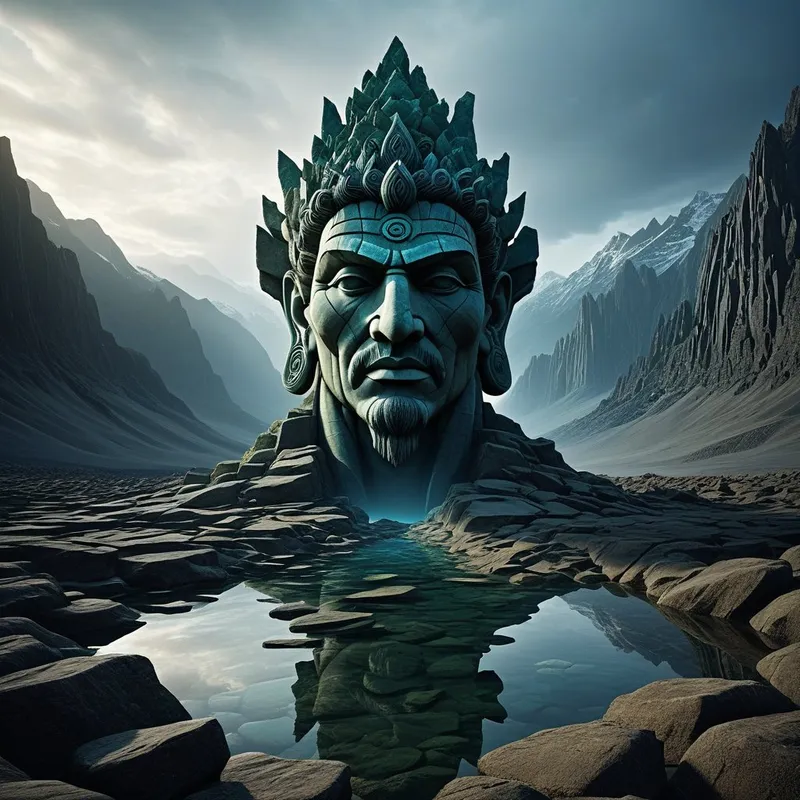
Earthquake Deities Myth Meaning & Symbolism
A global myth of primal beings whose restless movements shape the land, embodying the necessary chaos that precedes all profound change and renewal.
The Tale of Earthquake Deities
Listen. Beneath the solid ground you walk upon, beneath the roots of the oldest trees and the deepest wells, there is a world of restless motion. This is not a story of the sky, but of the dark, pressing weight of the earth’s belly.
In the beginning, the world was formless, a soft and yielding mud. Then came the Jishin, the World-Shaker. Some say it is a colossal catfish, Namazu, pinned beneath the islands by a mighty stone, guarded by a stern god who grows weary. Others whisper of a giant turtle, Akupara, who carries the continents on its back; when it stretches an ancient limb, the mountains tremble. In the lands of the far north, it is the angry stomping of a trapped god, Loki, writhing in his bonds as venom drips onto his face. Across the great ocean, the people say it is the great serpent Kukulkan turning in his subterranean bed, or the mighty Tepeyollotl, the "Heart of the Mountain," whose jaguar roar is the sound of splitting stone.
They are never still. Their sleep is fitful, a simmering tension. You can feel it in the unnatural silence of the forest, in the sudden stillness of birds. The pressure builds, a breath held too long in the chest of the world. The guardian god nods. The pin slips. The bonds chafe.
And then—movement.
It begins not with a sound, but with a feeling deep in the bones. A low, grinding groan rises from the very fundament, a voice older than language. The ground, that most trusted thing, becomes a liquid thing. It bucks like a wild horse, heaves like a sea. Trees dance a mad, splintering jig. Stones sing as they grind together. The air fills with the dust of millennia and the scent of newly exposed, deep earth—cold, metallic, and alive. It is chaos absolute, a fury that seems personal, as if the world itself is trying to shrug off a great, itching weight.
It does not last long. A minute. An eternity. Then, a slow settling. The groaning subsides into a rumble, then a sigh. The dust begins to fall, painting everything in a fine, grey veil. Where there was a hill, now there is a cliff. Where there was a valley, a new ridge rises, raw and bleeding soil. Rivers change course. Springs burst forth from new wounds. The map of the world is redrawn by an invisible, impatient hand.
And deep below, the Shaker rests again. Not in peace, but in pause. The guardian god retakes his watch. The pin is reset, for now. The world is forever altered, its new face a testament to the power that sleeps, restless and dreaming, beneath our feet.
Cultural Origins & Context
The myth of the Earthquake Deity is a global phenomenon, arising independently in seismically active regions from Japan to the Americas, from Greece to the Pacific Islands. This is not a single story, but a profound archetypal response to one of humanity's most universal and terrifying experiences: the solid earth becoming unstable. The narratives were not mere fables but vital cosmological tools. They were told by elders and shamans around fires, often following a tremor, as a way to re-establish order and meaning in the wake of chaos.
In Māori tradition, the god Rūaumoko, still unborn within the earth, causes quakes with his stirring. In ancient Greece, it was the wrath of Poseidon, the "Earth-Shaker." These stories served critical societal functions: they explained the inexplicable, offered a target for ritual appeasement (through prayers, offerings, or ceremonial binding of the deity), and ultimately, they reinforced a worldview where nature was animate, capricious, and deeply interconnected with human morality and action. The earthquake was a communication from the foundational layer of reality itself.
Symbolic Architecture
Psychologically, the Earthquake Deity represents the shadow of stability. It is the embodied truth that all foundations—personal, psychological, and societal—are provisional. The deity is not evil, but elemental. Its "rebellion" is not malice, but a fundamental expression of its nature: to move, to shift, to release accumulated pressure.
The earthquake is the psyche’s necessary violence, the demolition that precedes any authentic rebuilding.
The solid ground symbolizes our conscious identity, our beliefs, and the structures we deem permanent—our careers, relationships, and self-concepts. The restless deity below is the repressed content of the unconscious: traumas, unexpressed passions, forgotten talents, or innate truths that have been pinned down by the "guardian gods" of our ego, our society, or our family. The quake is the moment this repressed material forces its way into awareness. It is a crisis of meaning, a breakdown, a sudden and total collapse of the known world. The resulting landscape—with its new cliffs and waterways—symbolizes the irreversible change in the internal psychic structure after such an event. Old pathways are gone; new ones, often more authentic to the deeper self, are revealed.
The Dreamer's Resonance
When this mythic pattern erupts in modern dreams, it signals a profound somatic and psychological process of upheaval. Dreaming of earthquakes, trembling buildings, or fissures opening in the ground is rarely about a fear of literal disaster. It is the unconscious communicating a felt sense of foundational shift.
Somatically, the dreamer may be processing deep, held tension—a "fault line" of stress, illness, or unexpressed emotion that has reached its limit. Psychologically, it marks the eruption of a truth that can no longer be contained. This could be the end of a relationship that has long been unstable, the collapse of a career identity that no longer fits, or the shocking emergence of a memory or feeling that dismantles one's personal narrative. The dream is often accompanied upon waking by feelings of anxiety, but also a strange, raw clarity. The old ground is gone; the dream presents the terrifying, liberating fact of the collapse itself, not the new world that must be built from its rubble. It is the psyche performing its own necessary demolition.

Alchemical Translation
In the alchemical journey of individuation—the process of becoming one’s true, whole self—the Earthquake Deity models the crucial stage of nigredo: the blackening, the chaos, the dissolution. This is not a failure, but the essential first step in transmuting base matter (the unexamined life) into gold (the integrated self).
To be shaken is to be reminded that you are built upon a living, moving depth, not a dead slab.
The conscious ego, the "guardian god," strives for order and stasis. It pins down the wild, creative, and disruptive energies of the unconscious (the Namazu, the Kukulkan). But pressure builds. The alchemical work is to voluntarily engage with this depth, to listen to its rumblings before they become catastrophic. This means acknowledging the repressed anger, the stifled creativity, the ignored call to change. The "quake" in individuation is the voluntary or involuntary breakdown of the persona, the mask we present to the world.
The triumph is not in preventing the quake, but in surviving it and learning to read the new landscape it creates. The raw cliff face reveals hidden strata of the self. The new spring offers untapped emotional waters. The process teaches resilience not as rigidity, but as adaptability—the ability to stand not on rigid ground, but to find one’s balance within the movement, to build a life that acknowledges, even honors, the restless, shaping power that lies beneath all apparent form. We integrate the Shaker, not as an enemy, but as the deepest, most foundational architect of our being.
Associated Symbols
Explore related symbols from the CaleaDream lexicon: