Dwarves of Svartalfheim Myth Meaning & Symbolism
Master crafters of the underworld, the dwarves forge destiny's tools from the raw ore of chaos, shaping gods and worlds from the dark.
The Tale of Dwarves of Svartalfheim
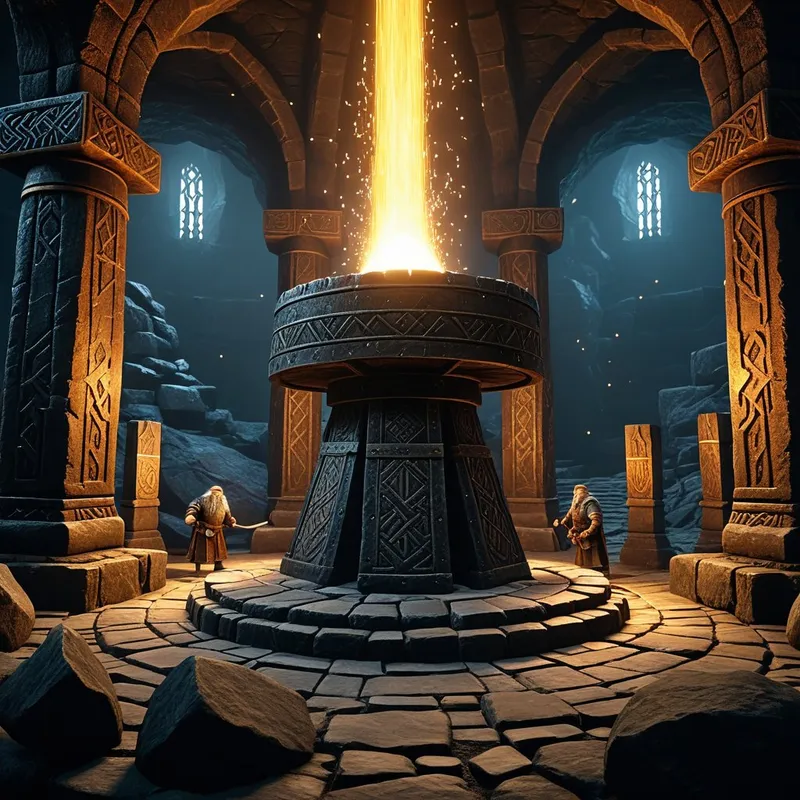
Listen. Hear the deep-earth rhythm, a pounding like a slow, stone heart beneath the roots of the Yggdrasil. This is the song of Svartalfheim, a world of perpetual twilight, of caverns that drink the light of stars and give back only the sullen glow of forge-fires. Here, in the pressing dark, dwell the masters of form: the dwarves.
They were not born of gentle earth or warm blood, but were shaped from the maggots that writhed in the flesh of the primal giant, Ymir. The gods found them, these quick, clever shapes in the dark, and gave them wit and purpose. They sent them down, down into the stone-veins of the world, to become its smiths, its rememberers, its hidden architects.
Their forges are not like those of men. Their anvils are mountains; their bellows, the breath of the earth itself. And from the raw, screaming ore—uru and gold and iron—they wrestle wonders. They crafted Gungnir, the spear that binds oaths, its point so sharp it cuts the future. They spun Draupnir, the ring that drips eight rings of equal weight every ninth night, a circle of endless becoming. For Freyr, they built Skidbladnir, a ship that folds to pocket-size yet can carry all the gods, a vessel of potentiality.
But their greatest tale is one of light, and the price of it. The gods, foolish and bright in Asgard, had captured the fiery essence of the world, Sol and Mani, and set them to run their courses. Yet they had no steady lights for their own halls. So Loki, the shape-shifter, the bringer of problems and solutions, was sent to Svartalfheim. He found the sons of the dwarf Ivaldi, and with honeyed words and dire threats, commissioned hair of gold for Sif, a ship for Freyr, a spear for Odin.
Yet pride is a poison that works even in the dark. Another dwarf, Eitri (or Sindri), and his brother Brokkr, heard of this commission and boasted they could make greater things. A wager was struck: Loki’s head against their skill. In his forge, Eitri worked the magic. He placed a pig’s skin in the hearth and commanded Brokkr to work the bellows without cease, no matter what. A fly—Loki in disguise—came and bit Brokkr’s hand fiercely, but he did not falter. From the fire came Gullinbursti, a boar of gold that shone in the dark and ran across sky and sea.
Next, Eitri threw gold into the flame. The fly bit Brokkr’s neck, drawing blood, but the dwarf pumped on. From the forge came Draupnir, the ring of multiplying wealth. Finally, Eitri set iron in the hearth. This time, the fly landed between Brokkr’s eyes and bit his eyelid so blood blinded him. Just for a moment, he stopped the bellows. It was enough. Eitri drew out the great hammer, Mjolnir. It was perfect in power, in magic, in might—but its handle was short, a flaw born of that moment’s lapse.
The gods judged. Gullinbursti, Draupnir, Mjolnir—they surpassed the works of Ivaldi’s sons. The dwarves had won. Loki, bound by his word, tried to flee, but Thor brought him back. The dwarves would have his head, but Loki, the silver-tongued, argued the wager was for his head alone, not his neck. Enraged but bound by logic, Brokkr did the only thing he could: he sewed the trickster’s lips shut with a thong, a silence earned and enforced in the deep places of the world. Thus the tools of the gods were born from dark earth, fierce pride, and cunning pain, and the dwarves returned to their endless hammering, the architects of destiny working in shadow.
Cultural Origins & Context
These tales of the dwarves are not mere fantasy, but the vital undercurrent of the Norse worldview. They survive primarily in the Poetic Edda and the later, prose Prose Edda of Snorri Sturluson, who sought to preserve a fading pagan cosmology for a Christian audience. The myths were the province of skalds (poets) and storytellers, shared in feasting halls where the firelight mimicked the forges below.
The dwarves served a crucial societal function. In a world perceived as inherently chaotic and hostile—Jotnar ever threatening, Ragnarok looming—culture itself was a hard-won craft. The dwarves symbolized the transformation of raw, dangerous nature (the ore, the corpse of Ymir) into the tools of civilization and divine order (weapons, ships, jewelry). They represented specialized skill, the hidden knowledge of craftsmanship that turns potential into power. They were a reminder that what sustains the world of light (Asgard, Midgard) is forged in the world of dark.
Symbolic Architecture
Psychologically, the dwarves of Svartalfheim are profound symbols of the creative unconscious—the mundus imaginalis where raw psychic material is shaped into the artifacts of the Self.
They are the personified instinct of the psyche to take the base, instinctual, often “maggot-like” or chaotic contents of the unconscious and hammer them into usable, even divine, forms.
Their realm is not a place of evil, but of potential. The dark is the necessary condition for the gestation of form. The glowing forge in the endless cave is the image of focused consciousness (fire) applied to the depths of the unknown (stone). Each artifact they create is a psychic complex made conscious: Gungnir is the focused will, Mjolnir is the transformative power that can both destroy and hallow, Draupnir is the self-generating wealth of the psyche.
The pivotal flaw in Mjolnir’s handle speaks to a fundamental truth of creation: nothing brought from the unconscious into consciousness arrives perfectly. There is always a slight awkwardness, a “short handle,” a compromise born of the moment of translation—when Brokkr’s focus broke. This flaw does not negate the power; it humanizes it, makes it usable. Similarly, the cursed ring Andvaranaut, another dwarf-forged object, symbolizes the shadow side of this creativity: when the shaped artifact (a talent, an obsession, wealth) is not integrated but possessed, it becomes a vehicle of doom, a ring of compulsive fate.
The Dreamer’s Resonance
When the motif of the dwarf-forge appears in modern dreams, it signals a profound somatic and psychological process: the pressure of incarnation. The dreamer is in the “cave,” the liminal space where an unnamed intensity—a feeling, a trauma, a nascent talent, a creative impulse—demands to be given form.
Somatically, this may manifest as a sense of deep pressure, of being “in the dark” or weighed upon, or conversely, as a restless, fiery energy with no outlet. Psychologically, it is the process of confronting the “maggots” of one’s personal Ymir—the ignored, writhing, perhaps shameful aspects of one’s history or personality. The dream dwarves are the autonomous psychic forces that work on this material whether the ego wills it or not. To dream of watching them work is to witness the Self organizing experience at a depth beyond everyday awareness. To dream of being a dwarf at the forge is to be actively engaged in this soul-work, hammering a raw emotion into a poem, a relational pattern into a new understanding, a grief into a memorial.
Alchemical Translation
The dwarven myth models the alchemical process of individuation—the forging of the integrated Self from the prima materia of the psyche. The journey is not one of ascending to light, but of descending into creative dark.
The first operation is the nigredo: the descent into Svartalfheim, the acknowledgment of the shadow, the chaotic, “maggot”-like contents of our personal and ancestral history. This is the ore.
The second is the albedo: the application of conscious focus (the forge-fire) to this material. This is the hard, repetitive work of therapy, reflection, artistic practice, or any discipline that seeks to understand and shape inner experience. Here, the ego must play Brokkr’s role: maintain the bellows-pulse of attention despite the “flies” of distraction, pain, and resistance.
The third is the rubedo: the production of the red, glowing artifact—the new psychic structure. This is the creation of Mjolnir, your own capacity for transformative action; of Gungnir, your clarified intent; of Draupnir, your ability to generate inner value. Crucially, one must accept the “short handle”—the imperfection, the quirk, the wound that remains part of the gift, as Brokkr’s momentary blindness is forever part of the hammer’s might.
Finally, the myth warns of the citrinitas gone awry: the temptation to hoard the golden artifact in the dark, like the dragon Fafnir with his ring, rather than letting it circulate in the world of life. The true alchemical goal is not to possess the gold, but to become the lapis philosophorum—the philosopher’s stone—itself: a being whose very nature transmutes base experience into meaning. The dwarves, in their eternal, subterranean labor, remind us that we are all, always, both the raw ore and the smith, and our lives are the anvil upon which the Self is forged.
Associated Symbols
Explore related symbols from the CaleaDream lexicon: