Dwarven Smithies Myth Meaning & Symbolism
A tale of subterranean craftsmen forging divine artifacts, embodying the hidden, transformative power of the unconscious that shapes the world above.
The Tale of Dwarven Smithies
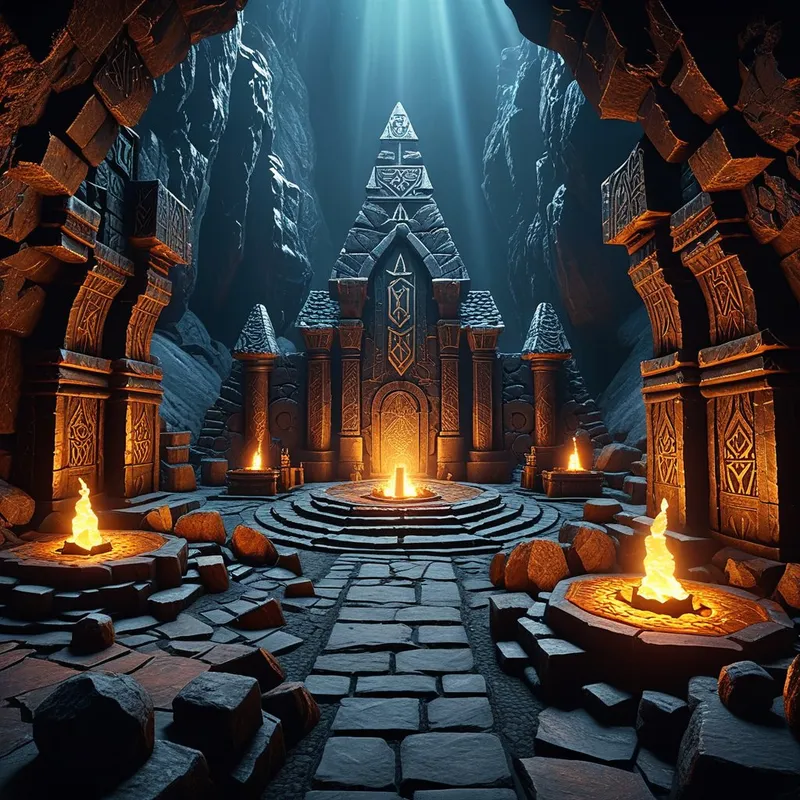
Listen, and hear the song of the deep places. Not in the high halls of the gods, nor in the sunlit meadows of men, but in the roots of the mountains, where the bones of the world are old and cold. Here, in the echoing dark, the dvergar toil. Their forges are not lit by sun or moon, but by the secret fires that bleed from the world’s heart.
Their hammers ring a rhythm older than speech, a pulse against the silent stone. They are the shapers of the unshaped, the namers of the nameless. From them came wonders that would shake the heavens and chain the monsters. They forged Gleipnir, a silken ribbon from the sound of a cat’s footfall, the beard of a woman, the roots of a mountain, the sinews of a bear, the breath of a fish, and the spittle of a bird—a thing of impossible subtlety to bind an impossible beast. From their anvils sprang Gungnir, the spear that flies true, and Skidbladnir, the ship that finds its own wind.
But one tale echoes loudest in the deep. The gods, in their wisdom and their need, came to the sons of Ivaldi. "Forge us," they commanded, "a treasure beyond treasures. Forge the hair of Sif, shorn by trickery, into gold more radiant than the sun. Forge a ship for the Æsir, and a spear for Odin himself." The dwarves bent to their task, their breath the bellows, their will the flame. And from the crucible, they drew miracles: hair of living gold, the great ship, the deadly spear.
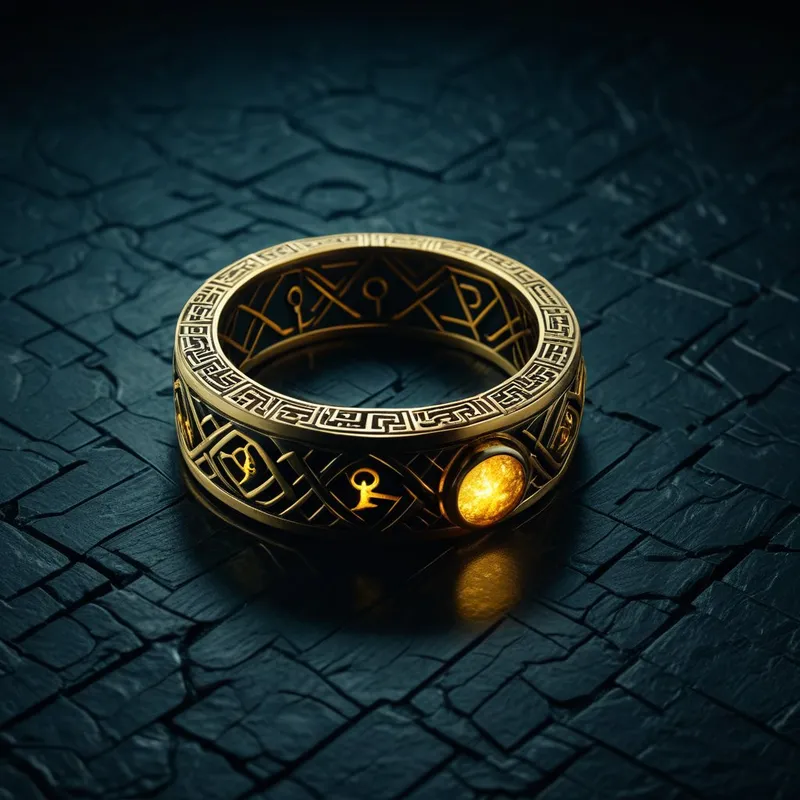
Yet pride stirs even in the dark. Another smith, Brokkr, with his brother Sindri, heard the gods’ praise. He bet his head against the trickster Loki that he could craft gifts greater still. In his forge, with Sindri at the bellows and Brokkr wielding the hammer, magic was hammered into being. A living boar with bristles of light, a ring that dripped eight more rings every ninth night, and lastly, a hammer. Mjölnir. Its handle was short, for Loki, as a fly, had bitten the smith’s eyelid in distraction, but its power was absolute, the protector of gods and men.
The gifts were presented. The gods judged, and Brokkr’s treasures were deemed the finest. The hammer, above all. But Loki fled from his lost wager, and the dwarf’s vengeance was left unclaimed—a debt written in the shadows. The smithies fell silent, their greatest works passed into the light above, while they returned to the deep, their craft now a legend, their anvils waiting.
Cultural Origins & Context
These tales are not mere fireside fancies. They are preserved in the Poetic Edda and the Prose Edda, texts that captured a fading pagan worldview in Christianized Iceland. The myths of the dvergar were likely part of a vast oral tradition, told by skalds and storytellers across the Viking Age and beyond.
Their societal function was multifaceted. On one level, they explained the origin of prized objects and materials—why gold is found in the earth, why certain weapons were deemed uncanny. On a deeper level, they articulated a fundamental Norse cosmological principle: creation is often born from dark, confined, and pressurized spaces, whether it’s the world forming from the void of Ginnungagap or a masterpiece forged in a subterranean cave. The dwarves represent the indispensable, yet marginalized, creative force. They are not gods, but without them, the gods are lesser. They reflect an ancient understanding of specialized craft, of the awe and suspicion afforded to those who work with the hidden elements of the earth (metal, stone, fire) and produce objects of transformative power.
Symbolic Architecture
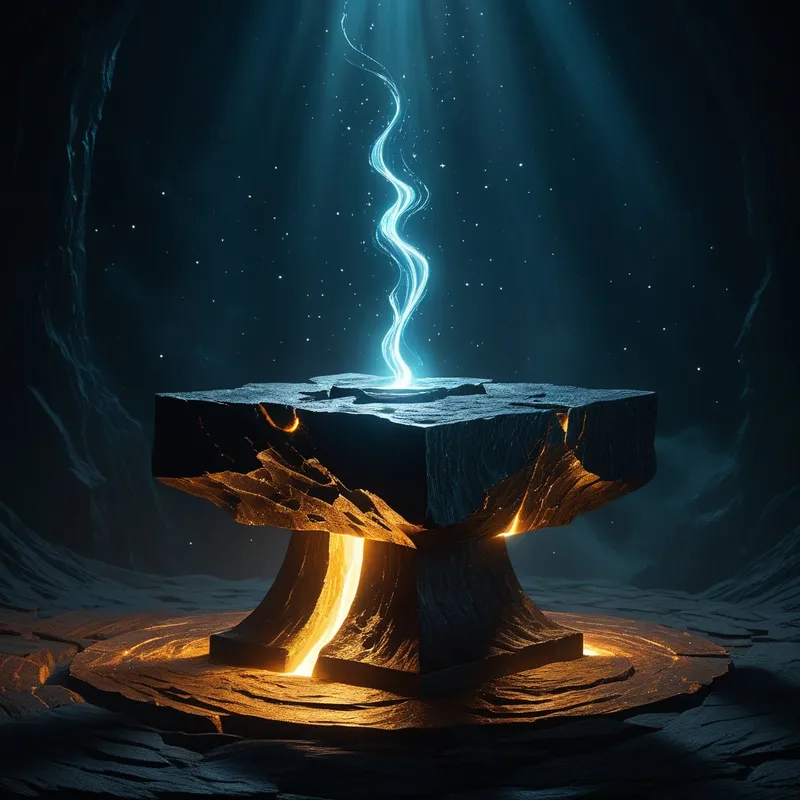
The dwarven smithy is not a literal workshop; it is a psychic map. It represents the unconscious in its most creative and formidable aspect. It is the dark, pressurized chamber of the psyche where raw, instinctual energy (the ore, the primal fire) is subjected to discipline (the hammer, the anvil) and shaped by a focused will (the smith) into a functional form (the artifact).
The masterpiece is not found, but forged. The self is not given, but hammered into being from the ores of experience and the fires of conflict.
The dwarves themselves symbolize the autonomous, complex creative drives within us. They are often irritable, greedy, proud, and bound by strict laws—they are not "nice" forces. True creativity from the depths is rarely polite or convenient; it can be obsessive, demanding, and exact a price. The artifacts they create—Mjölnir (defense, focused power), the ring (endless generativity, but also cursed attraction), the spear (piercing intention)—are symbols of psychic functions forged in the unconscious and made available to consciousness (the "gods" of our waking identity).
The Dreamer's Resonance
When the imagery of the dwarven smithy arises in modern dreams, it signals a profound process of psychic fabrication underway. The dreamer may find themselves in a low, warm, metallic-smelling space, hearing rhythmic hammering. They might be handed a strange, heavy object or watch a form take shape in the fire.
Somatically, this can correlate with a feeling of deep, internal pressure—a creative gestation or a necessary "working through" of a difficult emotion or life situation. Psychologically, it indicates that the unconscious is actively restructuring some aspect of the psyche. The "artifact" being forged could be a new skill, a reconciled aspect of the personality, a solution to a problem, or the painful but necessary shaping of resilience. The dream is an assurance: the work is being done, even if you are not consciously directing it. The dwarves are at their anvils.
Alchemical Translation
The myth models the alchemical process of individuation—the forging of a coherent, authentic Self. The base matter (the prima materia) is our unrefined nature, our complexes, traumas, and latent potentials—the raw ore in the mountain. The descent into the smithy is the introspective journey into the unconscious (nekyia).
The fire of the forge is the heat of intense feeling and conflict, without which no transformation is possible. The hammer is the relentless application of conscious attention and ethical choice.
The crafting of the artifact—say, the short-handled but mighty Mjölnir—is the creation of a functional psychic tool. Perhaps it is the ability to set boundaries (the hammer’s defensive power), even if that ability feels imperfect or "short-handed" at first. The bet with Loki represents the tricksterish, risk-taking element of the psyche that initiates the transformative challenge, forcing a higher standard of creation. The final act is integration: the gods accept and use the gifts. For the modern individual, this means consciously taking up what has been forged in the depths—a new perspective, a hard-won strength, a creative work—and allowing it to operate in the daylight world of our lives. We become, in part, both the dwarf in the dark and the god in the light, the creator and the wielder of our own destiny.
Associated Symbols
Explore related symbols from the CaleaDream lexicon: