Dwarven Forges Myth Meaning & Symbolism
A myth of subterranean craftsmen forging divine artifacts through cunning, sacrifice, and primal fire, shaping the fate of gods and worlds.
The Tale of Dwarven Forges
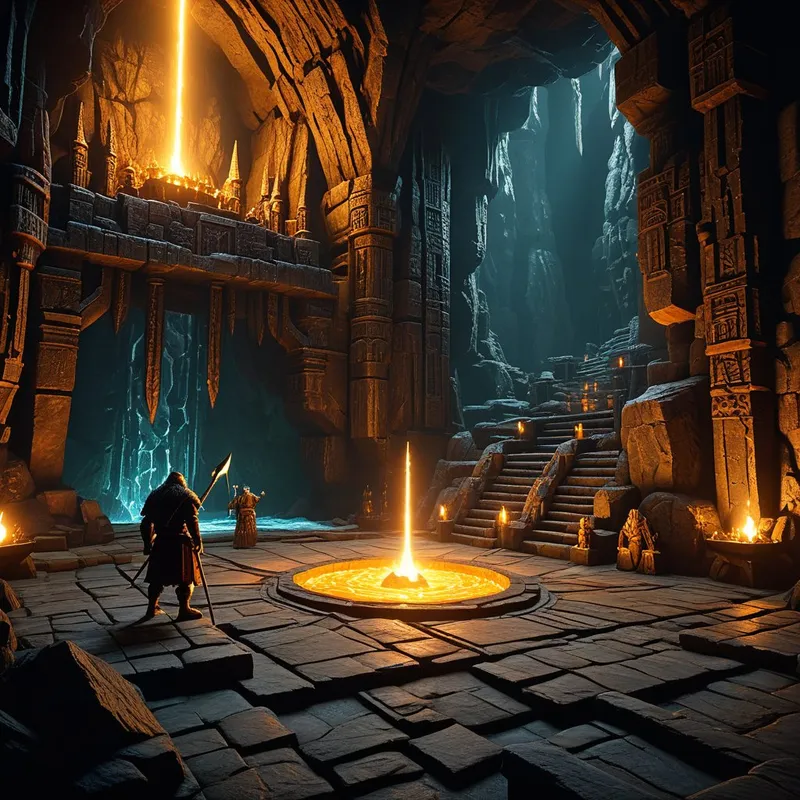
Listen, and hear the song of the earth’s deep heart. Not in the high halls of Asgard, where the mead flows golden, but in the crushing dark below the roots of Yggdrasil. Here, in realms of stone and secret fire, the sons of Ivaldi dwell. They are the dvergr, shaped from the maggots of the primordial giant Ymir, yet gifted with a cunning that rivals the gods themselves. Their forges are not mere hearths; they are the womb of the world, where element is made artifact, where potential is hammered into destiny.
The tale begins with mischief. The trickster Loki, silver-tongued and reckless, shears the glorious golden hair of Sif, wife of the thunder god Thor. To avert a crushing vengeance, Loki slithers down, down into Svartálfheim, the dark elf home. He finds the sons of Ivaldi at their anvils. He does not ask; he provokes, he bargains with a god’s arrogance. And so, under the mountain’s weight, the forges roar to life. From their hammers and tongs flow gifts of impossible craft: hair of spun gold that grows like living grain, the ship Skidbladnir that fits in a pocket yet carries all hosts, and the terrible spear Gungnir, which sings of its own accord for blood and oath.
But Loki’s tongue is a double-edged blade. Boasting of these wonders to another master of the deep, the dwarf Brokkr, he wagers his own head that Brokkr and his brother Eitri cannot make finer things. The wager is struck. In Brokkr’s forge, the fire is stoked to a sun’s heart. Eitri commands the craft; Brokkr works the bellows with a relentless, rhythmic heave. Loki, in the form of a biting fly, seeks to sabotage, drawing blood to break the rhythm. First, Eitri draws from the fire a boar of gold, Gullinbursti, whose bristles light the darkest path. The fly bites, but Brokkr does not falter. Next, from the molten stream, a ring of red gold, Draupnir, from which eight new rings drip every ninth night—an echo of endless becoming. The fly bites harder, yet the bellows pump.
Finally, Eitri places iron in the hearth. This is the masterwork. The forge screams with heat; the air itself trembles. Loki, desperate, lands on Brokkr’s eyelid and bites until blood blinds him. For one heartbeat, just one, Brokkr’s hand slips. The bellows sigh. Eitri draws out the hammer. It is mighty, terrible, and perfect in every way—save one. Its handle is short, a flaw born of that moment’s distraction. They name it Mjölnir. The gods judge. Each artifact is a marvel, but the hammer, flawed and peerless, is deemed greatest, for it will defend the worlds. Loki loses his wager, his lips stitched shut with a dwarven awl—a silence earned by the very craft he sought to undermine. The forges fall quiet, their children in the hands of gods, their power now woven into the tapestry of fate.
Cultural Origins & Context
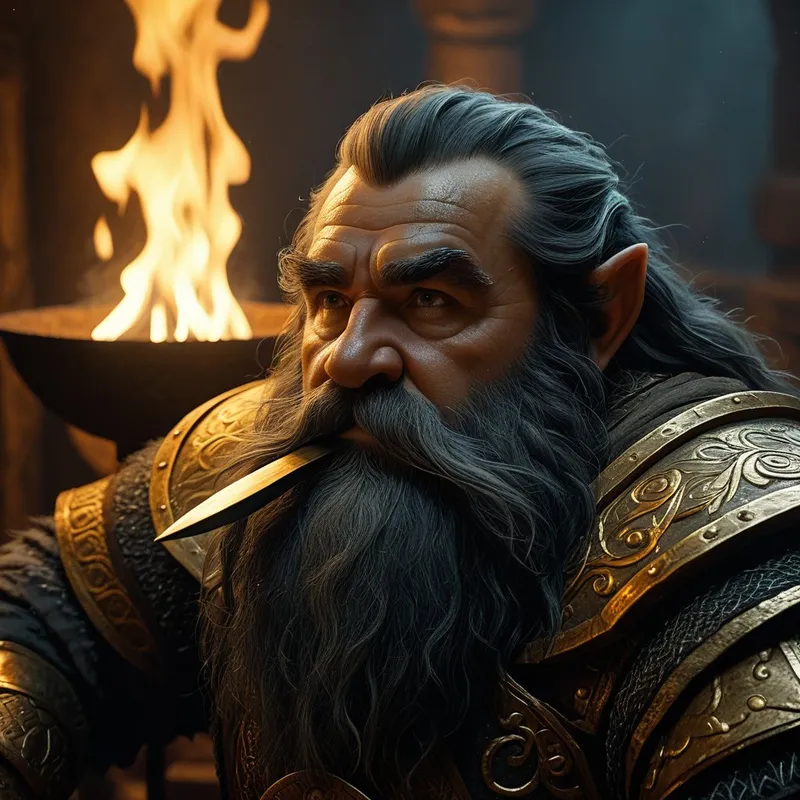
This myth, like the artifacts it describes, was forged in the oral traditions of the Viking Age and earlier Germanic peoples. It is preserved primarily in the Prose Edda of Snorri Sturluson, a Christian scholar writing centuries after the conversion, yet striving to catalog a fading pagan worldview. The tales of dwarven craft were not children’s stories; they were part of a complex cosmological framework that explained the origin of the gods’ most potent tools. They were likely told by skalds and storytellers, serving a societal function that blended entertainment, religious explanation, and deep cultural values.
The dwarves embody a crucial, amoral creative force that exists outside the divine order of Æsir and Vanir. They are of the earth, associated with raw material, mineral wealth, and the hidden processes of nature. Their forges represent the indispensable, often dangerous, source of technology and cultural power. The myth reinforces that even the gods are not self-sufficient; their sovereignty depends on bargains with these chthonic powers. It speaks to a culture acutely aware that mastery (of metal, of craft, of fate) comes with a price, often paid in cunning, pain, or sacrifice.
Symbolic Architecture
The dwarven forge is not merely a workshop; it is a profound psychological symbol. It represents the creative unconscious—the deep, heated, and pressurized realm beneath the surface of ego and conscious identity. Here, in the dark, the raw materials of the psyche (instincts, complexes, traumas, potentials) are subjected to the transformative fire.
The dwarves themselves are archetypal figures of the craftsman or technician of the soul. They are not guided by the lofty ideals of the hero or the moral codes of the gods. Their drive is pure craft: the impersonal, relentless urge to shape matter into form. They represent the focused, often obsessive, energy required for profound inner work.
The forge is where the unformed self is held in the fire of attention and struck by the hammer of will.
The artifacts are symbolic of psychic achievements. Draupnir is the symbol of fertile, self-renewing psychic energy. Gullinbursti is illumination born from the unconscious, a guiding light forged in darkness. Mjölnir, the flawed masterpiece, is perhaps the most potent: it is the weapon of discernment and defense of the psyche, whose power is inseparable from its imperfection—the short handle requiring the wielder to step closer to the threat, to engage fully.
The Dreamer's Resonance
When the imagery of the dwarven forge erupts into modern dreams, it signals a profound somatic and psychological process is underway. The dreamer may find themselves in a subterranean workshop, facing a furnace, or holding a hammer. This is not a call to literal craftsmanship, but an indicator that the deep unconscious is actively working on something.
Somatically, this can correlate with feelings of pressure, heat, or constriction—the "crucible" experience of life crises, intense emotional periods, or creative gestation. Psychologically, it marks the phase of fabrication. The dreamer is not passively analyzing their issues; the very structures of their being are being re-forged. The shadowy dwarven figures represent autonomous psychic forces—drives, talents, or neglected aspects of the self—that are laboring, often without the ego's direct supervision, to create a new capacity, a new tool for living.
To dream of sabotaging the forge (as Loki does) may reflect the ego’s fear of this transformative power, its attempts to derail painful but necessary change. To dream of successfully drawing an artifact from the fire signifies the imminent birth of a new psychic strength or insight from this period of turmoil.
Alchemical Translation
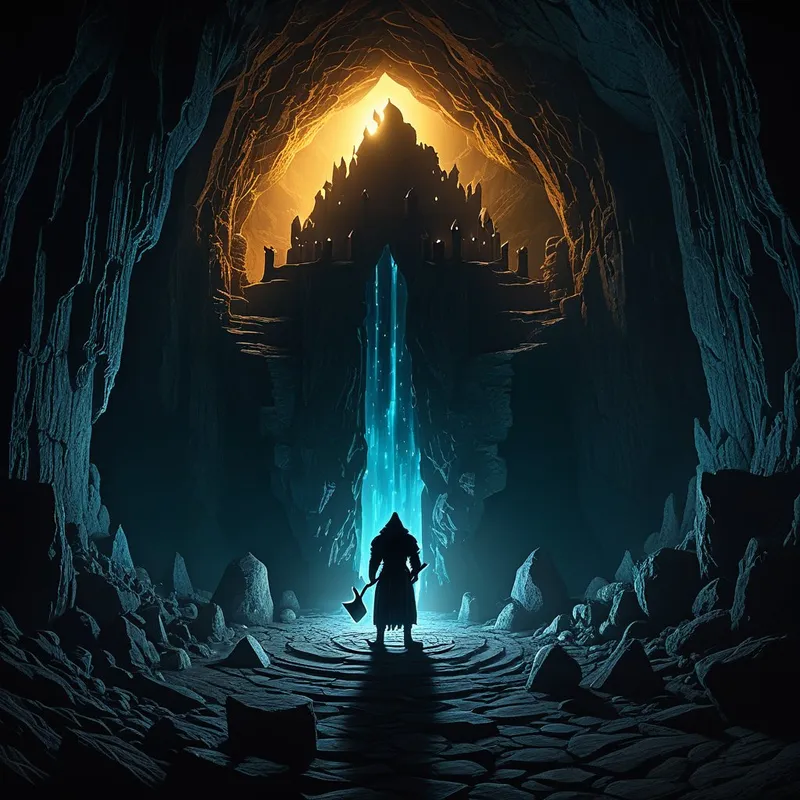
In the alchemical journey of individuation—the process of becoming psychologically whole—the myth of the dwarven forges models the stage of coagulatio and separatio. It is the work of giving durable form to what has been dissolved in the preceding stages of chaos and analysis. The ego (here, akin to Loki or the receiving gods) must descend into the unconscious (the forge), engage with its amoral, creative powers (the dwarves), and submit to a process it does not fully control.
The wager is central. Loki risks his head—his cleverness, his identity—for the sake of a greater creation. In our lives, this translates to the risk we must take to move beyond familiar patterns. We must wager our old, adaptive identities to gain access to deeper creative powers. The suffering in the forge—Brokkr’s bitten eyelid, the searing heat—is not meaningless pain but the necessary friction of transformation.
The flaw in the masterpiece, like Mjölnir's short handle, is not a failure but the signature of the real—the mark that individuation is a human, not a divine, process, perfect in its tailored imperfection.
The final artifacts are the psychic dominants that result from successful inner work: a renewed source of energy (Draupnir), the ability to find one’s way in darkness (Gullinbursti), and the capacity to set boundaries and defend one’s hard-won integrity (Mjölnir). The myth teaches that these tools for navigating life are not found, but forged, in the deep, dark, and fiery encounters with our own subterranean selves. We do not own the forge, but we can, with respect and courage, receive its gifts.
Associated Symbols
Explore related symbols from the CaleaDream lexicon: