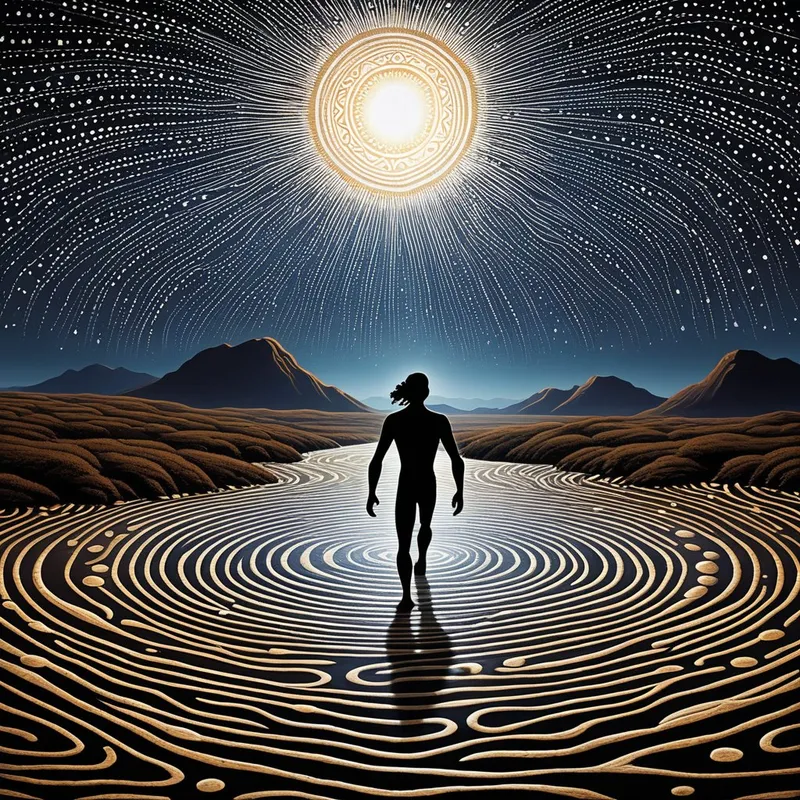
Dreamtime Ancestors Myth Meaning & Symbolism
The story of ancestral beings who emerged from a formless void to sing the world into existence, leaving their essence in every rock, river, and living thing.
The Tale of Dreamtime Ancestors
In the beginning, there was no beginning. There was only the Alcheringa, the Dreaming. It was not a time measured by sun or moon, but a state of being—a vast, silent, and fertile darkness. The earth lay asleep, flat and featureless, a slate of potential waiting for a story to be told upon it.
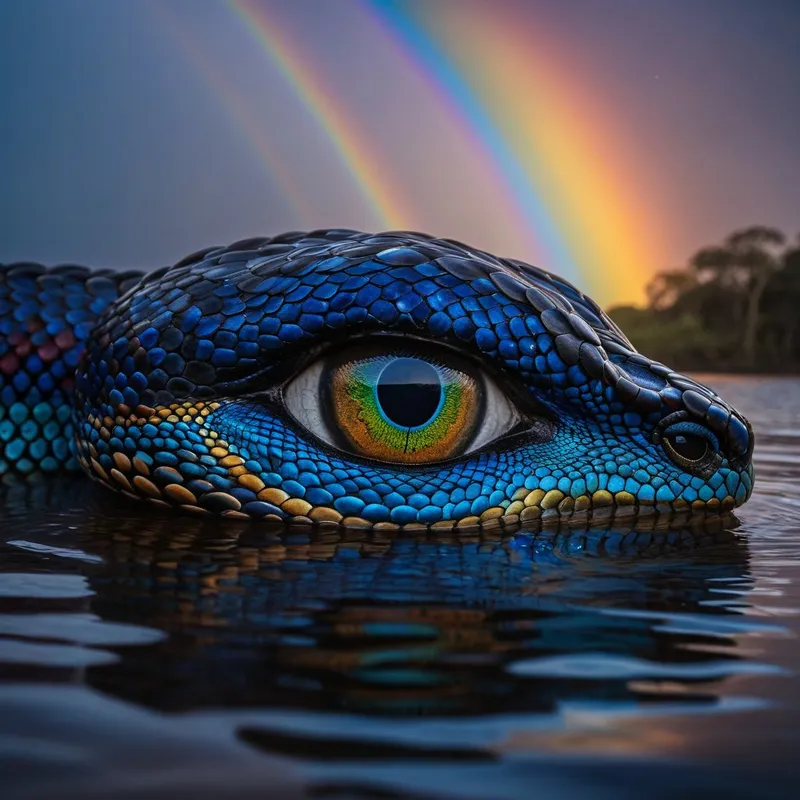
Then, from within the deep heart of this dreaming earth, they stirred. They were the Ancestral Beings. They were not gods from a distant heaven, but spirits of the land itself, taking forms both wondrous and familiar: the immense Rainbow Serpent, whose scales held all colors; the great Emu Man and Kangaroo Man; the wise Crow; and countless others, each a fusion of human, animal, and elemental force.
They broke through the crust of the dreaming world and emerged into the dim light. They did not walk upon the land; they became the land. Where the Rainbow Serpent slid, her massive body gouged deep riverbeds and valleys. Where she rested, she left permanent waterholes, life-giving and sacred. She sang as she moved, and the vibration of her song pushed up mountain ranges and carved out gorges.
The other Ancestors followed, each on their own epic journey. They hunted, loved, fought, and made laws. Kangaroo Man leapt across vast distances, and where his powerful feet struck the ground, hills rose. Emu Man’s feathers, shed in a great chase, became forests of spear-like trees. They performed great deeds and made terrible mistakes. They fought epic battles—not for conquest, but in the shaping of things. In one legendary conflict, the Fire Brothers fought the Rain Makers, and from their struggle came the first thunderstorms, which scarred the land with lightning and quenched it with rain, creating the balance of the seasons.
Their journeys were not random wanderings. They were the first stories, and the paths they traveled became songlines—invisible tracks of power and memory etched into the very fabric of the continent. As their tasks were completed, a profound transformation occurred. The Ancestors did not die. They subsided. Some turned to stone, becoming the distinctive rock formations that stand as sentinels. Others sank back into the earth or became the trees, the stars, or the animals we see today.
Their essence did not vanish; it was transmuted. The creative power that was in their actions now sleeps within the features they formed. The law they lived by is encoded in the land. The world was no longer a blank slate, but a living, breathing testament—a map of their journeys, a library of their stories, a body made sacred by their presence. The Dreaming did not end; it merely changed form, becoming the everlasting foundation of all that is.
Cultural Origins & Context
This is not a single myth, but the foundational framework for hundreds of distinct Aboriginal nations across the Australian continent. The stories of the Alcheringa are the constitutional documents of the oldest continuous culture on Earth, a spiritual and practical system of knowledge passed down orally for over 60,000 years. They were not told as mere entertainment around a fire, but as sacred, living knowledge essential for survival and identity.
Custodianship of specific stories belongs to specific kinship groups, linked to particular tracts of country. Elders, as knowledge-keepers, transmit the stories through ceremony, song, dance, and art. The intricate dot paintings of Central Australia are not abstract designs; they are aerial maps of country, depicting the journeys of the Ancestors and the location of sacred sites. To sing the songline is to navigate the land. To know the story of the waterhole created by the Rainbow Serpent is to know its law, its ecology, and its profound significance. The myth is the title deed to country, the manual for living, and the connection to one’s own spiritual essence, which originates from a specific Ancestral Being.
Symbolic Architecture
At its core, the myth presents a cosmology where the universe is not a created object, but a continuous, participatory event. The world is not something that was made; it is something that is always being dreamed into existence through the relationship between people, story, and land.
The Ancestors did not create a world separate from themselves; they became the world. This signifies a psychology of profound identification, where the inner landscape of the psyche and the outer landscape of reality are not two, but one.
The Ancestral Beings symbolize the primal, archetypal forces of the collective unconscious. They are the raw, instinctual patterns—the hunter, the mother, the trickster, the creator—that precede individual consciousness. Their journeys represent the process by which these formless potentials take shape, creating the recognizable features of both the external world and the internal psyche: our drives (the hunt), our emotions (the storms of conflict), our moral structures (the law).
The act of “subsiding” is perhaps the most profound symbol. It represents the movement from potential to actuality, from chaos to order, and from divine action to natural law. The Ancestor becomes the mountain, meaning the mountain is not inert matter, but solidified spirit, a constant reminder and reservoir of that creative power.
The Dreamer’s Resonance
When this mythic pattern stirs in the modern dreamer, it often manifests as dreams of profound connection to landscape, or of discovering that one’s body or environment is made of ancient, singing stone. One might dream of following a path of glowing footprints that are not human, or of encountering an animal that speaks with the voice of a forgotten law.
Psychologically, this signals a process of rooting—a desperate, often unconscious need to find one’s place in a fragmented world. It is the psyche’s attempt to move from a state of existential flatness (the featureless plain) to one of depth, meaning, and identity. The somatic experience can be a feeling of gravity, of being pulled downward into the earth, or conversely, a sensation of the ground itself vibrating with a latent, intelligible pattern. The dreamer is encountering the songlines of their own soul—the innate, archetypal patterns that, if followed, lead to their unique place in the world.
Alchemical Translation
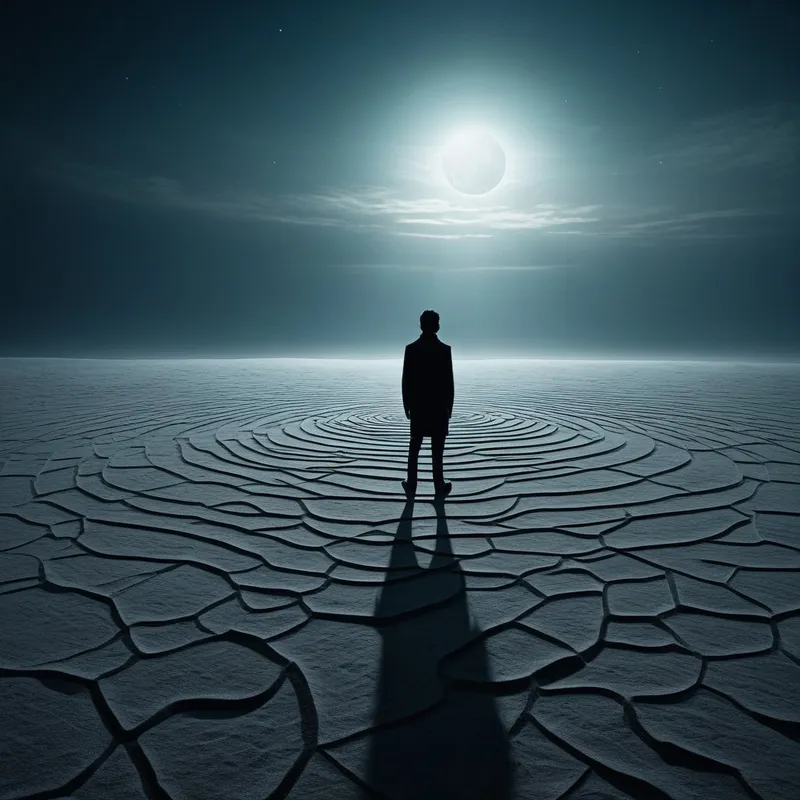
For the modern individual navigating a crisis of meaning, the Dreamtime myth models the complete alchemy of individuation. It begins in the massa confusa—the featureless void of potential, which is our unexamined life. The call to adventure is the stirring of an Ancestral force within: a deep instinct, a creative urge, a forgotten passion.
The journey of the Ancestor is the ordeal of giving form to that inner force. The battles fought are internal conflicts—between fire and water, between desire and restraint—whose resolution shapes the permanent features of our character.
The critical alchemical stage is the “subsiding.” This is the integration of the archetype. We do not remain identified with the raw, god-like power of the creative impulse (that leads to inflation). Instead, we allow that power to complete its work and then transmute it into lasting structure. The fiery passion becomes the disciplined craft. The nurturing instinct becomes a stable relationship. The trickster’s energy becomes adaptive intelligence. These become the permanent, reliable features of our personality—our internal mountains and rivers.
Finally, the myth teaches that this process is not a one-time event, but a perpetual dreaming. To be “in country” is to live in conscious, respectful relationship with these internal structures, to sing their stories so they remain alive. The individuated self is not a finished product, but a living landscape, eternally connected to the Alcheringa of its own soul, participating forever in the act of its own creation.
Associated Symbols
Explore related symbols from the CaleaDream lexicon: