Dreamcatcher Myth Meaning & Symbolism
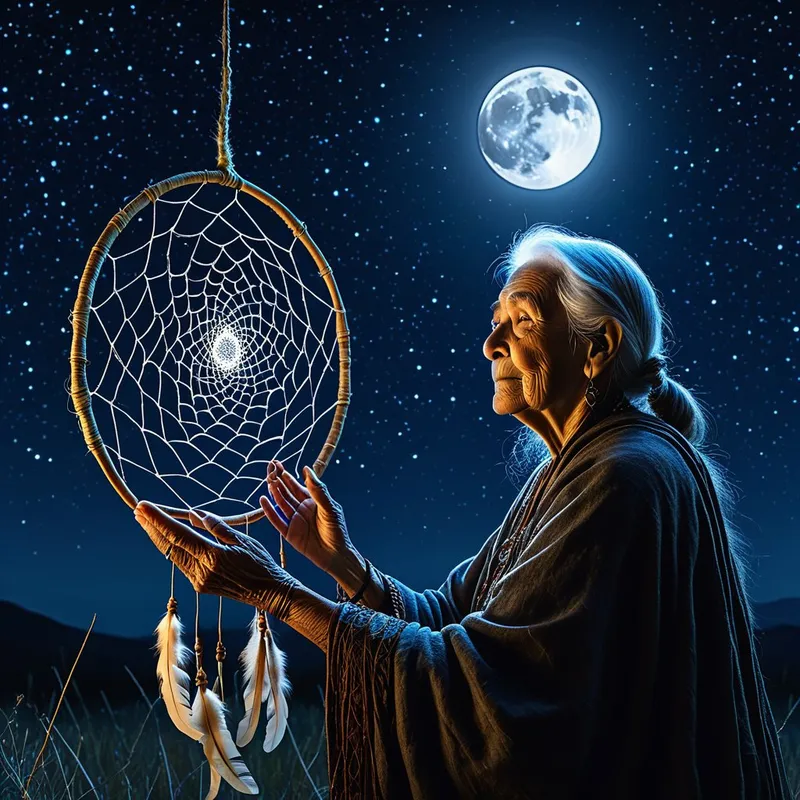
The Spider Woman, Asibikaashi, wove a sacred hoop to protect children, teaching that the web of life catches darkness, letting only light pass through.
The Tale of Dreamcatcher
In the time when the world was younger, and the veil between the spirit realm and the waking world was as thin as morning mist, the people lived close to the land. They knew the language of the wind and the stories told by the fire. But with the coming of the night, a different kind of whisper would stir. Not all dreams were kind. Some were visitors from the shadowed places, sent to tangle the spirit and steal the peace of the vulnerable—especially the little ones, whose souls were still bright and new.
The people cried out in their hearts, and their prayer was heard by Asibikaashi, the Spider Woman. She who had helped shape the world watched from her place between earth and sky. She saw the dark dream-forms, like smoke and shadow, slipping into the lodges, seeking the cradles where infants slept. Her grandmother’s heart ached.
One evening, as the sun bled into the west and the first star appeared, Asibikaashi descended. She took a young, pliable branch of willow and formed it into a perfect circle, the shape of the sun’s journey and the moon’s face. Then, from within herself, she began to spin. She spun a web, intricate and strong, within the hoop. The threads were not of silk, but of stories, of promises, of the connections that bind all life. She sang a soft, humming song as she worked, a lullaby for the world.
She took this sacred hoop to a mother holding her newborn. “Hang this above where your child sleeps,” Asibikaashi whispered, her voice like leaves rustling. “The night air is filled with both good and bad dreams. They will all come to the web.”
And so it was. When darkness fell, the dreams took flight. The bad dreams—the nightmares of confusion, fear, and mischief—were clever, but they knew only how to crawl. They clambered onto the web, becoming entangled in its sticky, thoughtful strands, held fast until the first rays of the morning sun touched them and burned them away to nothing.
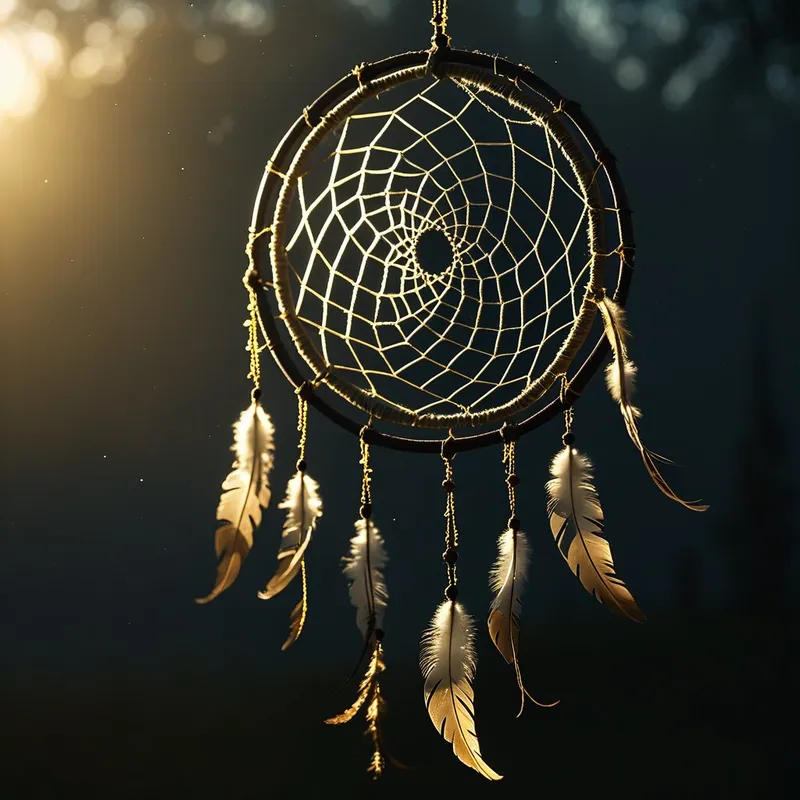
But the good dreams—the visions of guidance, the memories of ancestors, the gentle whispers of the land—they knew the true path. They moved with the lightness of starlight. Finding the open center, the sacred hole in the web, they would drift down, sliding along the single feather tied below, to descend upon the sleeping child like a soft blessing. The child would sleep, and their spirit would journey only on paths of light.
Asibikaashi taught the mothers, and the grandmothers, and they taught others. Soon, the dreamcatcher was found in many lodges, a silent guardian in the night, a tangible piece of a grandmother’s love stretched across a hoop, doing its sacred work as the world turned in its sleep.
Cultural Origins & Context
The dreamcatcher, as a physical object and its accompanying narrative, originates specifically with the Ojibwe (Chippewa) Nation. From this cultural heartland, the practice spread through intermarriage and trade to other Nations, including the Lakota, who incorporated it into their own traditions, sometimes with variations in the legend.
This was not a myth confined to ceremony alone; it was a domestic technology of the spirit. Grandmothers and mothers were the primary makers and storytellers. The act of crafting a dreamcatcher—selecting the willow, weaving the web, choosing the feathers—was a prayer in itself, a ritual of protection for the most vulnerable: infants and children. The story of Asibikaashi was told not as distant lore, but as immediate, practical wisdom. It explained the function of the object hanging above the cradleboard, embedding its purpose in a cosmological framework where spiritual forces are active and a benevolent, grandmotherly deity intervenes directly in family life. The myth served to comfort, to empower, and to reinforce the interconnected web of care that sustained the community.
Symbolic Architecture
The dreamcatcher is a mandala of the psyche, a map of how consciousness interacts with the unseen. Every element is a profound symbol.
The hoop is the circle of life, the wheel of the cosmos, and the boundary of the individual self. It frames the sacred space. The web, woven in a spiral from the outside in, represents the intricate, interconnected network of fate, relationship, and lived experience—the very fabric of reality. It is not a solid barrier, but a discerning filter.
The web does not seek to destroy the darkness, but to know it, to hold it in awareness until it can be transformed by the light of consciousness.
The center hole is the crucial aperture, the gateway of the Self. It symbolizes the open heart, the clear mind, the channel through which transcendent wisdom (the good dreams) can pass unimpeded. It is the void from which all creation emerges and into which true insight flows. The feather acts as a conduit and a breath; it represents air, spirit, and gentle descent, allowing the blessings to travel softly from the realm of the sacred to the realm of the human.
Psychologically, the myth presents a non-violent model of dealing with psychic content. It does not advocate for battling nightmares or repressing shadow material. Instead, it teaches discernment and containment. The bad dreams are acknowledged, caught, and held until they can be dissolved by the dawning light of awareness.
The Dreamer's Resonance
When the pattern of the dreamcatcher myth emerges in a modern dream, it often signals a psyche engaged in the essential work of filtration and integration. To dream of weaving a web, or of being protected by one, suggests the dreamer is actively building internal structures to manage the influx of psychic material—anxieties, inspirations, memories, and fears.
Somatically, this can feel like a tightening or a focusing in the head and chest, a gathering of personal boundaries. A dream of nightmares becoming visibly tangled in a net may correlate with the dreamer’s growing ability to name and contain diffuse anxieties, rather than being engulfed by them. Conversely, dreaming of light or clear visions flowing through a central opening often accompanies moments of intuitive clarity or emotional release, a feeling of the heart “opening up.”
Such dreams point to a process where the conscious ego is learning to collaborate with the deeper, instinctive wisdom of the psyche (the Spider Grandmother) to create a sustainable ecology of the self, where not everything that arises must be consumed, and where a sacred space is maintained for what is truly nourishing.
Alchemical Translation
The alchemical journey modeled by the dreamcatcher myth is one of psychic distillation. The modern individual is bombarded by a nightly “air” filled with stimuli: the unresolved residues of the day (the materia prima), cultural anxieties, and the churn of the personal unconscious. The individuation process requires building a vas hermeticum—a sealed vessel—for this work. The dreamcatcher is that vessel: the circle of the committed self.
The first operation is weaving the web—developing the ego’s capacity for reflection, interconnection, and critical thought. This web is our worldview, our values, our therapy, our mindfulness practice. It must be strong enough to hold tension and intricate enough to perceive patterns.
The goal is not a perfect, impenetrable filter, but a conscious, living matrix that participates in the act of choosing what defines us.
The second, and most vital, operation is maintaining the central void. This is the cultivation of inner silence, the via negativa. It is the disciplined practice of clearing a space not for more content, but for the transcendent function—the “good dream” of the Self that emerges not from the tangled personal history, but from the archetypal core. The feather reminds us that this wisdom arrives on the breath, in moments of grace, when we stop grasping and simply allow.
The final, daily operation is the dawn dissolution. This is the act of bringing consciousness to what was caught—the petty resentments, the irrational fears—and, without identifying with them, letting the light of mindful awareness dissolve their power. The bad dreams are not enemies; they are simply energies that cannot navigate the path to the center. By catching them, we see them. By seeing them in the morning light, we transmute them. We are left, day by day, with only what can pass through the heart’s true opening, weaving our souls into the larger, sacred web.
Associated Symbols
Explore related symbols from the CaleaDream lexicon: