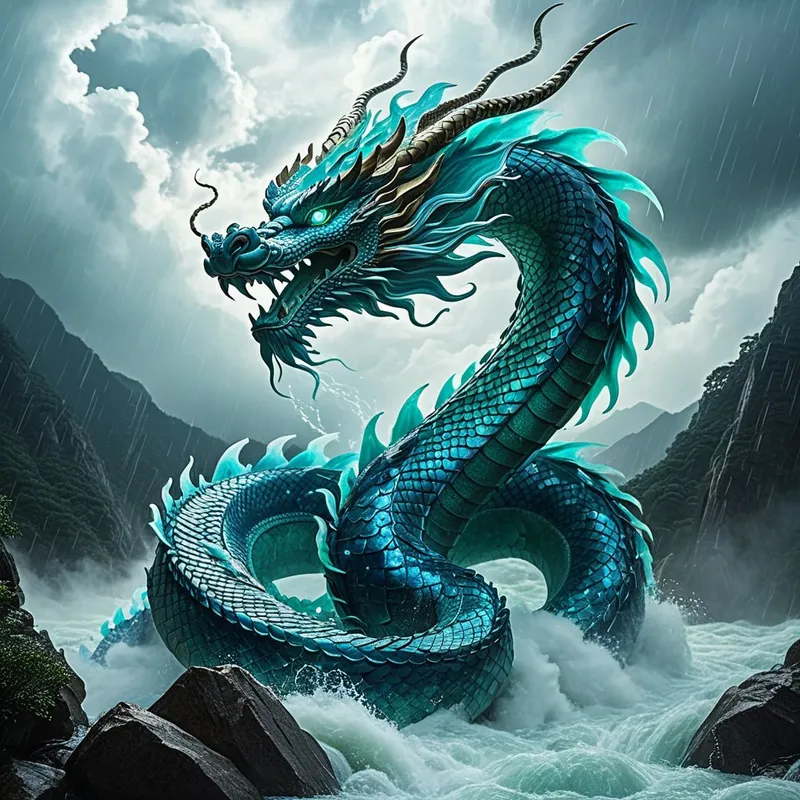
Dragon Clouds Myth Meaning & Symbolism
A myth where the Azure Dragon battles the chaos of drought, transforming his essence into life-giving clouds, embodying sacrifice for cosmic balance.
The Tale of Dragon Clouds
In the time when [the world](/myths/the-world “Myth from Tarot culture.”/) was young and the pillars of heaven were still being set, the land beneath the Firmament knew a different rhythm. The seasons were not yet a wheel but a conversation between great powers. Among them ruled the Qing Long, a being of immense and terrible beauty. His scales were the color of deep river jade and summer storms, and his body stretched across the eastern horizon at dawn. He was the spirit of rising wood, of burgeoning life, of the gentle, nurturing rains that coaxed seeds from their slumber.
For an age, his breath—a cool, moist exhalation—drifted westward as soft clouds, watering the plains and filling the great rivers. But from the deep south, a change stirred. A great heat, a stillness born of elemental pride, began to swell. It was the essence of unchecked Fire, a dominion that refused to yield. The rains ceased. The clouds dissipated like ghosts before noon. [The earth](/myths/the-earth “Myth from Hindu culture.”/), once soft and fertile, hardened and split into a mosaic of thirst. Rivers shrank to silver threads, then to dust. The song of the land became a silent, open-mouthed plea.
[The Azure Dragon](/myths/the-azure-dragon “Myth from Chinese culture.”/) watched from his celestial perch. He saw the green world he nurtured turn to ochre and bone. He heard not with ears, but with the spirit—the withering of the grain, the despair of the people who looked to the empty, brass-colored sky. His own power, tied to the east and the spring, was being besieged in its own realm. To challenge the southern heat directly was to risk a cataclysm, a war of elements that would shatter the tenuous balance of the [Wu Xing](/myths/wu-xing “Myth from Chinese Philosophy culture.”/).
His conflict was not of claw and flame, but of essence. [The law](/myths/the-law “Myth from Biblical culture.”/) of his being was to preserve, to nurture. And so, [the Dragon](/myths/the-dragon “Myth from Chinese culture.”/) made a choice that echoed through the corridors of heaven. He would not wage war. He would offer a truce written in his own substance. Drawing himself to his full, awe-inspiring length, he began a slow, solemn dance across the vault of [the sky](/myths/the-sky “Myth from Persian culture.”/)—a coil of celestial calligraphy. As he moved, he did not roar, but sighed. And from that sigh, he did not breathe mere mist. He began to breathe out the very core of his celestial vitality, his Qi.
Jade scales lost some of their luster. The formidable strength in his serpentine form softened. What flowed from him was not just [water](/myths/water “Myth from Chinese culture.”/), but a piece of his ordered, life-giving spirit, offered to the chaos of the drought. This sacrifice coalesced in the air not as a mere storm, but as [Dragon](/myths/dragon “Myth from Chinese culture.”/) Clouds—vast, intelligent formations that roiled with his wisdom and his sorrow. They were clouds that remembered their origin; they moved with purpose, seeking the most parched lands, the most desperate valleys. And when they could hold no more of the Dragon’s gift, they wept. The rain that fell was cool, gentle, and profound. It did not flood; it seeped. It kissed the cracked earth, and where each drop landed, a green shoot dared to rise again. The Dragon, diminished yet radiant in his purpose, watched the world drink, and in the sigh of the relieved wind, he heard his own name whispered in gratitude.
Cultural Origins & Context
The imagery of the dragon as a cloud-bringer and rainmaker is one of the oldest and most persistent strands in Chinese mythology and folklore, deeply embedded in agricultural society. Unlike the fire-breathing, treasure-hoarding dragons of the West, the Chinese Long is primarily a benevolent celestial being associated with waterways, weather, and imperial authority. The specific motif of “Dragon Clouds” (Long Yun) appears in classical texts, poetry, and oral traditions, often as a metaphor for auspicious weather and, by extension, benevolent rule.
This myth was not confined to temple lore but was lived by farmers who studied the sky. The shape and movement of clouds were read as the calligraphy of the Azure Dragon, a direct celestial text indicating the coming of rain. The myth functioned as a cosmological model, explaining the vital, sometimes precarious, balance of natural forces. It reinforced the Confucian ideal of virtuous sacrifice for the greater harmony and the Daoist principle of [Wu Wei](/myths/wu-wei “Myth from Taoist culture.”/)—the Dragon does not force the rain through conflict, but enables it through aligned, self-giving action. It was a story told to remind both peasant and emperor that true power lies not in domination, but in responsible, life-sustaining nurture.
Symbolic Architecture
At its [heart](/symbols/heart “Symbol: The heart symbolizes love, emotion, and the core of one’s existence, representing deep connections with others and self.”/), the myth is a profound [allegory](/symbols/allegory “Symbol: A narrative device where characters, events, or settings represent abstract ideas or moral qualities, conveying deeper meanings through symbolic storytelling.”/) for the [psyche](/myths/psyche “Myth from Greek culture.”/)‘s [relationship](/symbols/relationship “Symbol: A representation of connections we have with others in our lives, often reflecting our emotional state.”/) between [structure](/symbols/structure “Symbol: Structure in dreams often symbolizes stability, organization, and the framework of one’s life, reflecting how one perceives their environment and personal life.”/) and fluidity, order and [chaos](/symbols/chaos “Symbol: In Arts & Music, chaos represents raw creative potential, uncontrolled expression, and the breakdown of order to forge new artistic forms.”/), the conscious ego and the vital, often unconscious, energies of [life](/symbols/life “Symbol: The symbol of ‘Life’ represents a journey of growth, interconnectedness, and existential meaning, encompassing both the joys and challenges that define human experience.”/).
The Azure [Dragon](/symbols/dragon “Symbol: Dragons are potent symbols of power, wisdom, and transformation, often embodying the duality of creation and destruction.”/) represents [the principle](/symbols/the-principle “Symbol: A fundamental truth, law, or doctrine that serves as a foundation for a system of belief, behavior, or reasoning, often representing moral or ethical standards.”/) of conscious, nurturing order—the structured ego, cultural norms, and the [human](/symbols/human “Symbol: The symbol of a human represents individuality, complexity of emotions, and social relationships.”/) [impulse](/symbols/impulse “Symbol: A sudden, powerful urge or drive that arises without conscious deliberation, often linked to primal instincts or emotional surges.”/) to cultivate and protect. He is the yang [aspect](/symbols/aspect “Symbol: A distinct feature, quality, or perspective of something, often representing a partial view of a larger whole.”/) of gentle growth. The encroaching [drought](/symbols/drought “Symbol: Drought signifies a period of emotional scarcity, lack of resources, or feelings of deprivation leading to anxiety or intense longing.”/) and southern heat symbolize the invasion of unintegrated chaos—burning [anxiety](/symbols/anxiety “Symbol: Anxiety in dreams reflects internal conflicts, fears of the unknown, or stress from waking life, often demonstrating the subconscious mind’s struggle for peace.”/), emotional [aridity](/symbols/aridity “Symbol: Aridity symbolizes emotional or spiritual barrenness, a lack of nourishment, and a state of profound dryness or emptiness.”/), psychic stagnation, or a rigid, life-denying dogma that threatens to overwhelm the [personality](/symbols/personality “Symbol: Personality in dreams often symbolizes the traits and characteristics of the dreamer, reflecting how they perceive themselves and how they believe they are perceived by others.”/).
The ultimate sacrifice is not of something one has, but of the very structure one is, to make room for the transformative flow.
The Dragon’s [crisis](/symbols/crisis “Symbol: A crisis symbolizes turmoil, urgent challenges, and the need for immediate resolution or change.”/) is the crisis of any mature [consciousness](/symbols/consciousness “Symbol: Consciousness represents the state of awareness and perception, encompassing thoughts, feelings, and experiences.”/): when its existing methods of control and nurture are rendered obsolete by a changing inner or outer climate. His [solution](/symbols/solution “Symbol: A solution symbolizes resolution, clarity, and the overcoming of obstacles, often representing a sense of accomplishment.”/) is alchemical. He does not defeat the “fire” with more “[wood](/symbols/wood “Symbol: Wood symbolizes strength, growth, and the connection to nature and the environment.”/)” (which would only feed the [blaze](/symbols/blaze “Symbol: A large, uncontrolled fire representing destruction, purification, passion, or transformation.”/)), nor does he submit to it. He transmutes his own substance. His scales ([armor](/symbols/armor “Symbol: Armor represents psychological protection, emotional defense, and the persona presented to the world. It symbolizes both safety and the barriers that separate us from vulnerability.”/), [identity](/symbols/identity “Symbol: Identity represents the sense of self, encompassing personal beliefs, cultural background, and social roles.”/)) soften. His [breath](/symbols/breath “Symbol: Breath symbolizes life, vitality, and the connection between the physical and spiritual realms.”/) ([spirit](/symbols/spirit “Symbol: Spirit symbolizes the essence of life, vitality, and the spiritual journey of the individual.”/), [intention](/symbols/intention “Symbol: Intention represents the clarity of purpose and direction in one’s life and can symbolize motivation and commitment within a dream context.”/)) becomes the medium of change. The Dragon Clouds are the beautiful, transient result—the symbolic children of this union between structured [spirit](/symbols/spirit “Symbol: Spirit symbolizes the essence of life, vitality, and the spiritual journey of the individual.”/) and chaotic need. They represent creative [insight](/symbols/insight “Symbol: A sudden, deep understanding of a complex situation or truth, often arriving unexpectedly and illuminating hidden connections.”/), compassionate feeling, and adaptive [action](/symbols/action “Symbol: Action in dreams represents the drive for agency, motivation, and the ability to take control of situations in waking life.”/) born from personal sacrifice. The rain is the embodied result: healing, [integration](/symbols/integration “Symbol: The process of unifying disparate parts of the self or experience into a cohesive whole, often representing psychological wholeness or resolution of internal conflict.”/), and the renewal of the inner [landscape](/symbols/landscape “Symbol: Landscapes in dreams are powerful symbols representing the dreamer’s emotional state, personal journey, and the broader context of life situations.”/).
The Dreamer’s Resonance
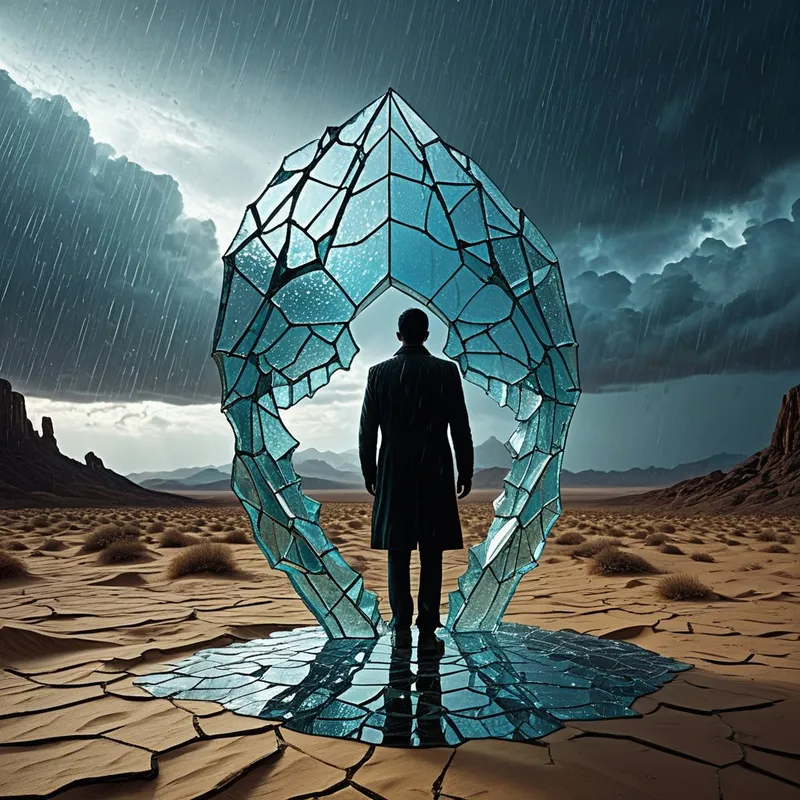
When this myth stirs in the modern unconscious, it often manifests in dreams of profound personal drought. One may dream of endless deserts, empty wells, or a withering garden they are tasked to save. The emotional tone is one of responsibility coupled with helplessness. The “Azure Dragon” aspect of the dreamer feels a deep, caregiver’s duty to fix the situation, but all conventional tools are dust.
Somatically, this can correlate with feelings of constriction in the chest (the Dragon’s coiled dilemma), a dry throat, or a general sense of energetic depletion. Psychologically, the dreamer is at the precipice of the Dragon’s choice. [The ego](/myths/the-ego “Myth from Jungian culture.”/)-identity, which has perhaps defined itself through competence and provision, is facing a situation it cannot solve through its existing repertoire. The dream is an invitation from the deeper Self to consider a different currency of exchange: not more effort, but a transformation of essence. To ask, “What guarded part of my own vitality, my own ‘spirit,’ must I willingly exhale to end this inner drought?”
Alchemical Translation
The journey of the Azure Dragon is a masterclass in the alchemical stage of [solutio](/myths/solutio “Myth from Alchemical culture.”/)—dissolution—not as a defeat, but as a necessary step in the individuation process. For the modern individual, the myth models the path from a caregiver archetype bound by duty to a magician archetype who transforms reality through self-transformation.
First, one must recognize the true drought. This is often a crisis of meaning, creativity, or relationship that cannot be watered by old habits. The “southern heat” may be a burnout, a rigid mindset, or an emotional block.
Second, one must cease the outer battle and turn inward. The Dragon stops trying to fight the climate and turns his attention to his own nature. This is the critical move from blaming external circumstances to engaging in inner work.
The cloud is the shape of the spirit in transition, no longer solid, not yet liquid—a testament to the courage of becoming.
Third, and most crucially, is the willing dissolution. This is the conscious, painful decision to let go of a part of one’s self-concept—the competent provider, the always-strong one, the certain ideologue—and to offer that energy back to the psyche in a new form. It is allowing oneself to be vulnerable, to express a buried sorrow (the Dragon’s tear), to admit a need, or to embrace a creative impulse without guarantee of outcome.
The “Dragon Clouds” that form are the new, fluid identities and insights that arise. They are the compassionate understanding, the artistic expression, or the flexible strategy born from this sacrifice. Finally, the rain is the integration. It is the tangible change in one’s life: healed relationships, renewed passion, practical solutions that seemed to arrive effortlessly, as the nourishing results of an inner alignment. The individual, like the Azure Dragon, is forever changed—perhaps less rigidly defined, but infinitely more connected to the source of life within and without, having learned that true harmony requires the courage to become the weather that heals.
Associated Symbols
Explore related symbols from the CaleaDream lexicon: